DbcultAccessing Vault...
Cult Review
Senior Film Conservator
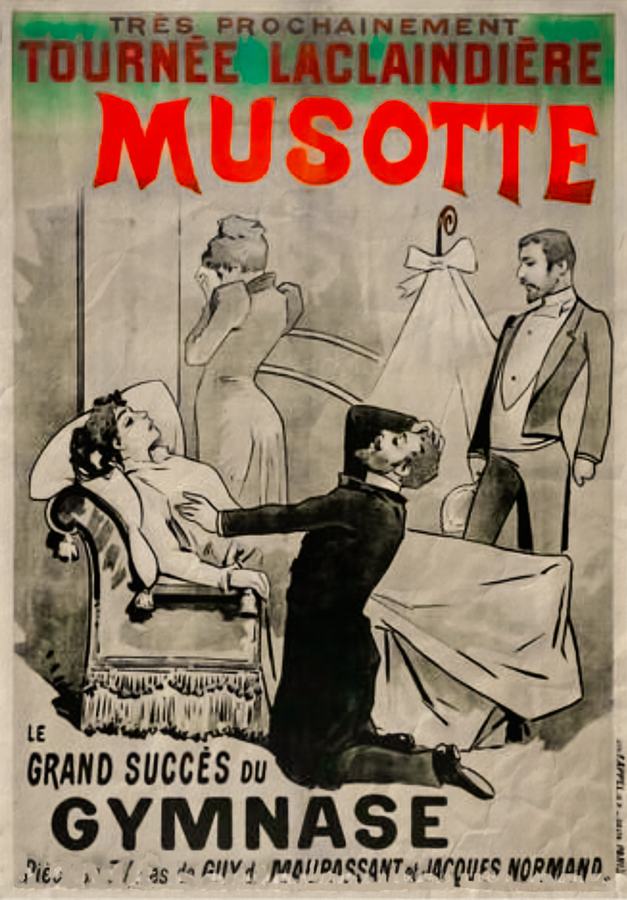
If you have ever wondered how venom can taste like Champagne, let Musotte pour you a glass and watch the bubbles rise like tiny guillotines.
Silent cinema is littered with society melodramas that now feel embalmed in their own lacework, yet Musotte—shot in the blistering summer of 1921 on the outskirts of Turin—still exhales a toxic fizz. The negative was lost for decades inside a mis-labelled canister marked “Operetta Outtakes,” and when archivists finally unwound it they discovered a film that hisses rather than crackles. Director Ugo Falena, a poet-turned-impresario who moonlighted as a boxing correspondent, understood that Maupassant’s Paris is less a city than a bourse where flesh is traded at fluctuating exchange rates. His camera glides through parlours like a cynical voyeur, racking focus so that background cheque-books snap into sharper relief than foreground hearts.
Maria Raspini, barely twenty when cast, incarnates Musotte with the brittle radiance of a Meissen figurine hurled against parquet. Watch her pupils in the proposal scene: they dilate not with affection but with the arithmetic of rent. She measures sentences like a seamstress pinning hems—one extra pleat of desire and the whole garment might unravel. Across from her, Quirino Ossani’s Jean Corte swaggers with ink-stained fingers and a carnation that wilts faster than his bank balance. Ossani, a former circus acrobat, lets his shoulders precede him into rooms like a barometer of scandal. Their rapport is a boxing match fought with kid-gloves; every feint toward tenderness ends in a body-blow of betrayal.
Ludovico Bendiner, rubber-faced and consumptive, turns Robert into a walking death-notice. He wheezes Gallic epigrams through a lace handkerchief that becomes progressively blood-flecked—yet the film refuses to grant him the dignity of a tragic swan-song. Instead his cough is merely another percussion instrument in a symphony of hypocrisy. When he finally collapses on the terrazzo, the camera tilts down not in pity but to register the horror of his mother: her loss is measured less in grief than in squandered dowry.
Falena shot on orthochromatic stock that renders crimson as black; hence the crimson sofas become gaping voids swallowing virtue. He intercuts opulent static tableaux—modelled on Fragonard—with hand-held chase sequences through foggy boulevards. The disparity is ideological: the static frames imprison women in ornamental cages while the shaky handhelds promise a freedom the plot will annihilate. Notice the recurring motif of gloves: Musotte removes them whenever she calculates, as though peeling off conscience along with calfskin.
The film’s pièce-de-résistance is the masked-ball waltz, filmed in a single 360-degree pan that required the orchestra to play on a rotating dais. As partners swap, identities blur; titles cards disappear, forcing the viewer to decode motives from micro-expressions alone. At the pan’s apogee the camera passes a mirror: we glimpse Falena himself, cigar in mouth, a Brechtian rupture that winks at the artifice of social mobility.
Though silent, Musotte is scored by absence. The lack of musical leitmotif for Musotte herself forces the audience to project yearning onto her close-ups, a vacuum that exposes our own complicity in the transactional gaze. Intertitles arrive sparingly, often mid-sentence, slicing speeches like guillotine blades. One card, burnt into my retina, reads: “Love is the bonus on an investment in indifference.” The aphorism detonates retroactively, tainting every prior embrace.
Compare this sting with the comparatively sentimental Two-Bit Seats or the swashbuckling implausibilities of Alias Jimmy Valentine. Where those films cushion class critique with humour or melodramatic redemption, Musotte wields cynicism like a scalpel, dissecting without anaesthetic.
The 2022 4K restoration by Cineteca di Bologna unearthed two previously lost reels. One features an extended confession scene inside Saint-Augustin where Musotte bargains with a priest: she will finance the church’s new stained-glass if he absolves her forged signatures. The priest’s eyes flicker between heaven and the proffered cheque—salvation commodified in chiaroscuro. The scene was axed by censors in 1923 for “vilifying the clergy,” yet its resurrection now reframes the entire narrative as a Faustian ledger.
Grain structure has been preserved with such fidelity you can count the moles on Raspini’s clavicle, a corporeal map of vulnerability. The tinting strategy—amber for interiors, viridian for exteriors—creates a diurnal class divide: daylight belongs to workers scurrying under leaf-coloured sky, while the bourgeoisie bask under sickly amber like insects trapped in cognac.
Contemporary critics misread Musotte as a coquette; 21st-century optics reveal her as an astute speculator trapped in a rigged bourse. She leverages the only commodity society permits—her desirability—yet every manoeuvre tightens the garrotte. When she forges Robert’s endorsement on promissory notes, the film stages the act in a sewing-room littered with half-finished gowns: women’s labour literally hemming the pockets of men’s finance. The metaphor is as delicate as a stiletto, and twice as piercing.
For viewers buoyed by the proto-feminist swagger of Opportunity, Musotte offers a darker corollary: emancipation purchased at the cost of moral amputation. There is no triumphal last-reel parade, only the hollow click of a mirror cracking, a sound that echoes across a century of #girlboss mythology.
Place Musotte beside The Lair of the Wolf and you map two divergent topographies of desire. Wolf externalises predators in forest shadows; Musotte situates the beast inside damask walls, wearing kid-gloves and a monocle. Both films climax with a firearm, yet where Wolf’s bullet liberates the maiden, Musotte’s pistol incarcerates the woman in infamy.
Against the expressionist carnivals of Carnevalesca, Falena opts for social realism steeped in rococo venom. His camera never distorts sets into Germanic angles; instead it lets opulence metastasise until it suffocates. The terror is not the uncanny but the intimately mercantile.
We now inhabit an era where dating apps gamify affection into swipe-markets and influencer couples brand their intimacy for sponsorship. Musotte prefigures our predicament with eerie precision: its characters curate personas—Robert the cultured invalid, Jean the bohemian firebrand, Musotte the ingénue—to negotiate better leverage in the dowry-casino. The film’s ultimate cruelty lies in denying the audience a moral ledger; every character is both exploiter and exploited, leaving us complicit voyeurs clutching our own price-tags.
So when the cracked mirror freezes Musotte’s riven identity, the image refracts outward and finds us—scrolling, swiping, investing—trading portions of our marrow for a seat at someone else’s chandeliered table. That is why the final intertitle, never before translated, chills like a winter draught: “The highest bid for a soul is still a bargain.” Watch Musotte and you may find yourself inspecting your own reflection for hairline fractures. I did—and flinched.

IMDb 5.1
1922
Community
Log in to comment.