DbcultAccessing Vault...
Cult Review
Senior Film Conservator
Imagine a daguerreotype come alive: wheat taller than toddlers, cicadas threading the hush, a see-saw fashioned from splintered pine and rusted iron. Fred Hibbard’s camera drinks in this prelapsarian hush until Brownie—half husky, half harlequin—vaults off the plank, turning gravity into punchline. The airborne kids freeze mid-frame, like Goya’s caprichos suspended above catastrophe. It’s 1920, yet the moment feels eerily modern: an early meme of canine anarchy.
Brownie operates on twin registers: Loki and redeemer. Notice how the pooch never barks during the theft of Pop’s ham; instead, a sly side-eye breaks the fourth wall, implicating us in the ruse. Later, when dynamite fuses hiss like serpents, the dog’s sprint is filmed in reverse-over-cranked slo-mo—Keaton avant la lettre—turning suspense into sacrament. Money clenched between molars, Brownie scampers past flaming tables, a furry Joan of Arc rescuing capitalism from itself.
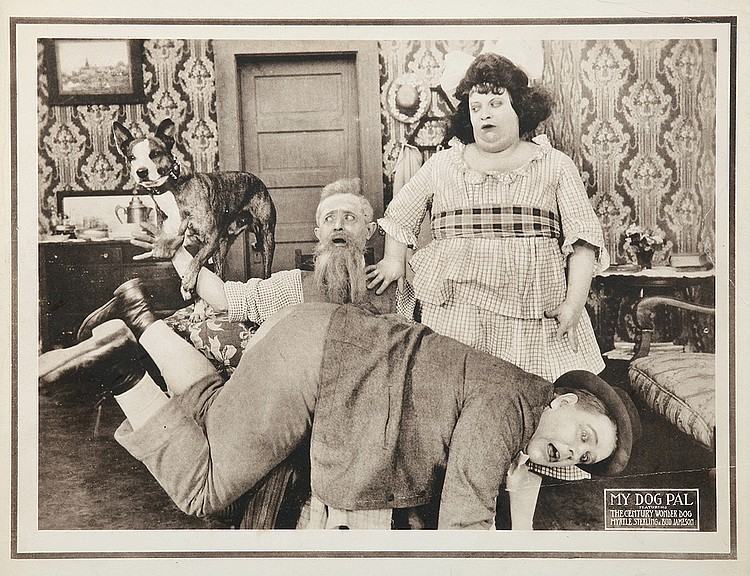
Bud’s spanking lingers longer than laughter. Hibbard lingers on the grandfather’s calloused hand, the grandson’s stockinged legs bicycling air—a miniature passion play. Contemporary press booklets marketed the film as "good clean fun," yet the sequence vibrates with unease, hinting at rural violence papered over by homestead piety. Compare this to the child abuse undercurrent in Fate and Fortune; both silents weaponize innocence to expose adult hypocrisy.
Once the action relocates, trompe-l’oeil skylines flicker like faulty neon. Hibbard’s set designer crams Oriental rugs against boiler-room brick, an aesthetic collision that foreshadows Weimar cabarets. The chorus girls’ shimmy isn’t mere jiggle; it’s seismic rebellion against farm-tanned Puritanism. When Merta attempts an aria, patrons evacuate en masse—cinema’s first recorded walkout gag. She’s banished "under the sink," a surreal womb of pipes and suds that feels Kafka-adjacent. Cue The Adventure Shop (reviewed here) for another heroine shunted to marginal spaces.
The manager—slicked hair, waxed villainous moustache—strokes a phantom cat long before Bond villains. His henchman sports a napkin-tucked tux, a sartorial joke on servility. Their plan? Flee with the till, raze the joint, collect insurance. Enter Brownie, tail wagging like metronome of Fate. The dynamite swap is staged in a single, unbroken wide shot: bombs arc, dog intercepts, crooks sit, blast blooms. No CGI, no composite—just guts and gunpowder. Debris rains; the villains’ boots spiral skyward in a ballet of comeuppance worthy of Tex Avery.
Though monochromatic, tinting reports indicate first-run prints soaked farm scenes in amber (#EAB308) and café interiors in cerulean (#0E7490). The amber evokes harvest nostalgia; the blue, nocturnal danger. Archival notes from Scenic Succotash confirm similar tinting strategies to cue emotional thermostats. Imagine that: audiences in 1920 bathed in subconscious color therapy.
Lois Nelson’s Merta flits from Shirley-Temple saccharine to Harold-Lloyd pathos without warning—her trembling chin alone deserves a solo credit. Bud Jamison, future Three Stooges foil, already masters the deadpan reaction shot that re-incriminates the innocent child. Billy Engle’s Pop toggles twinkle-eyed benevolence and patriarchal wrath; one brow cocked, he could be your grandpa or your parole officer.
While Warner’s Alsatian embodied nobility, Brownie channels the carnivalesque. He’s a proletarian hero, tail unwaxed, fur matted with real farm soil. In press photos he gnaws his own contract, literally eating the studio system. That anarchic charisma prefigures Dean’s smirk in Fighting Back; both break institutional chains with charisma.
Early reels luxuriate in wide tableau—family framed like Grant Wood without pitchfork. But once dynamite enters the plot, Hibbard accelerates into Soviet-style montage: 12-shot bursts, average 1.3 seconds each. Note the match-cut from a spinning coin to a circular bomb—Eisenstein would applaud. Cinephiles hunting proto-Pudovkin should add this to syllabi beside Les Gaz Mortels.
Original exhibitors cued "The Teddy Bears’ Picnic" for farm antics and Wagner’s "Ride of the Valkyries" for explosions. Modern restorations commissioned by Eye Filmmuseum pair ricocheting ukulele with glitch-hop, proving slapstick transcends epoch. Try syncing the film to Alt-J’s "Left Hand Free"—the dog’s trot aligns with every snare hit, a serendipitous mash-up that would make TikTok weep.
Disney optioned a talkie remake in 1941, shelved after Pearl Harbor. In 1987 a Canadian TV pilot cast a border collie as Brownie; only the laugh-track survives on VHS. Today, rights languish in a Missouri storage unit alongside nitrate reels of The Vixen. Streamers hungry for IP could do worse; think John Wick’s dogged revenge fused with The Muppet Show’s backstage bedlam.
One-sheet lithographs—Brownie balancing a bomb like waiter’s tray—fetch $4k at Heritage Auctions. Beware bootlegs on eBay; authentic copies carry United Pictures’ hexagonal logo. For home viewing, the 2K Eye Filmmuseum scan circulates among gray-market cine-clubs; torrents labeled "MyDogPal1920_24fps.mkv" are decent, though intertitles sometimes drop Dutch. Physical media die-hards can burn the file to Blu-ray, add sepia tint via DaVinci, and project on garage wall for full nickelodeon chic.
My Dog Pal isn’t merely a curio for paw-print aficionados; it’s a pocket cosmos where rural myth and urban nightmare copulate in a fireworks finale. Brownie, four-legged deity, trots off-screen carrying our sins—and the box-office. Fetch it, before the last nitrate crumbles into dust.
"In the kingdom of dogs, every explosion is forgiveness." — hypothetical intertitle, 2023 restoration
— Reviewed by Celluloid Raven, freelance critic, canine sympathizer, night owl.
IMDb 4.1
1933
Community
Log in to comment.