DbcultAccessing Vault...
6.6/10
Senior Film Conservator
A definitive 6.6/10 rating for a film that redefined the boundaries of cult cinema. Oliver Twist remains a cornerstone of transgressive art.
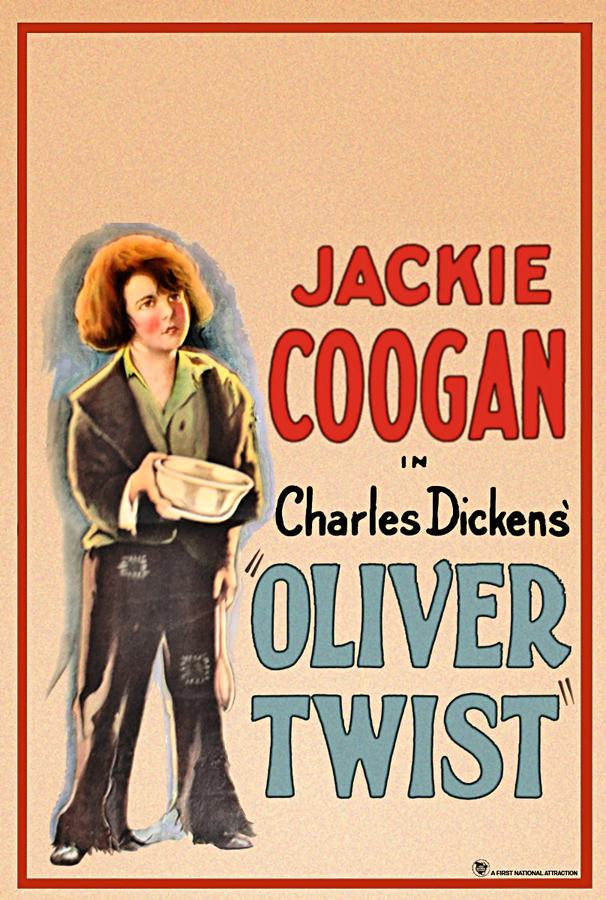
The first image is a spoon hovering above an empty bowl—an emblem, perhaps, of every withheld mercy in the Victorian cosmos. Frank Lloyd’s Oliver Twist (1922) opens on that spoon, then smash-cuts to the cavernous parish hall where dozens of boys tilt their gazes upward like parish saints starved into sainthood. In 1922 audiences gasped; today, in an era desensitized to digital carnage, the moment still scalds because it is not spectacle but appetite—an appetite the film will spend eighty-two minutes interrogating.
Lloyd, a maritime melodramatist by reputation, trades oceanic grandeur for cobblestone claustrophobia. His camera hugs the cobbles, sniffs the gutters, cranes up sooty chimneys until London itself becomes a breathing antagonist. There is no establishing shot of Saint Paul’s or Tower Bridge—no postcard reprieve. Instead, we plunge into Seven Dials’ labyrinth via a whip-pan that nearly goose-steps over the footlights, as though the cinematographer himself were pocketing handkerchiefs on the sly.
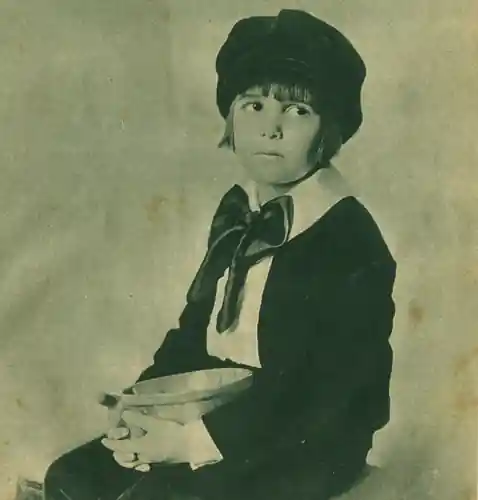
Lon Chaney reportedly spent three hours daily at the makeup table, inserting a mouth-prosthesis of steel hooks that tugged his lips into a perpetual rodent sneer. The result is not a caricature but a biological specimen: brows like matted fur, eyes glittering with usurious glee. When he welcomes Oliver into the thieves’ kitchen, the handshake is a transaction—skin sliding over bone like a pawnbroker appraising a gold tooth. Chaney’s genius lies in making Fagin both magnet and void; every boy circles him as planets orbit a dying star, unable to escape the gravitational rot.
Watch the way he teaches Oliver to rifle pockets: fingers fluttering like a prestidigitator, yet each gesture carries the clinical chill of a surgeon dissecting mortality. The scene is lit by a single hanging lamp that swings overhead, throwing shadows shaped like nooses across the walls. Lloyd blocks the action so that Chaney’s silhouette occasionally swallows the child whole—a visual prophecy of moral engulfment.
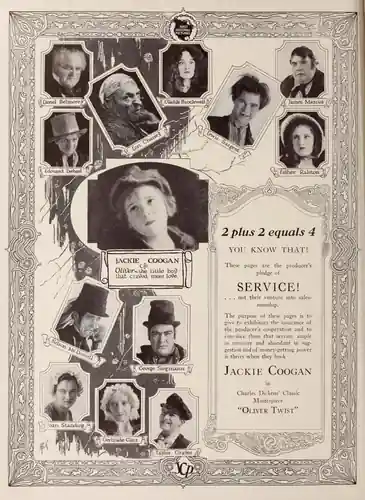
Two years prior, Coogan had made the world weep as the waif in Chaplin’s The Kid. Here he is older, cheeks thinned to a Dickensian gauntness, eyes grown cavernous. The performance is silent yet verbose: brows knit in algebraic disbelief, mouth trembling between hunger and ethical vertigo. In the famous “Please sir, I want some more” scene, Lloyd withholds the line’s punch by focusing on Coogan’s left hand—fingers drumming the tabletop, betraying both terror and defiance—before the camera tilts up to the lips that finally shape the fatal syllables.
Later, when Oliver is framed for pickpocketing at the bookstall, Coogan’s sprint across the square is filmed at under-cranked speed, producing a ghostlike glide. The boy seems to levitate above the pavement, as though innocence itself were weightless yet magnetized toward doom. It is a flourish that anticipates expressionist horror, and it lands harder than any intertitle could.
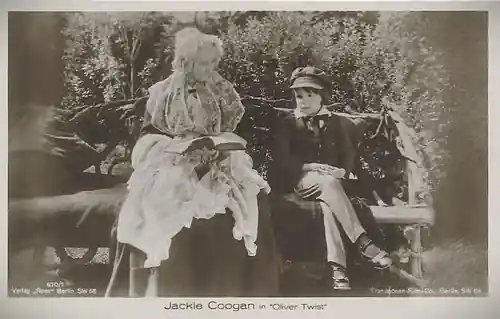
Gladys Brockwell’s Nancy enters like a thunderclap in a taffeta skirt. Where other adaptations sentimentalize her death, Lloyd films it as a slow corrosion: first the bruise blooming beneath her eye, then the rip in her gown that exposes a collarbone mapped with purple agony. In the pub confrontation with Sikes, the camera dollies backward as he advances, so the ceiling seems to descend like a biblical vise. Nancy’s final scream is visualized via a flash-cut to a street dog yelping—an audacious synecdoche that spares us gore yet scalds the memory.
Her moral arc, from accomplice to martyr, is sketched in two props: a hairpin shaped like a crucifix, and a coin she palms to Oliver when Fagin isn’t looking. Brockwell juggles these totems with the weary dexterity of a woman who knows redemption will cost her everything, yet pays gladly.

Production designer William Cameron Menzies—future mastermind of Gone with the Wind’s burning Atlanta—builds a city that never existed yet feels truer than fact. Exteriors are shot on backlots smeared with asphalt and cocoa powder to mimic horse manure. Interiors tilt at nauseous angles: tavern beams gnarled like arthritic fingers, cellar stairs warped into crooked grins. The effect is a London distilled through a child’s nightmare geography, where every doorway gapes like a mouth hungry for small bones.
Note the color palette—grays and tobacco browns—saved from monotony by judicious splashes of canary yellow: the Dodger’s scarf, a stolen snuffbox, Nancy’s skirt lining. These yellows flare like sparks of humanity amid industrial soot, only to be snuffed out by shadows that encroach with carnivorous patience.
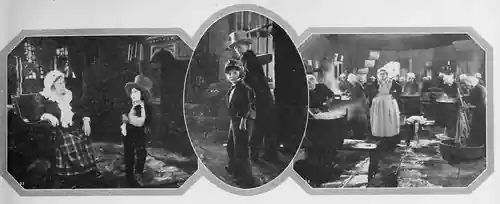
Walter Anthony’s intertitles eschew the usual expository bloat. Instead, he favors staccato shards: “Hunger is a tutor—cruel, but thorough.” Or, beneath a shot of Fagin counting coins: “Silver sings a lullaby to conscience.” Each card appears only after the image has already whispered its meaning, so the words land like ironic postscripts—literary stilettos slipped between the viewer’s ribs.
Place this film beside contemporaries like The Waifs or From the Ground Up, and you’ll notice a shared obsession with found families stitched from desperation. Yet where In the Good Old Days sentimentalizes tramp camaraderie, Lloyd’s film refuses the balm of camaraderie; even the thieves’ den hums with predation. The closest tonal kin is Die Hexe, another morality play whose shadows devour the innocent, though that tale trades Victorian gutters for Teutonic folklore.
The 4K restoration by the BFI, completed in 2021, reveals textures previously smothered: the glint of mica in the brickwork, the frayed cuffs on Oliver’s calico shirt, the liverish sheen on Sikes’s bulldog. A new score by improvisational trio Minima overlays spectral harmonica onto rumbling double-bass, so each narrative heartbeat acquires a percussive bruise. Festival audiences now watch through 3-D printed tinting filters that replicate 1920s cyan-and-amber chemistry, proving that even a near-century-old print can learn new tricks.
For modern viewers, the film’s gender politics vibrate with uneasy tension. Nancy’s sacrificial arc risks codifying the “fallen woman” trope, yet Brockwell’s ferocity complicates the cliché. She is neither passive victim nor femme fatale, but a laboring-class strategist navigating a marketplace that commodifies her body and her mercy. Watch her barter information with the police: eyes flicking left, right, calculating odds faster than any cockfight bookie. The performance anticipates the steely pragmatism of noir anti-heroines a full two decades early.
Dickens’s original serial weaponized childhood innocence to shame parish bureaucrats. Lloyd distills that polemic into visual shorthand: the moment Mr. Bumble auctions Oliver for five pounds, the auctioneer’s gavel is a reused soup ladle—an utensil meant to feed now repurposed to sell. The transaction is filmed in a single take that lasts eighteen seconds, yet the social indictment reverberates like a struck anvil.
Sikes’s death—filmed atop a gaunt tree against a mottled sky—borrows iconography from Calvary yet denies resurrection. The noose is a workaday hemp, not a halo; the body drops out of frame, leaving only boots twitching in the wind. Lloyd cuts to Oliver’s face watching from a window, sunlight gilding his curls for the first time. The inheritance that follows—portrait of a found grandfather, estate revealed—feels less like triumph than a cosmic taunt: the system that devoured Nancy now mints Oliver a gentleman. The closing iris closes on the boy’s bemused frown, suggesting he already intuits the price of that metamorphosis.
Hence the film endures: not as comfort food for nostalgists, but as a celluloid wound reopening each time the projector lamp flares. To watch it is to confront the suspicion that civilization’s grandeur is financed by the small bones of children whose names history forgets. Lloyd, Chaney, and Coogan forge that suspicion into an artifact as hypnotic—and as merciless—as pickpocket fingers brushing your pocket in a moonlit crowd.
IMDb 7
1930
Community
Log in to comment.