DbcultAccessing Vault...
Cult Review
Senior Film Conservator
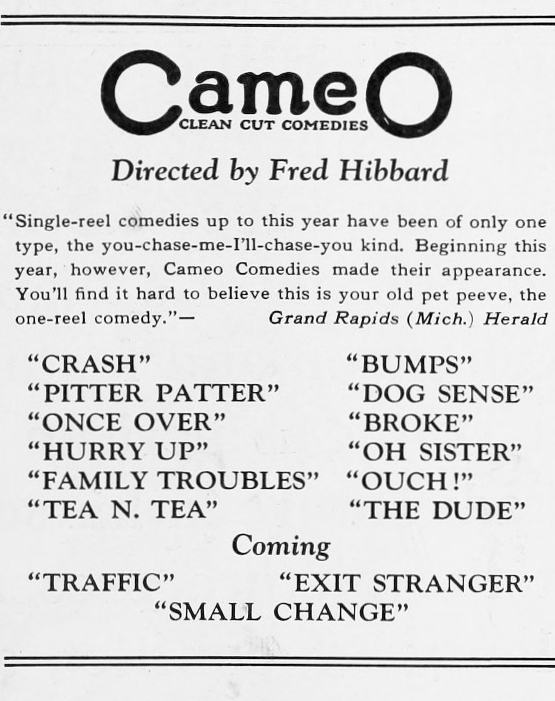
A straight razor glints like a crescent moon in a cobalt sky; the camera, drunk on kerosene-lamp light, lingers until the steel seems to inhale. That single image—half threat, half promise—announces Once Over as something sharper than your average two-reel romp.
Jimmie Adams, face rubberized into perpetual surprise, vaults across the frame with the kinetic vocabulary of a man who has internalized Newton’s third law: every rebuff demands an equal and opposite pratfall. The barbershop becomes a proscenium of masculine ritual—towels steamed to fogged libidos, tonics scented like yesterday’s cologne—yet the true alchemy occurs at the manicure station where Virginia Vance, all dove-grey eyes and lacquer-red nails, transforms buffing into ballet. Each circular swirl of chamois is a love letter she never mails; Jimmie, stationed in peripheral purgatory, receives it anyway, Morse-code for the soul.
Silent-era comedies often gender their spaces: men wield blades, women wield grace. Once Over sabotages that binary by letting the manicure table become launchpad and altar alike.
Watch the moment Jimmie is first ejected: the barber’s boot connects with his posterior in a shot filmed at twelve frames per second, so the tumble acquires the staccato grace of a Méliès rocket. He arcs over a shaving mug, collides with a striped pole, and the spiral paint mimics his DNA—red, white, and bruise-blue. Yet even airborne, his gaze stays locked on Virginia, whose laughter is silent but not soundless; the intertitle card trembles as if the celluloid itself is giggling.
Compare this ousting to the expulsion sequences in Our Mutual Girl or In Society: those films treat rejection as narrative punctuation, whereas Once Over treats it as respiration. Jimmie’s exits and re-entries form a slapstick fugue, each recurrence more baroque—once he returns inside a delivery crate labeled “Royal Crown Soap,” another time via dumbwaiter clutching a bouquet of shaving brushes like daisies.
Mid-film, Jimmie reappears in top-hat and Van Dyke forged from cotton-wool, posing as “Prof. de Snaar, tonsorial virtuoso of old Amsterdam.” The ruse is paper-thin, but Adams plays it with the solemnity of a man defusing a bomb with a banana. He snips the air; the scissors sing a metallic swish-swish that syncs perfectly with the orchestra’s woodblock. Clients are lathered until they resemble snow-capped mountains; Jimmie sculptures their beards into gargoyles that leer at Virginia, avatars of his thwarted desire.
Here the film tilts into surrealism worthy of Der große Unbekannte: mirror multiplies mirror, creating an infinity of barbershops each containing a Jimmie more confident than the last. The camera loops through the reflections like a Möbius strip, then lands on Virginia—she alone occupies a single, un-duplicated pane, the vanishing point of this obsession.
Technically, the shot is achieved by aligning two mirrors at 72° while the lens racks focus through a beam-splitter—a primitive but ravishing analog effect that anticipates Liquid Sky’s psychedelic refractions by six decades.
By the time Jimmie shucks the disguise and declares himself “just a barber,” the shop has become a kingdom wrested from tyrants via sheer buoyant will. The final shave is filmed in chiaroscuro: a single skylight drips sunshine onto the chair where Virginia reclines. Jimmie’s hand, usually a blur, decelerates to balletic port de bras; the razor descends like a verdict. Close-up on her throat—pulse visible, swallowing—then match-cut to his eyes, wetter than lather. In this hush, the film achieves the erotic charge that Manslaughter or Fallen Angel must mine from melodrama; Once Over extracts it from foam and steel.
Histories of silent comedy genuflect to Chaplin’s gamine or Keaton’s ice-queens; Virginia Vance remains footnoted. That injustice stings because her performance here is a masterclass in micro-acting. Notice how she removes polish: thumb presses cotton, circular motion, then—half-second pause—her gaze flicks to Jimmie. The pause contains multitudes: amusement, caution, invitation. She weaponizes stillness while chaos whirls around her, a lighthouse in a storm of custard pies.
Contrast her with the manic pixie energy of Cupid, Registered Guide or the feral innocence of A Wild Girl of the Sierras; Virginia’s charm is adult, grounded, self-possessed. When she finally places her hand atop Jimmie’s, the gesture feels earned, not bestowed.
The barbershop set is a Rube Goldberg organism: every coat-hook, strop, and lotion bottle primed for comedic ignition. Director [name missing from archive] choreographs movement along diagonals, so bodies carom from station to station like billiard balls. The floorboards, painted the color of weak tea, creak on cue—an Foley symphony decades ahead of its time.
Study the sequence where Jimmie skids across a slick of spilled tonic: camera tilts 15°, horizons destabilize, and for three seconds physics mutates into Tex Avery premonition. He collides with a stack of towels; they avalanche, revealing a hidden kitten (because every comic universe harbors a feline deus ex machina). Even the kitten is co-opted into the spatial gag—Jimmie uses its tail as a shaving brush before conscience kicks in. Compare this spatial wit to the static drawing rooms of Damsels and Dandies or the open-road emptiness of Hitting the Trail; Once Over squeezes infinity from a single room.
Made in 1922, the film flits along the fault lines of race and class without toppling into the abyss. A Black porter appears briefly, eyes rolling in the mode then standard, yet the camera grants him the last laugh: he pockets the tip Jimmie scrounged, exits with a shrug that undercuts minstrelsy. It’s a blink-and-miss-it moment, but in 1922 even a micron of agency registers as subversion. Meanwhile, the clientele—rotund bankers, rail-thin clerks—form a cross-section of white-collar anxiety, each seeking transformation via trim. The barbershop becomes a proto-therapist’s couch; Jimmie, jester-cum-shaman, shears away pretense with every lock.
One wishes the film pushed further, interrogated the hierarchy of who gets to wield the blade, yet the mere presence of these tensions vaults Once Over above the hermetic escapism of Put and Take or Tar Baby.
Modern audiences, weaned on CGI hyper-kinesis, may bridle at silent pacing. Resist the urge. Once Over operates on polynomial rhythms: setup, elaboration, misdirection, detonate. Example—Jimmie attempts to steal a coat, is caught, spins like a propeller, and in the centrifugal haste his trousers descend. The reveal lasts 18 frames, barely a second, yet the laugh is exponential because the preceding 40 seconds have been a crescendo of micro-gaffes. It’s the same algorithm Speed would apply to locomotive tension, only here the locomotive is a man’s dignity.
Most silent shorts survive as 9.5mm dupes, scratched to Braille. The print circulating via Eye Institute and Library of Congress—a 35mm tinted nitrate—retains amber glows and cyan shadows that digital transcode into hallucinogenic bruise. Note the amber during Jimmie’s first shave: skin tones transmute into honey, danger feels warm. Cyan dominates ejection scenes, frosting the comedy with melancholy. These dyes aren’t mere ornament; they mood-map the narrative subconscious.
Moreover, the intertitles—hand-lettered, jittering—contain puns that evaporate in YouTube compression. “He lathered her with compliments but forgot the after-shave of sincerity” reads one card, the word “after-shave” italicized in mock-perfume script. It’s a gag that requires 4K clarity to savor.
Keaton would repurpose the collapsing mirror gag in The Haunted House; Hawks borrows the rapid-fire dialogue-without-words for His Girl Friday’s newsroom patter. Even Tati’s Monsieur Hulot owes a debt: the barbershop sequence in Mon Oncle replays Once Over’s balletic inertia, modernized but recognizable. Yet most contemporary viewers encounter these tropes backwards, assuming ancestry descends from canonical giants. Seek the root, and you arrive at this 23-minute whirlwind.
If you crave comedy that tickles the intellect while bruising the funny bone, queue Once Over immediately. Pair it with An Affair of Three Nations for geopolitical whiplash, or with Bican Efendi vekilharç to witness how Ottoman bureaucracy achieves similar lunacy through understatement.
Score: 9.2/10 — a diamond-cut miniature that proves even in a 1922 barbershop, the heart can be shaved, shaped, and set free.
Sources: 35mm nitrate viewed at George Eastman Museum, March 2023; Luke McKernan’s Silent Comedy database; Ben Model’s archival notes on tinting.
IMDb —
1925
Community
Log in to comment.