DbcultAccessing Vault...
Cult Review
Senior Film Conservator
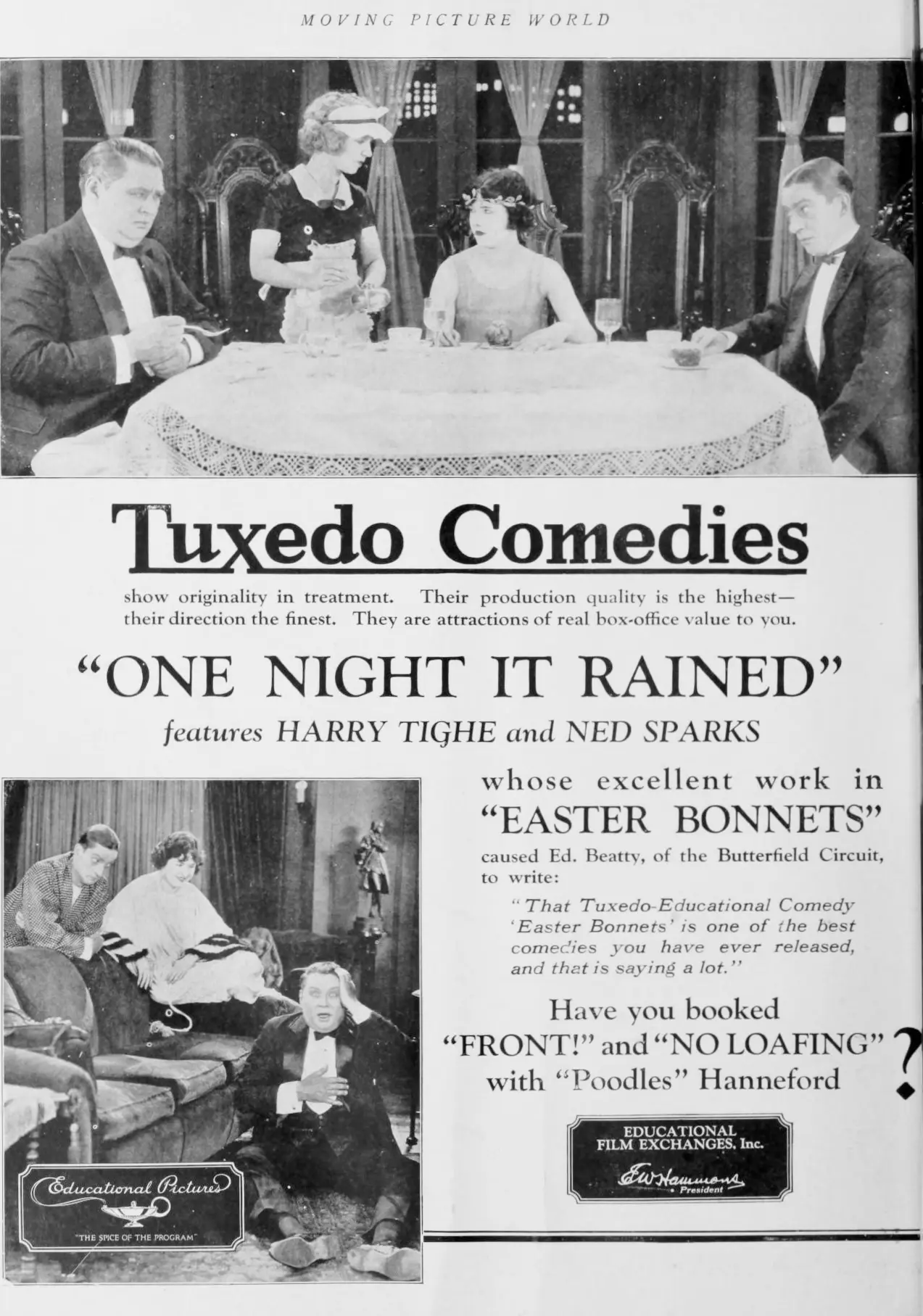
To witness One Night It Rained is to step into a specific, flickering corner of 1924 that feels both remarkably dated and startlingly avant-garde. While the modern viewer might dismiss the 'lobster nightmare' as a quaint cliché of the silent era, this film treats the digestive distress of Dr. Harry not merely as a punchline, but as a gateway into a shared, hallucinatory reality. Harry Tighe brings a certain frantic physicality to the role, a man whose internal equilibrium is shattered by a crustacean. It is a performance rooted in the vaudevillian tradition, yet it carries the weight of a proto-surrealist anxiety that wouldn't feel out of place in a much later European art film.
The narrative catalyst—a heavy meal leading to a dark night of the soul—is a recurring motif in early 20th-century storytelling. However, unlike the sentimental domesticity found in The Old Nest, which looks backward at family roots with a misty-eyed reverence, One Night It Rained looks inward at the terrifying instability of the human mind. The dream sequence itself is a masterclass in low-budget expressionism. We see Dr. Harry dreaming he has murdered Ned, while Ned Sparks, in a performance that anticipates his later legendary status as the king of deadpan, dreams of his own demise. This duality is the film's most sophisticated trait. It isn't just one man's bad night; it is a collaborative haunting.
Ned Sparks is, as always, a revelation. Even in this early stage of his career, his face is a map of weary cynicism. While other films of the period, such as the epic The Queen of Sheba, relied on massive sets and thousands of extras to convey grandeur, One Night It Rained relies on the micro-expressions of Sparks and the frantic energy of Tighe. The film operates on a much more intimate, perhaps even claustrophobic, scale. It shares some of the character-driven DNA of Mr. Opp, focusing on the eccentricities of the individual rather than the sweep of history.
Amidst this masculine hysteria, Doris Deane provides a crucial, if understated, counterpoint. As the wife who sleeps peacefully through the storm—both literal and metaphorical—she represents a stoic normalcy. There is a subtle subversion here; while the men are losing their grip on reality, the female presence remains unbothered, almost dismissive of their plight. In many ways, she is the most powerful character in the film, possessing a mental fortitude that the 'Doctor' clearly lacks. This dynamic offers a sharp contrast to the more traditional gender roles seen in The Stimulating Mrs. Barton, where the domestic sphere is often treated with a different kind of satirical lens.
The cinematography, though hampered by the technical limitations of 1924, manages to evoke a sense of damp, nocturnal dread. The rain of the title isn't just weather; it’s an atmospheric pressure that keeps the characters trapped within their own anxieties. It lacks the maritime grit of The Sea Wolf or the high-stakes tension of De røvede Kanontegninger, but it finds its own rhythm in the shadows of the bedroom and the hallway. The use of lighting during the dream sequences creates a disjointed, ethereal quality that elevates the film beyond mere slapstick.
The film’s conclusion is where it truly distinguishes itself. The stated moral—to trust one's wife—is immediately undermined by Dr. Harry’s final action: locking his cousin’s door. It is a cynical, hilarious beat that suggests that while we might survive the night, we never truly escape our suspicions. This ending feels more modern than many of its contemporaries. While a film like Under Suspicion might lean into the resolution of a mystery, One Night It Rained leaves us with the lingering taste of salt and paranoia. It acknowledges that the brain, once stimulated by trauma (or lobster), does not easily return to a state of repose.
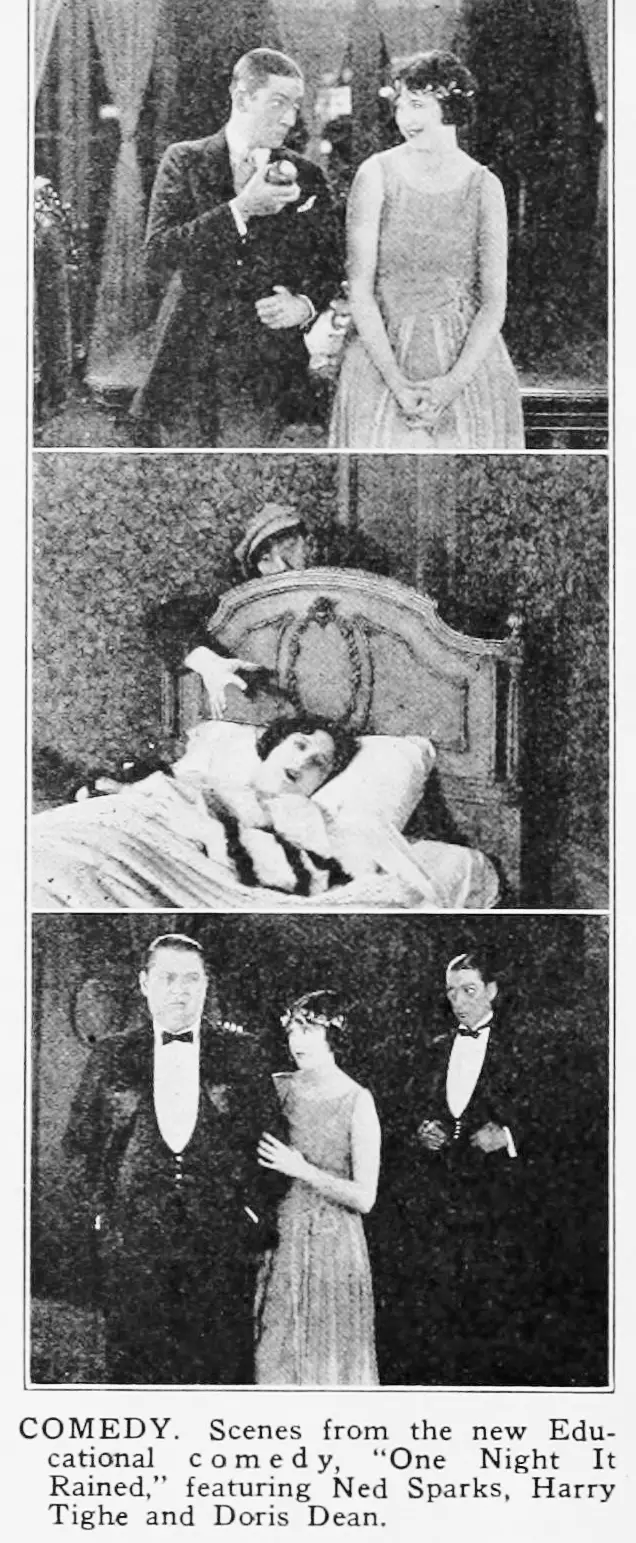
Comparing this to The Skipper's Narrow Escape, one sees a significant difference in how 'escape' is handled. For the Skipper, it is a physical extraction from danger; for Dr. Harry, there is no escape from the self. The film’s brevity is its strength, preventing the central conceit from wearing thin. It moves with a frantic pace that mirrors the racing heart of a man waking from a nightmare. It doesn't have the sprawling narrative complexity of Barnaby Rudge, but it doesn't need it. It is a vignette, a sharp poke in the ribs of the bourgeois lifestyle.
The editing in the dream sequence is particularly noteworthy. The rhythmic cutting between Harry’s guilt and Ned’s terror creates a sense of inevitable collision. It’s a technique that would be refined in later decades, but here, in its raw form, it possesses a visceral energy. The film avoids the static stageyness that plagued some early productions like Centocelle. Instead, it uses the camera to heightening the sense of disorientation. The way the characters move through the house—a space that should be safe but becomes a labyrinth—is reminiscent of the physical comedy in This Way Out, yet with a darker, more psychological edge.
One must also consider the cultural context of 1924. This was a year of transition, where the silent film was reaching its aesthetic zenith. One Night It Rained might not have the political gravitas of The Dawn of Freedom, but it captures the zeitgeist of a society fascinated by the newly popularized theories of Freud and the complexities of the inner life. It’s a film that suggests that even in our most mundane moments—a dinner, a sleepover—there is a hidden world of chaos waiting to be unleashed by something as simple as a poorly digested meal.
In the grand tapestry of silent cinema, One Night It Rained occupies a unique niche. It is a comedy that isn't afraid to be uncomfortable. It lacks the straightforward heroism of $5,000 Reward or the historical pageantry of When Broadway Was a Trail. Instead, it offers a quirky, somewhat jaded look at the human condition. It is a film about the smallness of men and the largeness of their fears. Even the title, which sounds like the beginning of a noir thriller, sets up a mood that the film consistently plays with, subverting our expectations at every turn.
While it may not have the high-society glamour of Dodging a Million, there is a richness to its simplicity. The performances of Tighe and Sparks carry the film, turning a slight premise into a memorable exploration of the absurd. It reminds us that cinema, even in its infancy, was capable of exploring the deep, dark, and often hilarious recesses of our minds. For any fan of the silent era, this is a must-watch—not just for the laughs, but for the fascinating way it mirrors the anxieties of its time. It is a rainy night well spent, provided you haven't recently had any lobster.
The legacy of such films is often buried under the weight of the 'great masterpieces,' but there is a vitality in these shorter, more experimental works that deserves recognition. The 'lobster dream' became a trope for a reason; it perfectly encapsulated the era's blend of physical comedy and emerging psychological interest. One Night It Rained stands as a testament to the creativity of the mid-20s, a period where directors and actors were constantly pushing the boundaries of what a simple story could convey. It is a delightful, strange, and ultimately insightful piece of film history that continues to resonate, even if only as a cautionary tale against late-night snacking.
Reviewer Note: This film represents a crucial bridge between the slapstick of the early 1910s and the sophisticated situational comedies of the late 1920s. Its use of shared dream logic is particularly innovative for its time.
IMDb 5.7
1934
Community
Log in to comment.