DbcultAccessing Vault...
Cult Review
Senior Film Conservator
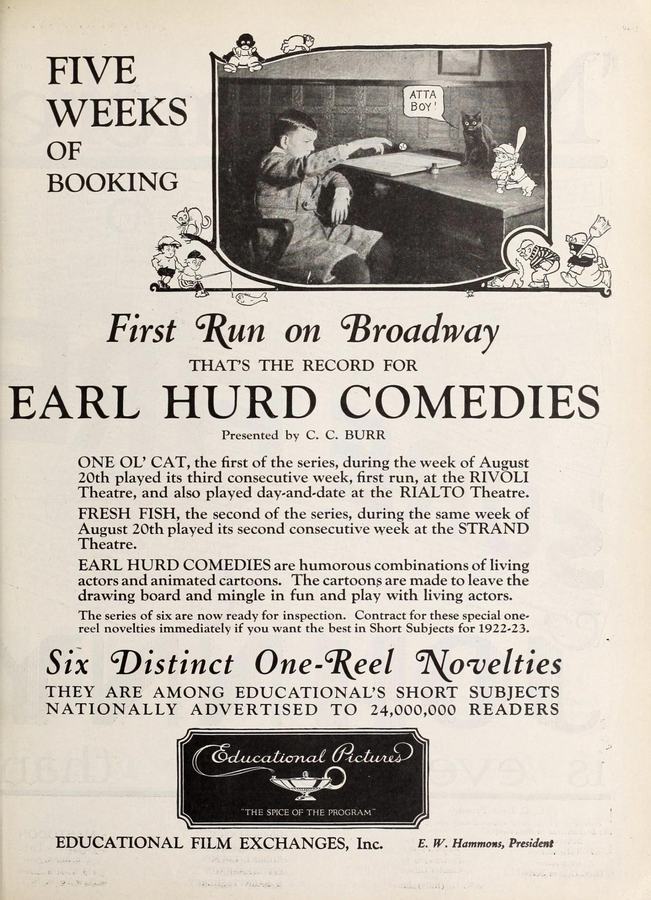
To witness One Ol' Cat is to observe the very birth of the animated syntax. Earl Hurd, a titan whose name is often whispered in the same hallowed halls as Winsor McCay, brought a different kind of rigor to the table. While McCay was obsessed with the illustrative grandeur of the draftsmanship, Hurd was the pragmatist who understood that for animation to survive, it needed a repeatable, scalable process. In this short, we see the early fruits of his 1914 patent—the invention of the cel. This technical leap allowed for the characters to exist independently of their environment, a concept that seems elementary today but was as radical then as the non-linear editing in Jim Corwey ist tot would be decades later.
The visual language of One Ol' Cat is one of stark contrasts and rubbery resilience. The cat itself is not merely an animal; it is a smudge of liquid darkness that refuses to be contained by the geometry of the screen. Unlike the grounded, almost theatrical performances found in contemporary live-action dramas like Nell Gwynne, the movement here is untethered from the human experience. Hurd employs a rhythmic cadence that feels almost musical, a visual jazz that predates the synchronized sound era by over a decade.
The 'One Ol' Cat' game, a variation of early baseball, serves as the skeletal structure for Hurd's comedic explorations. In the hands of a lesser artist, this would be a simple series of falls and crashes. However, Hurd imbues the boy and the feline with a shared sense of mischievous destiny. The way the ball interacts with the environment—shattering expectations and occasionally the very physics of the frame—mirrors the chaotic energy of Holding His Own. There is a relentless momentum to the short that demands the viewer's absolute attention, as every frame contains some minute detail of movement that contributes to the overall comedic crescendo.
Consider the spatial awareness Hurd displays. Even with the limitations of the medium, there is a sense of depth and weight. When the cat retreats into the background, it doesn't just get smaller; it carries with it the psychological weight of a predator awaiting its next opportunity for chaos. This level of characterization through movement alone is something that many live-action films of the time, such as The Sheep o' Leavenworth, struggled to achieve with full casts and elaborate sets. Hurd’s economy of line is his greatest strength; he says more with a single curve of the cat’s tail than most directors say with a three-page monologue.
When we look at One Ol' Cat alongside the broader cinematic output of the 1910s, its uniqueness becomes even more pronounced. While Out Yonder or The Brand of Satan were exploring the dark corners of the human psyche and the burgeoning tropes of the Western and the thriller, Hurd was exploring the limits of the imagination. There is a purity in One Ol' Cat that is absent from the heavy-handed moralizing of The War Bride's Secret. It is a film that exists for the sake of its own existence, a celebration of the fact that, on paper, anything is possible.
The shadows and lighting in Hurd's work, though simplified, suggest a burgeoning understanding of cinematic mood that we see perfected in European works like Os Faroleiros. However, where the latter uses light to evoke dread, Hurd uses the absence of detail to focus the viewer's eye on the action. It is a masterclass in minimalism. Even the more traditional narrative structures found in Child of M'sieu feel somewhat archaic when compared to the fluid, almost liquid storytelling Hurd achieves here.
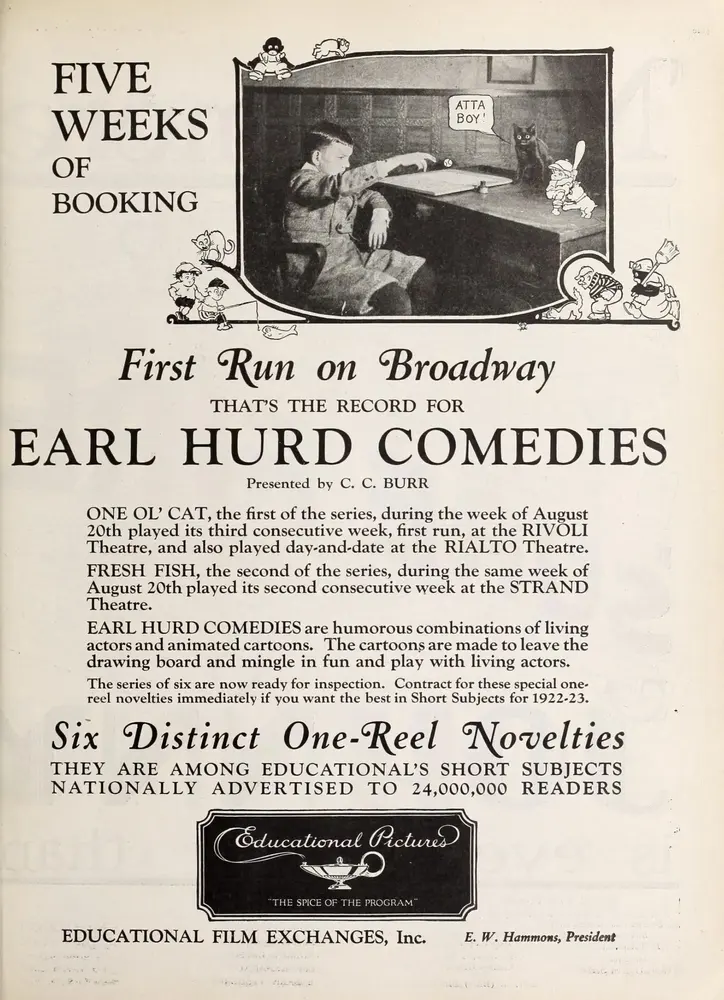
One cannot discuss One Ol' Cat without acknowledging the sheer labor involved. In an era before computerized assistance, every frame was a testament to the artist's endurance. The registration of the cels, the consistency of the ink, the timing of the exposures—all of these required a level of precision that is often overlooked by the modern audience. The film possesses a certain 'jitter' that gives it a heartbeat, a reminder that this was a handmade artifact. This tactile quality is something that even the most high-budget productions of the time, like Het geheim van het slot arco, couldn't replicate with their static cinematography.
The influence of this short extends far beyond its five-minute runtime. You can see its DNA in the chasing sequences of The Phantom Foe, where the camera’s pursuit of the antagonist mirrors Hurd’s pursuit of the cat. The way Hurd handles the 'reveal'—the moment a gag reaches its payoff—is a template for the comedic timing that would later define the Golden Age of animation. Even the deceptive simplicity of the character designs finds an echo in The Square Deceiver, where appearances are rarely what they seem.
On a deeper level, One Ol' Cat reflects the burgeoning urban chaos of the early 20th century. The cat represents the untamable elements of nature that persist even within the confines of a modern home. It is a source of frustration, joy, and ultimately, a catalyst for growth. This theme of domestic disruption is explored in a more somber light in A Woman of Pleasure, but Hurd keeps it light, preferring the slapstick over the soap opera. The boy’s persistence in the face of feline sabotage is a microcosm of the American spirit of the time—a relentless drive to succeed against all odds, much like the characters in The Forfeit.
The sheer audacity of Hurd's visual puns—the way a tail becomes a hook, or a head becomes a projectile—prefigures the surrealist movement that would soon take over the art world. While films like Irrungen were dealing with the complexities of human error, Hurd was showing us that error itself could be a source of infinite creativity. The 'One Ol' Cat' isn't just a pet; it is the muse of the inkwell, a creature born of charcoal and imagination that refuses to stay on the page.
Re-evaluating One Ol' Cat in the twenty-first century is an exercise in cinematic archaeology. We are looking at the foundation of an entire industry, the first tentative steps of a giant. Earl Hurd’s contribution to the medium cannot be overstated, and this short is perhaps the purest expression of his genius. It lacks the polish of Disney or the cynicism of modern adult animation, but it possesses a raw, unadulterated joy that is infectious.
As we navigate an era of digital perfection and AI-generated imagery, there is something profoundly moving about the imperfections of One Ol' Cat. The slight bleed of the ink, the occasional flicker of the light, the hand-drawn lines that don't quite meet—these are the fingerprints of a creator who was truly 'holding his own' in a world that hadn't yet realized the power of the moving drawing. It is a film that demands to be seen, not just as a historical curiosity, but as a vibrant, living piece of art that continues to challenge our perceptions of what cinema can be. Whether you are a scholar of the silent era or a casual fan of the 'Bobby Bumps' series, this short remains an essential piece of the puzzle, a five-minute burst of creativity that echoes through the decades.
IMDb 5.8
1927
Community
Log in to comment.