DbcultAccessing Vault...
Cult Review
Senior Film Conservator
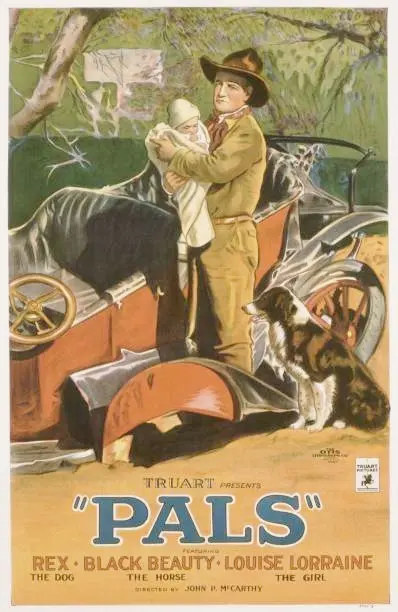
Stepping back into the silent era is often an exercise in historical appreciation, but every so often, a film emerges from the archives that transcends its age, speaking directly to timeless human experiences. Pals (1925), a compelling Western penned by George Hively, is precisely one such cinematic artifact. It’s a narrative that, despite the absence of spoken dialogue, resonates with an emotional depth and a sturdy moral compass that feels remarkably contemporary. The film, a vehicle for the charismatic cowboy star Art Acord, is far more than a simple genre piece; it’s a poignant exploration of unexpected parenthood, unwavering loyalty, and the relentless pursuit of justice in a world still finding its footing.
The story unfurls with the arrival of Bruce Taylor, likely portrayed by the inimitable Art Acord, into the dusty, nascent mountain town of Caliente. Acord, a legitimate rodeo champion turned screen idol, brought an authentic gravitas to his roles, and here, he embodies the archetype of the lone cowboy with a twist. He is not alone, however; he is accompanied by his extraordinary companions: Rex, a dog of remarkable intelligence and loyalty, and Blackie, a magnificent horse whose presence is as commanding as any human character. Their journey takes an unforeseen, transformative detour when Rex, with an almost preternatural instinct, unearths an abandoned automobile in the parched, unforgiving desert. Within this forgotten vessel, a helpless infant lies, a stark symbol of vulnerability amidst the vast, indifferent landscape. This discovery immediately elevates the narrative beyond typical Western tropes, infusing it with an unexpected tenderness and an immediate sense of profound responsibility.
Caliente, true to the rugged individualism of frontier settlements, lacks the societal infrastructure for such an orphaned child. Bruce, a man whose life until this point has likely been defined by self-reliance and the open road, is thus thrust into the role of an impromptu guardian. This premise alone is a powerful hook, challenging conventional notions of masculinity and heroism. It’s a theme that echoes, albeit indirectly, in films like A kölcsönkért csecsemök (The Borrowed Babies), where the care of children becomes a central, often comedic, but always humanizing element. Here, however, the stakes are higher, the solitude more pronounced, and Bruce's commitment more profound. His struggle to nurture this tiny, dependent life in an environment ill-suited for it forms the emotional core of the film, laying bare his inherent goodness.
Into this challenging scenario steps Molly Markham, gracefully portrayed by Louise Lorraine. Molly, a figure of compassion and strength, offers her assistance to Bruce, her innate kindness drawn to his predicament. Her willingness to help, however, ignites the venomous jealousy of Obediah Dillwater, brought to life with appropriate menace by Andrew Waldron. Dillwater is not merely a rival for Molly's affections; he is a classic cinematic villain, holding Molly’s grandfather under a crushing financial obligation, a common and effective narrative device in silent dramas to establish a character's moral bankruptcy and control. This financial leverage, a theme explored in depth in films like Everyman's Price or John Heriot's Wife, immediately establishes the high stakes of Dillwater’s machinations, turning a romantic rivalry into a battle for freedom and dignity.
Dillwater’s malevolence escalates, culminating in a nefarious conspiracy to have Bruce arrested for kidnapping the baby. This false accusation is a masterstroke of villainy, designed to remove his rival and simultaneously isolate Molly. The tension builds palpably as Bruce is unjustly incarcerated. The visual storytelling, characteristic of the era, would have relied heavily on close-ups of Acord’s expressive face, conveying his indignation and resolve, contrasted with Waldron's sneering triumph. The intertitles would have succinctly delivered the plot points, allowing the performances and the action to carry the emotional weight.
The heart of Pals, and indeed one of its most thrilling sequences, revolves around Bruce’s escape from jail. This is where the titular 'pals' truly shine. Rex the Dog and Blackie the Horse are not mere props; they are integral characters, demonstrating an almost human understanding and loyalty. Their aid in Bruce’s liberation is a testament to the powerful bond between man and animal, a recurring and beloved motif in Westerns. This sequence, undoubtedly filled with dynamic action and clever maneuvers, would have been a highlight for audiences of the time, showcasing Acord’s athletic prowess and the remarkable training of the animals. It evokes a similar spirit of daring and resourcefulness seen in films focusing on escape or proving innocence under duress, like the high-stakes scenarios potentially found in Look Out Below!
Crucially, Bruce's escape is not an act of flight from justice, but a strategic maneuver to secure it. He doesn't simply disappear into the wilderness; he returns with the sheriff, determined to prove his innocence through proper channels. This demonstrates a core tenet of the Western hero: a belief in order and fairness, even when personally wronged. His return is perfectly timed, coinciding with Dillwater’s attempt to force Molly into a marriage, leveraging his financial hold over her grandfather. This dramatic climax, a race against time and villainy, is a staple of silent melodrama, executed here with a frontier twist. The showdown, presumably a tense confrontation between Bruce and Dillwater, would have delivered a satisfying resolution, allowing the audience to cheer for the triumph of good over evil. The uncredited director, working from Hively's tight script, would have orchestrated these scenes for maximum emotional impact, using cross-cutting and dramatic staging to heighten the suspense.
One cannot discuss Pals without dedicating significant attention to Rex the Dog and Blackie the Horse (often portrayed by the famous Black Beauty). In an era before sophisticated special effects, animal performers were stars in their own right, and their contributions to the narrative were often pivotal. Rex, in particular, is elevated beyond a mere pet; he is a sentient being whose actions drive key plot points, from discovering the baby to aiding in Bruce’s escape. This anthropomorphism, common in silent films featuring animals, forged a deep connection with audiences. The bond between Bruce and his animal companions is portrayed with such authenticity that it becomes a central theme: loyalty, unconditional affection, and the idea that family extends beyond species. This tradition of animal co-stars is rich in cinema history, from Rin Tin Tin to Strongheart, and Rex and Blackie stand proudly among them, demonstrating intelligence and an almost human understanding that elevates the film's emotional resonance.
George Hively's screenplay for Pals is a masterclass in silent film narrative construction. Without dialogue, every scene, every intertitle, every gesture must be meticulously crafted to convey meaning and emotion. Hively understood the power of visual storytelling, creating a plot that is both straightforward in its morality and complex in its emotional undercurrents. The pacing, crucial in silent films, would have moved from moments of quiet tenderness (Bruce caring for the baby) to exhilarating action (the jailbreak, the rescue). The use of location, the rugged beauty of the mountain town and the harsh desert, serves not just as a backdrop but as an active participant in the story, shaping the characters and their struggles.
The performances, particularly that of Art Acord, are vital. Silent film acting demanded an exaggerated yet nuanced physicality, using facial expressions and body language to communicate thoughts and feelings that dialogue would later convey. Acord, with his natural athleticism and screen presence, was perfectly suited to this. His portrayal of Bruce Taylor is not just that of a rugged cowboy, but a man capable of deep empathy and fierce protectiveness. Louise Lorraine, as Molly, projects both vulnerability and inner strength, making her a compelling damsel in distress who is also an active participant in her own fate. Andrew Waldron's Obediah Dillwater, on the other hand, provides the necessary contrast, a clear and unambiguous villain whose every gesture screams avarice and malice.
The Western genre was a cornerstone of early American cinema, and silent Westerns, with their emphasis on sweeping landscapes, heroic figures, and clear-cut morality, captivated audiences. Pals fits squarely within this tradition, yet it distinguishes itself by weaving in powerful themes of found family and the unexpected tenderness of a hardened man. It reflects the American ideal of rugged individualism tempered by compassion, a narrative that resonated deeply in the 1920s and continues to hold appeal today. While many silent films of the era, such as Singer Jim McKee or Up and Going, focused on more traditional cowboy heroics, Pals adds a layer of domesticity and paternal instinct that enriches the genre considerably. It's a reminder that even in the most action-oriented genres, the human (and animal) heart can provide the most compelling drama.
The film’s resolution is a deeply satisfying one, a classic happy ending where virtue is rewarded and villainy vanquished. Molly, Bruce, the baby, and their faithful animal companions—Blackie and Rex—are united, looking forward to a happy life together. This final tableau solidifies the film’s central message: that family can be forged in the most unexpected circumstances, and that loyalty and love are the strongest bonds of all. It's a heartwarming conclusion that leaves the audience with a sense of optimism and the belief that even in the wild, untamed frontier, a place for happiness and true companionship can be found.
In an age dominated by sound and spectacle, revisiting Pals offers a refreshing perspective on cinematic storytelling. It proves that a powerful narrative, compelling characters, and genuine emotion transcend technological limitations. The film, through its simple yet profound premise, reminds us of the enduring human need for connection, for family, and for justice. It’s a quiet triumph, a small gem from the silent era that speaks volumes about the bonds that truly matter. For enthusiasts of early cinema, Westerns, or simply heartwarming tales of unlikely heroes, Pals is a delightful and surprisingly resonant experience, a testament to the timeless appeal of a good story well told, proving that some tales, like true friendship, need no words to be understood.
IMDb —
1922
Community
Log in to comment.