DbcultAccessing Vault...
Cult Review
Senior Film Conservator
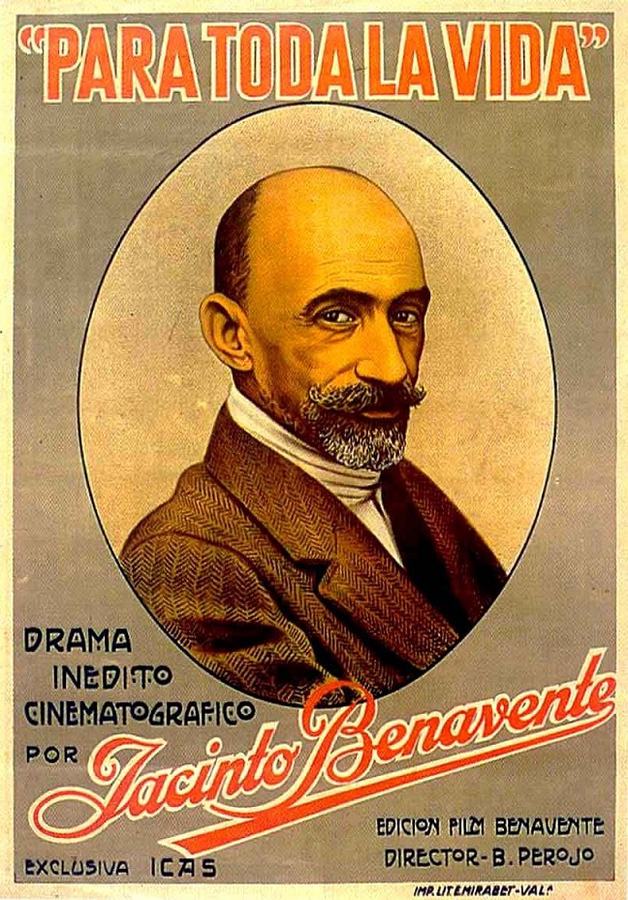
In the pantheon of early twentieth-century cinema, Benito Perojo’s Para toda la vida (1923) stands as a monumental bridge between the theatrical prestige of Jacinto Benavente and the avant-garde aspirations of a developing Spanish film industry. This is not merely an adaptation; it is a profound reimagining of space and silence. While many films of the era, such as The Long Lane's Turning, relied heavily on moralistic didacticism, Perojo delves into the murky ambiguities of the human heart, where right and wrong are subsumed by the crushing weight of social expectation.
To understand the gravity of this work, one must acknowledge the source material. Jacinto Benavente, a Nobel Prize winner, was a master of the 'theatre of the mind,' where dialogue was the primary vehicle for psychological revelation. Translating this into a medium that, at the time, lacked synchronized sound required a director of Perojo’s caliber. He understood that the absence of Benavente’s sharp prose must be compensated for with a visual vocabulary that was equally articulate. The result is a film that feels remarkably modern in its restraint. Unlike the frantic pacing found in The Lost City, Para toda la vida breathes with a deliberate, almost agonizing slowness, allowing the audience to inhabit the silence alongside its characters.
The narrative arc is a slow-motion collision of ideals. We witness a marriage that has become a mausoleum. The title itself, which translates to 'For All of Life' or 'Forever,' is stripped of its romantic connotations and recast as an ontological threat. It is the 'forever' of a prison cell, the 'forever' of a reputation that cannot be scrubbed clean. This thematic density mirrors the psychological complexity seen in Conscience, yet Perojo infuses it with a specifically Mediterranean sense of fatalism.
The ensemble gathered here—Paul Menant, Manuel Montenegro, Pierrette Houyez, and the luminous Rachel Devirys—delivers performances that are startlingly devoid of the 'semaphore' style of acting common in silent cinema. Devirys, in particular, possesses a face that is a landscape of suppressed emotion. Her ability to convey the transition from hope to resignation without a single intertitle is a testament to Perojo’s direction. In many ways, her performance challenges the gendered tropes found in films like A Woman's Business, where female agency is often sacrificed at the altar of plot convenience.
Maurice Schutz and Henri Baudin provide the necessary gravitas to the male roles, embodying the rigid patriarchal structures that Benavente so frequently critiqued. The interactions between these characters are filmed with an eye for spatial power dynamics. The way characters are positioned in a room—often separated by vast expanses of ornate furniture or framed by doorways that look like gilded cages—tells the story more effectively than any dialogue could. This visual strategy evokes the same sense of societal entrapment found in Her Husband's Honor, yet Perojo’s execution is more atmospheric and less melodramatic.
Technically, Para toda la vida is a triumph of lighting and composition. Perojo, who spent significant time in the French film industry, brought back a sophisticated understanding of lighting as a narrative tool. The use of shadows is not merely decorative; it is an externalization of the characters' internal states. The flickering light of candles and the harsh glare of the Spanish sun are used to create a world of stark contrasts. This is a far cry from the more straightforward cinematography of The Uplifters. Here, the camera is an active participant, a silent witness to the erosion of a family unit.
The set design deserves its own analysis. The interiors are lush, cluttered, and claustrophobic. They represent the accumulation of history and expectation that the characters cannot escape. Every object, from the heavy drapes to the family portraits, seems to be watching. This sense of being observed—of the public eye penetrating the private sphere—is a central theme. It echoes the social surveillance explored in The Question, but Perojo grounds it in a uniquely Spanish obsession with 'el qué dirán' (what people will say).
Beyond its aesthetic merits, the film is a fascinating sociological document. It captures a Spain in transition, caught between the rigid traditions of the nineteenth century and the encroaching modernity of the twentieth. The conflict at the heart of the film—the tension between individual desire and collective duty—is a universal one, but it is rendered here with a specific cultural intensity. While a film like Lest We Forget deals with the collective trauma of war, Para toda la vida deals with the quiet, domestic trauma of the status quo.
The pacing of the film mirrors the experience of its characters. It is a slow burn that builds to a crescendo of quiet desperation. There are no grand explosions or chase sequences; the climaxes are internal, found in a look, a gesture, or a long-awaited decision that comes too late. This commitment to psychological realism is what elevates the film above its contemporaries. It shares a certain kinship with the European 'Kammerspielfilm' (chamber film) movement, focusing on the intimate details of a few characters within a confined setting to reveal broader truths about the human condition.
When comparing this work to other international productions of the time, such as the German Die siebente Großmacht or the American The Tong Man, Perojo’s film stands out for its lack of exoticism or sensationalism. It does not seek to shock the audience with the 'other,' but rather to unsettle them with the familiar. It is a film about the horror of the everyday, the tragedy of the mundane. In this sense, it feels more aligned with the works of Ibsen or Strindberg than with the swashbuckling adventures that were popular at the box office.
The film’s legacy is one of artistic integrity. Perojo refused to simplify Benavente’s complex moral landscape for the screen. He respected the audience’s intelligence, trusting them to navigate the nuances of the plot. This approach is evident when looking at his later career, but Para toda la vida remains one of his most pure expressions of cinematic art. It is a film that demands to be watched with the same attention one would give to a great painting or a complex piece of music.
Every frame of this film is meticulously composed. Notice the way the light falls through the shutters, creating a literal barred-cage effect on the floor. This is not accidental. Perojo uses the architecture of the home to reflect the architecture of the characters' lives. The grand staircases do not lead to freedom; they lead to further levels of isolation. The dining table is not a place of communion, but a battlefield where the weapons are silence and averted eyes. This use of space is far more sophisticated than the theatrical staging found in I millepiedi.
Furthermore, the film’s exploration of the 'sins of the father'—a recurring theme in Spanish literature—is handled with a delicate touch. We see how the choices of the previous generation weigh upon the current one, creating a cycle of unhappiness that seems impossible to break. This intergenerational conflict is handled with more nuance here than in His Father's Son, focusing on the emotional fallout rather than just the narrative consequences.
To watch Para toda la vida today is to rediscover a lost language of cinema. It is a reminder that before the advent of sound, film had already reached a peak of expressive power. Perojo’s ability to capture the 'unseen'—the thoughts, the regrets, the silent screams of his characters—is nothing short of miraculous. It is a film that lingers in the mind long after the final frame has faded to black, much like the haunting imagery of Ein Gruss aus der Tiefe.
In the end, Perojo’s masterpiece is a testament to the power of the image to transcend language and time. It is a searing, beautiful, and ultimately heartbreaking look at the cost of living a life defined by 'forever.' It is a film that deserves to be restored, studied, and celebrated as a foundational work of Spanish and European cinema. It is, quite literally, a film for all of life.
The sheer ambition of the project—to take the most celebrated playwright of the day and strip him of his words—was a gamble that paid off immensely. It forced a new kind of storytelling, one that relied on the rhythm of the edit and the intensity of the close-up. In the landscape of 1920s cinema, where many films were content to be mere diversions, Para toda la vida dares to be something different—a precursor, perhaps, to the psychological depth that directors like Antonioni or Bergman would later explore. It is a vital link in the chain of cinematic evolution, proving that the silent screen was never truly silent; it was simply waiting for the right voice to give it meaning.
The film also provides a stark contrast to the more adventurous or genre-focused works of the time, such as Die Sklavenhalter von Kansas-City. Where those films sought to expand the horizon of the viewer through spectacle, Perojo seeks to deepen the viewer's understanding by looking inward. This inward gaze is the film's greatest strength and its most lasting contribution to the art form. It is a profound meditation on the human condition that remains as relevant today as it was a century ago.
IMDb —
1920
Community
Log in to comment.