DbcultAccessing Vault...
Cult Review
Senior Film Conservator
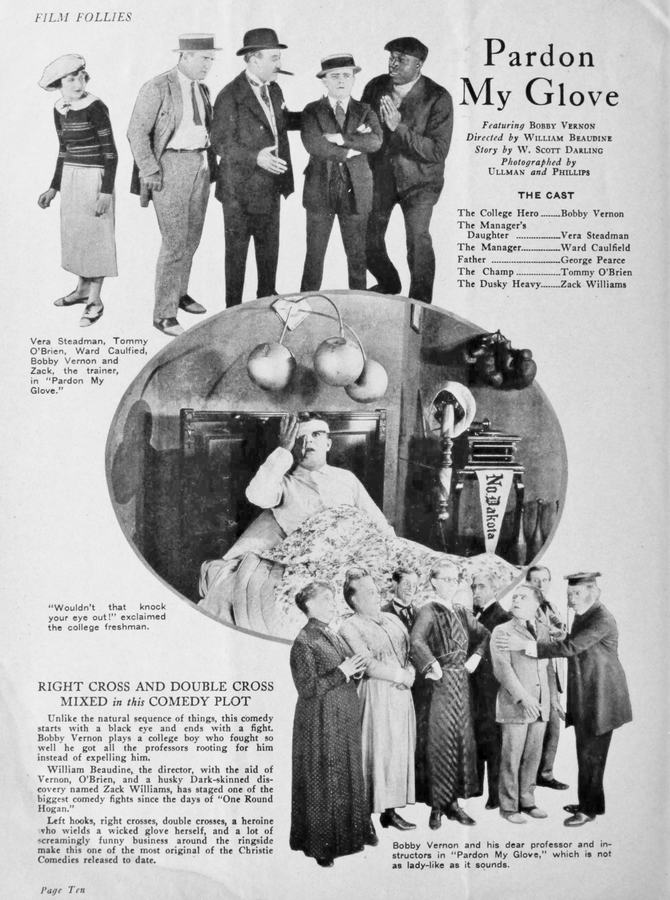
In the pantheon of early 20th-century sports cinema, few films capture the intersection of academic indifference and physical prowess with as much kinetic charm as Pardon My Glove. Directed with a keen eye for the rhythmic demands of the silent era, this 1922 gem serves as a fascinating specimen of the 'college-athlete-turned-pro' trope. Bobby Vernon, an actor often relegated to the periphery of slapstick history, delivers a performance that balances the vulnerability of a disappointed son with the raw, unpolished grit of a man who finds his only true expression through his fists. The film is not merely a sports comedy; it is a meditation on the commodification of the human body and the redemptive power of spontaneous defiance.
The screenplay, penned by the prolific Scott Darling, initiates its movement with a classic comedic premise: the scholar who cannot study because the siren call of the gymnasium is too loud. Jimmie Carter is a protagonist defined by his exclusions. He is excluded from the faculty's good graces, and subsequently, excluded from his father’s household. This double-exile creates a vacuum that the professional boxing world is all too eager to fill. Unlike the more somber explorations of social standing found in Snobs, Darling’s script treats Jimmie’s fall as a liberation. The world of academia is portrayed as a sterile, suffocating environment, whereas the boxing ring, despite its inherent corruption, offers a visceral reality that Jimmie craves.
When Jimmie is recruited by a professional manager, the film shifts its tone from collegiate farce to a more nuanced critique of the sporting industry. The manager is a quintessential figure of the era—a man who views athletes as mere chess pieces in a gambling apparatus. His requirement that Jimmie serve as a 'jobber'—a fighter paid to lose—introduces a moral tension that elevates the film above standard genre fare. This thematic exploration of 'throwing' a fight resonates with the era’s anxieties regarding the integrity of professional sports, a sentiment also touched upon in contemporary works like The Hero of the Hour.
The decision to devote the entire second reel to a single fight sequence was a bold editorial choice for 1922. It allows the audience to experience the passage of time within the ring, capturing the fatigue, the tactical shifts, and the psychological warfare inherent in pugilism. The cinematography during these scenes is remarkably fluid. While it lacks the frenetic cutting of modern sports films, it possesses a spatial clarity that highlights Bobby Vernon's physical commitment to the role. One can see the sweat, the hesitation, and the eventual ignition of pride when he spots his father, George C. Pearce, in the crowd.
This moment of recognition is the film’s emotional fulcrum. The presence of the father, who had previously written Jimmie off as a failure, transforms the match from a transactional event into a quest for paternal absolution. It is a stark contrast to the domestic melodramas of the time, such as The Awakening of Bess Morton, where redemption is often found through quiet suffering. In Pardon My Glove, redemption is loud, violent, and public. Jimmie’s decision to win, despite the manager’s orders, is an act of existential rebellion. He chooses his identity over his livelihood, a theme that echoes the rugged individualism celebrated in Kindred of the Dust.
Vera Steadman, playing the manager’s daughter, provides more than just a decorative romantic interest. She represents the ethical conscience of the film. Her presence in the crowd, alongside Jimmie’s father, creates a dual pressure: the need to prove his worth as a man to his progenitor and his worth as a hero to the woman he loves. Steadman’s performance is subtle, utilizing the expressive potential of the silent medium to convey a mixture of anxiety and burgeoning admiration. Her character serves as a bridge between the corrupt world of her father and the aspirational world Jimmie wishes to inhabit. The chemistry between Vernon and Steadman is palpable, providing a soft counterpoint to the brutality of the ring.
The film’s portrayal of the manager’s daughter avoids the more tragic tropes seen in The Sacrifice of Pauline. Instead, she is an active participant in Jimmie’s moral awakening. Her silent encouragement is the catalyst that allows Jimmie to break free from the 'arrangement.' This dynamic adds a layer of sophistication to the plot, suggesting that personal integrity is often a collaborative effort, sparked by the expectations of those we hold in high regard.
From a technical perspective, Pardon My Glove utilizes the limited technology of its day to maximize impact. The lighting in the fight sequences creates a stark, high-contrast environment that mirrors the moral clarity Jimmie eventually achieves. The use of intertitles is sparse but effective, allowing the visual storytelling to carry the weight of the narrative. This economy of language is a hallmark of Scott Darling’s style, ensuring that the pacing remains brisk and the focus stays on the character’s internal struggle. While it may not possess the exotic visual flair of Die Lieblingsfrau des Maharadscha - 2. Teil, it excels in its grounded, American realism.
The supporting cast, including Zack Williams and Tom O'Brien, populate the world with a sense of lived-in authenticity. Williams, in particular, brings a physical presence that emphasizes the danger Jimmie faces in the ring. The contrast between Jimmie’s slight frame and the formidable opponents he faces underscores the 'underdog' narrative that has become a staple of the genre. This visual storytelling is far more effective than the heavy-handed didacticism found in some other films of the period, such as The Edge of the Abyss.
The central conceit of the 'fixed' fight is a powerful metaphor for the social constraints of the 1920s. Jimmie is told to lose because it is more profitable for those in power. His refusal to do so is a metaphorical middle finger to the establishment. This theme of individual agency against systemic corruption is a recurring motif in silent cinema, yet it feels particularly poignant here because the stakes are so personal. It is not just about money; it is about the right to be excellent. In this regard, the film shares a spiritual kinship with A Successful Failure, where the protagonist must redefine what it means to win in a world that values the wrong things.
Furthermore, the film’s exploration of masculine identity—specifically the tension between the 'intellectual' expectations of the father and the 'physical' reality of the son—remains strikingly relevant. Jimmie’s struggle to reconcile these two halves of himself is a journey many modern viewers will recognize. The film suggests that true fulfillment comes not from conforming to external expectations, but from mastering one’s own talents, however unconventional they may be. This is a much more nuanced take on personal growth than the somewhat simplistic transformations seen in Betty Sets the Pace.
Ultimately, Pardon My Glove is a triumph of silent storytelling. It avoids the pitfalls of excessive sentimentality while delivering a powerful emotional punch. The final scenes, where Jimmie must face the consequences of his victory, are handled with a refreshing lack of artifice. There are no grand speeches, only the quiet satisfaction of a man who has reclaimed his soul. It is a film that rewards multiple viewings, as each watch reveals new subtleties in the performances and the direction. Compared to the more overt theatricality of The Masked Heart, this film offers a more grounded and ultimately more moving experience.
For those interested in the evolution of the sports film, or for those who simply appreciate a well-told story of defiance, Pardon My Glove is essential viewing. It stands as a testament to the enduring power of the underdog story and the timeless appeal of seeing a man stand up for himself when the world expects him to fall. It is a knockout in every sense of the word, a piece of cinematic history that still manages to feel vital and urgent over a century later. Whether you are a fan of Horizon Hunters or the more stylized Die blaue Laterne, there is something in Jimmie Carter’s journey that will resonate with the fighter in all of us.
A cinematic relic that hits with the precision of a champion’s jab and the heart of a poet.
IMDb 6.5
1926
Community
Log in to comment.