DbcultAccessing Vault...
Cult Review
Senior Film Conservator
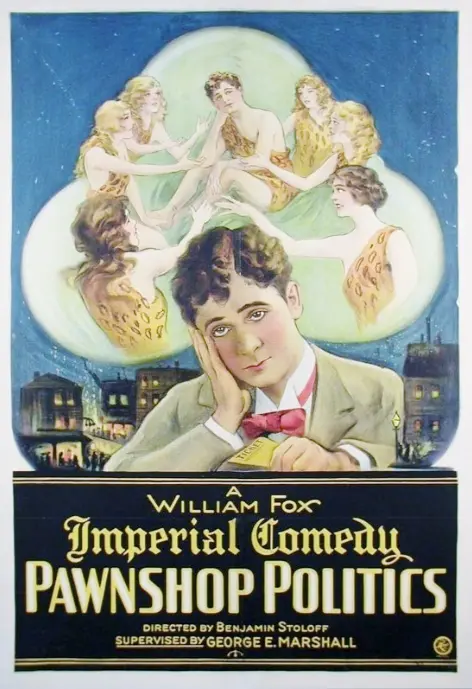
Should you invest your time in this nearly century-old silent comedy? Short answer: yes, but only if you appreciate the gritty, unpolished charm of 1920s independent filmmaking over the high-gloss production of the major studios.
This film is for the cinephile who enjoys seeing how early cinema dismantled political apathy through slapstick; it is certainly not for anyone who finds the frantic, repetitive pacing of silent shorts to be a chore. It is a film that thrives on its own cynicism, which feels surprisingly modern in an era of political fatigue.
1) This film works because it understands the inherent comedy of the 'bait-and-switch,' using the pawnshop setting as a microcosm for the deceptive nature of politics.
2) This film fails because its romantic subplot involving Kitty Dolan is almost entirely devoid of chemistry, serving as a mere structural excuse for the political hijinks.
3) You should watch it if you want to see a rare example of a silent-era protagonist who wins not through moral superiority, but through clever manipulation and a bit of physical intimidation.
Pawnshop Politics begins with a sequence that feels like a masterclass in tension management. We see a 'tough' character enter the shop, hand on his holster, eyes darting. In any other film of the period, such as the more earnest dramas like The Pitfall, this would be the precursor to a tragedy. Here, director J. Walter Ruben plays with the audience's conditioned fear. The man isn't there to rob Abie; he’s there to liquidate his assets. This immediately establishes Abie as a man who cannot be easily rattled, a trait that serves him well when the stakes shift from commerce to community leadership.
The pawnshop itself is a character. It’s cluttered, claustrophobic, and filled with the discarded remnants of other people's lives. This setting provides a sharp contrast to the clean, aspirational world of the alderman’s office that Kitty represents. George Harris plays Abie with a frantic energy that borders on the neurotic, yet he possesses a localized wisdom. He knows the value of a gun, the value of a vote, and the value of a well-timed insult. Unlike the more stoic heroes found in The Unblazed Trail, Abie is a creature of the city—fast-talking (in intertitles) and even faster-moving.
George Harris is the engine of this film. His performance isn't as balletic as Keaton or as pathetic as Chaplin; instead, he has a rugged, blue-collar physicality. When he sees Kitty for the first time, his 'love at first sight' isn't a poetic swoon. It’s a momentary glitch in his internal machinery. He stops mid-transaction, a visual cue that the pawnshop—his entire world—has been momentarily devalued by the presence of something he cannot put a price on.
Barbara Luddy, who would later find immortality as the voice of Lady in Disney’s Lady and the Tramp, is unfortunately given very little to do here. She is the 'prize' at the end of the political race. However, she manages to inject a sense of urgency into her scenes with Harris. There is a specific moment where she explains her father's plight, and her gestures are remarkably restrained for the era. She doesn't resort to the wild flailing often seen in films like Daring Love. Her performance suggests a woman who is tired of her father's failing campaign, adding a layer of realism to the otherwise absurd plot.
The supporting cast, particularly the rival candidate, plays into the archetypes of the day. The villain is mustache-twirling in his villainy, yet the act of planting a bomb in a pawnshop feels remarkably dark for a comedy. It’s a tonal shift that reminds the viewer that the 1920s were not just about flappers and jazz, but also about labor unrest and urban violence. This film treats the bomb not as a terrifying threat, but as a logistical problem for Abie to solve, which is a brutally simple and effective way to handle tension.
Visually, Pawnshop Politics is a product of its time, utilizing mostly static medium shots. However, the final act breaks this mold. The sequence where Abie stirs up the lazy voters is a triumph of editing and choreography. He doesn't give a speech. He doesn't appeal to their civic duty. He insults them. He offers to 'lick' them—to fight them all. This leads to a mass chase that is filmed with a surprising amount of kinetic energy.
The camera captures the mob as a singular, undulating wave of humanity. It’s a cynical take on democracy: the only way to get people to the polls is to make them angry enough to chase you there. Compared to the more traditional heroics in Fighting Blood, the resolution of Pawnshop Politics feels like a satirical jab at the American voter. The cinematography during this chase uses wide shots to emphasize the scale of the mob, making the individual voters look like a herd of cattle being driven toward a pen—the polling station.
If you are looking for a deep, emotional journey, look elsewhere. However, if you want to see a 1926 film that correctly identifies that the average person is more motivated by a personal grudge than by political ideology, then yes, it is worth your time. It is a lean, mean, and surprisingly funny look at the intersection of love and local government.
The film’s pacing is its greatest asset. At a time when many films were beginning to bloat, such as the sprawling Enemies of Women, Pawnshop Politics keeps its runtime focused. Every gag leads directly into the next plot point. The bomb isn't just a gag; it's the catalyst for Abie's transition from shopkeeper to political fixer. The film is efficient. It works. But it’s flawed in its lack of character development outside of Abie.
Pros:
Cons:
One of the most striking things about Pawnshop Politics is how it treats the 'bomb.' In many films of this era, like The Master Key, a bomb is a source of pure melodrama. Here, it’s treated with a weirdly nonchalant attitude. Abie doesn't panic. He sees the bomb as just another piece of unwanted inventory that he needs to return to its original owner. This lack of sentimentality is what makes the film stand out. It suggests that in the world of the pawnshop, everything—even a lethal weapon—is just another item to be traded, sold, or returned.
"The film suggests that democracy isn't won through speeches, but through the ability to outrun a mob you've successfully insulted."
This observation highlights the film's core philosophy. It doesn't believe in the nobility of the 'common man.' It believes the common man is lazy and needs to be tricked into doing the right thing. It’s a stance that feels incredibly bold for 1926, a time when many films were still peddling Victorian-era morality. By contrast, Together or Bonds of Love seem almost naive in their portrayal of human nature.
Pawnshop Politics is a fascinating relic. It is not a polished gem, but a rough-cut stone that still manages to catch the light. George Harris is a revelation of nervous energy, and J. Walter Ruben’s direction ensures that the film never slows down long enough for you to question its leaps in logic. While it lacks the visual experimentation of The Virgin of Stamboul, it makes up for it with a sharp, street-smart sensibility. It is a film that respects the hustle. It understands that in the city, you are either the one doing the pawning or the one being pawned. Abie chooses to be the pawnbroker of his own destiny, and that makes for a compelling, if chaotic, viewing experience. Watch it for the history, stay for the riot, and leave with a slightly more cynical view of your local alderman.
IMDb —
1924
Community
Log in to comment.