DbcultAccessing Vault...
6.2/10
Senior Film Conservator
A definitive 6.2/10 rating for a film that redefined the boundaries of cult cinema. Pro Patria remains a cornerstone of transgressive art.
In the annals of early silent cinema, few names resonate with the same prestige as Albert Capellani. With Pro Patria, a 1914 adaptation of Victorien Sardou’s stage play 'Patrie,' we witness a confluence of theatrical rigor and nascent cinematic fluidity. This production is not merely a filmed play; it is a sprawling historical palimpsest that captures the zeitgeist of 16th-century Flanders with a level of detail that borders on the obsessive. Unlike the more fantastical escapades found in The Extraordinary Adventures of Saturnino Farandola, Capellani’s work here is grounded in a heavy, palpable realism that demands the viewer's absolute attention.
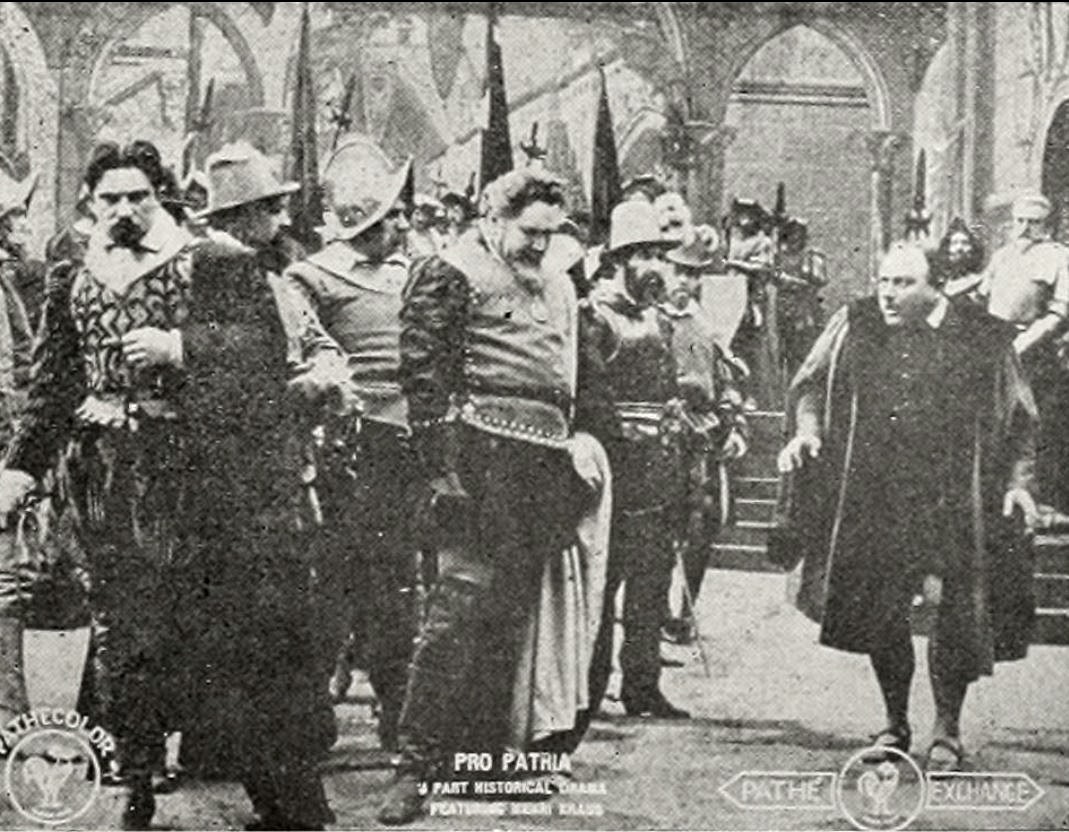
The most haunting aspect of this 1914 production is its setting. Filmed in Louvain, Belgium, shortly before the city was ravaged by the fires of World War I, the film serves as a spectral record of a lost European beauty. The cobblestone streets, the Gothic arches, and the looming cathedrals provide an authenticity that no studio backlot could ever replicate. When we compare this to the contemporary Lights of London, the sheer scale of the Belgian locations elevates Pro Patria into a different echelon of artistry. The camera lingers on the textures of the stone and the weight of the period-accurate armor, creating a sensory experience that bridges the gap between the 1500s and the early 20th century.
At the heart of this historical tempest is Paul Capellani. His portrayal of Karloo is a masterclass in the transition from stage histrionics to the more nuanced demands of the screen. While many actors of the era were still trapped in the exaggerated gesticulations of the 19th-century theater—witnessed to some degree in A Prisoner in the Harem—Capellani employs a restrained intensity. His eyes convey the internal friction of a man torn between his love for a woman and his duty to a burgeoning nation. The chemistry between the cast, including the formidable Henri-Amédée Charpentier and Yvonne Sergyl, creates a web of intrigue that feels remarkably modern in its complexity.
Victorien Sardou was the architect of the "well-made play," a structure defined by its logical progression, its use of suspense, and its climactic revelations. Albert Capellani honors this structure while expanding its horizons. The film’s six reels are paced with a rhythmic precision that avoids the static nature of many stage-to-screen adaptations. Where Du Barry focuses on the opulence of the French court, Pro Patria focuses on the grit of the resistance. The plot maneuvers—secret letters, midnight trysts, and the constant threat of the Spanish Inquisition—are handled with a sophistication that makes the film feel like a precursor to the political thrillers of later decades.
When examining the cinematic landscape of 1914, Pro Patria stands as a monolith of prestige. It lacks the populist sensationalism of The Perils of Pauline, opting instead for a somber, intellectual engagement with history. There is a thematic kinship here with Amalia, yet Capellani’s direction is more fluid, more attuned to the potential of the medium to tell stories through shadow and composition rather than just title cards. The use of depth in the frame—soldiers marching in the background while conspirators whisper in the foreground—shows a sophisticated understanding of the three-dimensional space that was rare for its time.
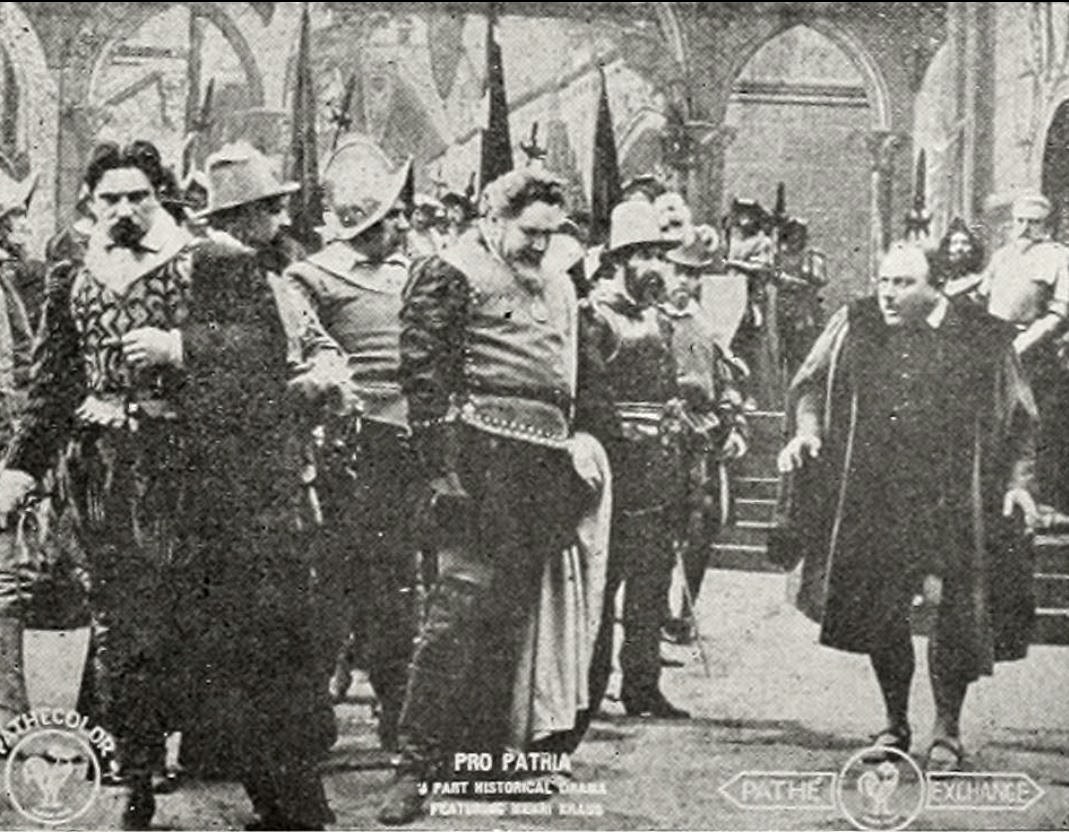
One cannot discuss this film without acknowledging the staggering attention to costume and property. The production feels as though it excavated a museum and brought its contents to life. The heavy brocades, the gleaming breastplates, and the period-specific weaponry are not mere window dressing; they are essential to the film's immersive power. In an era where some films, like Three Strings to Her Bow, relied on simpler settings, Pro Patria represents the "superspectacle" of its day. This is cinema as a grand cultural statement, an attempt to prove that the new medium could rival the high arts of opera and theater.
The title itself, Pro Patria (For the Fatherland), underscores the film's central preoccupation. Released on the eve of the Great War, its depiction of a small nation struggling against a massive imperial power must have resonated profoundly with audiences of the time. The moral quandaries presented—whether one should sacrifice personal happiness for the greater good—are treated with a gravity that avoids easy sentimentality. While For the Queen's Honor explores similar themes of loyalty, Capellani’s approach is more cynical, more aware of the blood and betrayal required to achieve liberty.
Technically, the film is a marvel of its era. The lighting, while naturally constrained by the technology of the time, is used effectively to create mood, particularly in the subterranean scenes where the Dutch patriots meet. There is a starkness to the Spanish occupiers' quarters that contrasts with the warmer, though more cluttered, homes of the citizens. This visual storytelling is far more advanced than the relatively straightforward cinematography of A Melbourne Mystery or The Miner's Daughter. Capellani understands that the camera is not just an observer but a participant in the drama.
To watch Pro Patria today is to engage with a pivotal moment in film history. It represents the peak of the French "Film d'Art" movement, which sought to bring literary and theatrical prestige to the masses. The involvement of the SCAGL (Société Cinématographique des Auteurs et Gens de Lettres) ensured that the adaptation maintained the intellectual integrity of Sardou’s original work. While films like Shadows of the Moulin Rouge offered contemporary thrills, Pro Patria offered a timeless meditation on the cost of freedom. It is a dense, demanding, and ultimately rewarding piece of cinema that proves that even in 1914, the medium was capable of profound psychological depth and historical grandeur. The six reels do not merely grip; they envelop the viewer in a world of steel, shadow, and sacrifice.
For those interested in the evolution of the historical epic, this film is an essential touchstone, standing alongside other monumental works like The Life of Our Saviour in its ambition, yet surpassing it in its narrative fluidity and character complexity. It remains a shining example of how early filmmakers used the past to speak to the anxieties and aspirations of their own present.
IMDb 6.8
1919
Community
Log in to comment.