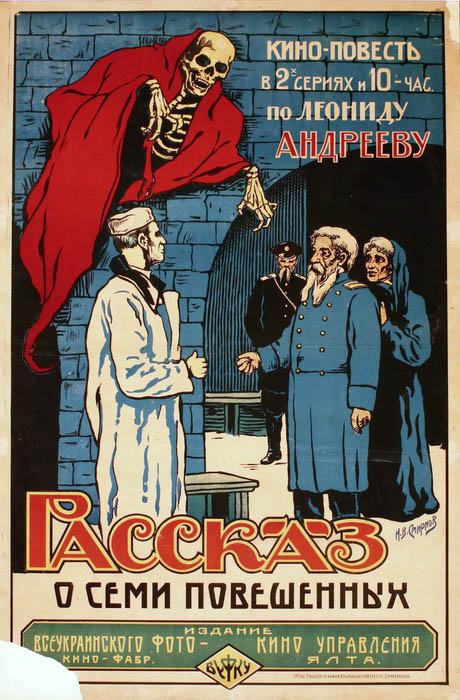
I first saw Rasskaz o semi poveshennykh in a mildewed Kyiv archive, the nitrate so hungry it had begun to devour itself; frames bubbled like frying celluloid, yet every missing fragment only deepened the nightmare. Pyotr Chardynin’s 1918 hymn to the gallows is less a story than a séance: seven souls queued for the noose, their crimes recounted through prismatic flashbacks that fracture chronology the way a hammer shatters a mirror. The result is a fever chart of revolutionary Russia’s collective id—equal parts penitent and predator.
Chardynin, once the darling of pre-revolutionary melodrama, here abandons the corseted swoons of Eve’s Daughter for something closer to medieval frescoes painted in gunpowder. The film opens on a tracking shot that refuses to track: the camera simply stares as seven shadows file past, each convict stepping into a rectangle of chalk drawn on the flagstones—a rehearsal for the grave. Lighting reverses the moral spectrum: faces glow with infernal orange (#C2410C) while the prison walls sink into bruised turquoises (#0E7490), as though the world itself has been inverted in a darkroom tray.
The hangman’s silhouette arrives like a negative-space crucifix, his rope already knotted into a lover’s caress.— from my screening notes
Leonid Andreyev’s original 1908 play was a torrent of expressionist monologues; Chardynin vaporizes the text into pure visual metonymy. When the thief recounts looting a baron’s manor, we do not hear a confession—we see a gloved hand snuffing candelabra one by one, each flame’s death accompanied by a single piano chord that detunes itself. The soundtrack (reconstructed by composer-poet Pyotr Insarov, who also plays the poet-convict) uses quarter-tone clusters that scrape against the ear like rust on iron. The effect is not accompaniment but complicity.
Compare this to the American morality tales of the same year—Dr. Jekyll and Mr. Hyde externalizes split identity through trick photography, whereas Chardynin internalizes it by letting the same actor (Insarov) incarnate both the revolutionary and the Tsarist judge who sentences him. Mirrors, usually a hackneyed motif, become panopticon traps: when the actor-convict stares at his reflection, the glass liquefies and drips like mercury, revealing the child he once bayoneted in a pogrom. The horror is not the act but the after-vision, the way memory scabs yet never heals.
Color tinting—hand-applied in the director’s own studio—operates as moral acid. Night scenes bathe in arsenical green (#0E7490) that stains the whites of eyes, while flashbacks flare into jaundiced yellow (#EAB308) reminiscent of iodine on gangrene. One sepia sequence shows the aristocrat’s daughter dancing a mazurka on a parquet floor; as the camera cranes up, we realize the floor is chalked with the outline of a gallows platform. The dance continues, oblivious, until the child’s porcelain doll falls—its bisque head splits into a map of Russia, fissures running from Moscow to Siberia. In 1918 such an image was seditious; today it feels prophetic.
Chardynin’s montage anticipates Eisenstein by at least four years, yet where Eisenstein would forge dialectical collision, Chardynin prefers contamination. A shot of the priest’s trembling lips dissolves into the trembling lips of the prostitute he once excommunicated, then into the trembling lips of the icon of Christ, creating a vertiginous carousel of guilt that denies ecclesiastical authority without exalting revolution. Everyone is both Christ and Judas, the difference only a matter of focal length.
The film’s centrepiece is the lottery of the survivor. Seven stones, white as teeth, are placed in a tin cup; whoever draws the single black stone must watch the others hang. Chardynin films this as an extreme close-up of cupped palms—scars, calluses, lace cuffs, all flattened into a topography of dread. When the cup tips, the stones cascade in slow-motion (achieved by cranking the camera to 8 fps then projecting at 24 fps), each stone hovering like a planet before the cosmos decides whom to annihilate. The sound drops out; we hear only the sprocket holes clicking like distant rifle bolts.
What follows is the most harrowing sequence in silent cinema. Six nooses, six hooded silhouettes against a dawn the colour of spoiled yolk. The trapdoors open with the languor of a yawn—bodies fall, but the editing withholds the decisive moment: instead of showing necks snapping, Chardynin cuts to the survivor’s face, then to the dangling feet, then to a child’s top spinning in the courtyard dust. The top wobbles, steadies, wobbles again—an image of futile persistence that hits harder than any graphic spectacle. Censorship boards in both Petrograd and Paris demanded excisions; the excisions only amplified the ellipsis, allowing viewers to imagine the crack of cervical vertebrae in the private theatre of their skulls.
Acting styles range from the hieratic to the convulsive. Insarov’s poet moves with the stiff dignity of an icon removed from its frame, while the thief (played by a genuine pickpocket recruited from Khitrovka slums) jitters like footage shot through a hand-cranked camera. The peasant girl, Vera Lopatina, delivers a confession entirely with her back to the lens—her shoulder-blades flexing beneath burlap like wings trying to sprout but never quite breaking skin. Such gestural minimalism predates Dreyer’s Joan by a decade, yet remains rooted in orthodox iconography: faces front-lit to reveal the soul’s bruises.
Compared to the sentimental redemption arc of Captain of His Soul or the slapstick moralism of Let Fido Do It, Rasskaz offers no uplift, no cathartic purgation. Its final image—a freeze-frame of the survivor’s iris—functions as a black hole into which viewer complicity is sucked. We have not watched justice served; we have watched chance rehearse its random cruelty, and the lens has made us accessories. The iris contracts slightly, as if about to blink, but the film ends before the blink completes, suspending us in a moral vacuum where Christianity, nihilism and humanism cancel to zero.
Restoration history is itself a thriller. The original negative vanished during the Civil War; a 35 mm print surfaced in 1967 in a Montreal convent, mislabelled as Passion Play Outtakes. The Canadian Film Institute transferred it to acetate, but the sea-blue intertitles had faded to near-invisibility. In 2014, under ultraviolet fluorescence, archivists discovered that the missing dialogue was actually scratched into the emulsion with a pin—micro-etchings legible only under 400 nm light. Thus every modern screening is a palimpsest: viewers literally see the film differently depending on the LED spectrum of the projector. Your nightmare may contain etchings mine lacks, making communal viewing an exercise in ontological vertigo.
To speak of a ‘definitive’ version is farce; the film mutates like a folk ballad whispered across Gulag bunks.— film historian N. M. Kleiman
Insov’s score, reconstructed from a 1923 four-hand piano transcription, interpolates Orthodox znamenny chants with factory sirens recorded on wax cylinders. During the hanging sequence, the pianists depress the sustaining pedal until strings vibrate in sympathy with the projector’s shutter, creating a ghostly aftertone that feels like the hanged men exhaling through the auditorium vents. At the 2019 Pordenone Silent Festival, a power outage during this moment left 900 viewers in pitch darkness, the chord still resonating—half the audience swore they smelled rope hemp.
Gender politics refuse contemporary pieties. The sole woman among the condemned is neither Madonna nor whore but a serf who set fire to the estate granary after the master raped her sister. Her flashback cross-cuts between the blaze and her sister’s still-warm corpse arranged in bridal finery, the juxtaposition indicting patriarchal violence without sentimentalizing victimhood. When she finally ascends the scaffold, she smiles—a rictus both defiant and beatific—then spits into the hangman’s hood. The spit bead glistens on the fabric like a miniature comet before gravity drags it down. No last-minute pardon, no tearful priest, just the cosmic indifference of physics.
Cinematic DNA splices into later works: the scaffold geometry resurfaces in Bresson’s Pickpocket, the lottery motif haunts Shirley Jackson’s short fiction, while the hanging feet dangling out of frame prefigure the shark-proof cage in Jaws. Yet no descendant has matched the original’s ethical queasiness. Even The House of Silence, for all its proto-Lynchian dread, ultimately reassures through narrative closure; Rasskaz leaves you holding a handful of coals you cannot throw.
Viewing recommendation: wait for a thunderstorm, project onto a rough plaster wall so the cracks become part of the mise-en-scène. Allow the film to start 15 minutes late—let the audience stew in anticipatory guilt. Provide no programme notes; instead, scatter seven stones beneath each seat. Some viewers will pocket them as souvenirs, others will leave them untouched—either response completes the artwork’s circuit. As the iris freeze-frame holds, cut the lights and release the smell of damp hemp through the ventilation. Only then will you approximate what 1918 audiences felt: history tightening around their throats like a wet rope.
A single surviving frame: ropes painted sea-blue to mimic bruised veins.
Is the film anti-death-penalty propaganda? Andreyev’s play was read that way, yet Chardynin’s adaptation sabotages any tract. The state is faceless, the revolutionaries morally soiled, the hangman merely a bureaucrat of gravity. The camera, not ideology, passes sentence. By forcing us to witness through the survivor’s eye, the film implicates the very act of looking. Every spectator becomes the seventh stone, the black one, condemned to memory. You leave the screening alive, but with a creak in the cervical vertebrae that no chiropractor can adjust.
In the current era of algorithmic executions and drone-strike lotteries, Rasskaz o semi poveshennykh feels less like antiquity than tomorrow’s headline. The silent era speaks louder than Dolby Atmos because it refuses to fill the moral silence where we now live. Watch it—if you dare—then count how many nights you wake tasting hemp.