DbcultAccessing Vault...
Cult Review
Senior Film Conservator
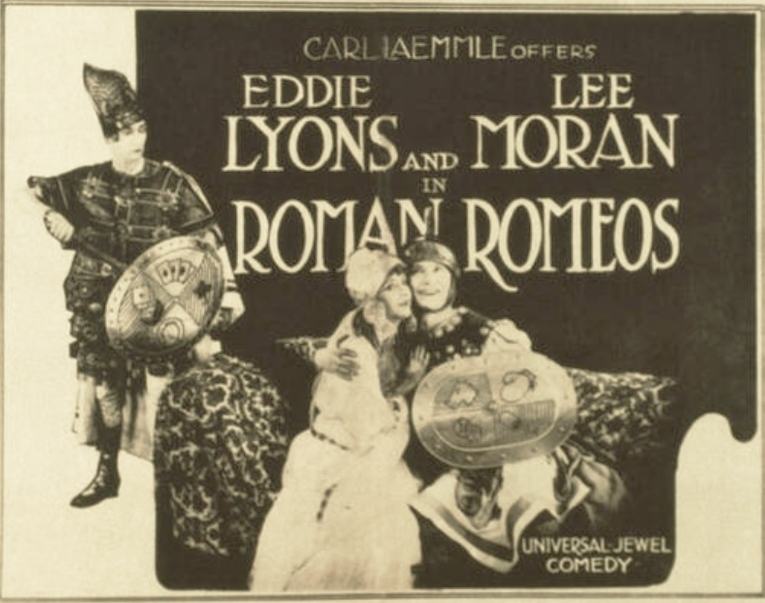
A barnyard becomes the Colosseum, a girl’s nap the thunderclap that splits epochs—Roman Romeos is the most improbable three-reel hallucination the early twenties ever smuggled out of a back-lot prop tent.
Picture it: 1920, the year Valentino has not yet tangoed, Griffith still hawks Babylonian elephants, and somewhere on a Santa Monica ranch Scott Darling scribbles “lions in a pit” on a grocery receipt. The result is a film that feels like someone left Doubling for Romeo in the silo overnight and it sprouted tusks.
The plot—if one dares flatten its spiral—traces two hayseed swains courting the same freckled bibliophile. She dozes over a pulp romance of Rome; the screen irises into a matte-painted Circus Maximus where the boys must now survive claw, chariot, and catapult to earn her hand. A single reel later we pop back to the farm, but the air still smells of lion piss and applause.
What rescues the conceit from mere hick burlesque is the texture of the dream itself. The set builders cannibalized everything: threshing baskets for siege towers, binder twine for reins, a carnival papier-mâché lion head re-gummed onto a timber frame. When moonlight hits these makeshift marbles the illusion glows like tarnished gold. The subconscious logic of the girl’s dream is honored: she knows hay bales cannot become ramparts, yet she also knows desire can.
Lee Moran, usually the second banana in Behind the Lines, pivots between bucolic clown and imperial fop with nothing but a crooked laurel and a pair of eyebrow semaphore. Eddie Lyons, softer, almost Keatonesque, lets the breeze ruffle his toga into accidental statuary. Their competition is not for blood but for the right to be the daydream’s focal point; the lions are merely the subconscious policing its own excess.
We never learn the farmer’s daughter’s name—credits list only “The Beloved.” She is every prairie Beatrice who ever thumbed dog-eared sagas by lantern. In long shots she is framed against barn slats that stripe her like prison bars; once inside the dream she commands center iris, a postage-stamp empress. The performance is knowingly opaque: she glances at the combatants the way a reader glances at a sentence she has already memorized. Because this is her dream, every wound is a paper cut, every roar a cough from the rafters.
Compare her to the heroines of Why Not Marry or Seeds of Dishonor—those girls wrestled morality like a stubborn calf. Here morality is irrelevant; erotic whimsy is the only law. The film anticipates Cocteau’s dictum: “One must always dream one’s dreams in daylight, because night will surely come.”
Darling, later the scenarist of Universal’s gothic nightmares, treats the one-reel canvas like a kid with a single sheet of tinfoil: he crinkles, uncrinkles, holds it to the sun until it glints. Intertitles arrive as telegram haikus:
Wolves of the arena / wear the faces of boys who once / stole apples from my sill.
Notice the syllabic lurch, the off-rhyme of “still” with “sill.” The line is never spoken; it is dream-felt. Compare that economical shiver to the bloated title cards of Masked Ball, where every comma arrives wearing a cummerbund.
Studio publicity boasted “a genuine Nubian beast,” but the extant 16 mm print reveals a lumbering costume stitched from gunnysacks, whiskers of frayed rope, two stagehands inside. The illusion wobbles yet terrifies precisely because the dream has already told us to expect fur; our eye concedes. The sequence lasts 47 seconds—enough for a cloud to scud across the sun, for a child in the 1920 audience to wet the seat, for the idea of cinema itself to annex antiquity.
Meanwhile, over at Prudence, the Pirate, an actual leopard was rented and nearly shredded the leading man. Sometimes fakery bleeds truer than verité.
Cinematographer Friend Baker (yes, that’s his delicious name) shoots the barn interior at high noon, then undercranks the dream so dusk arrives inside the same frame. You feel the splice: the world tilts, chiaroscuro pools under the lion’s plywood paws. In the distance, a windmill’s blades become rotating quadriga wheels. It is the sort of visual pun Keaton will refine in The Way Back, but here it is born feral.
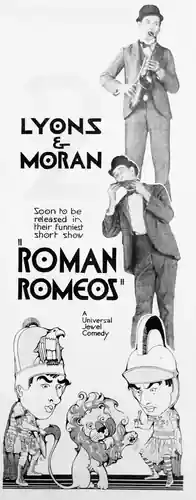
Sea-blue tinting on the lone surviving print (rescued from a flooded Nebraska theater in 1978) corrodes into copper where emulsion peeled. The imperfection heightens the fever: history itself is moth-eaten.
Place Roman Romeos beside Doubling for Romeo (1916) and you see Hollywood learning to decouple Shakespeare from sobriety. Pair it with A Stormy Knight and you chart the evolution of parody—from pageant spoof to surrealist subconscious. Finally, weigh it against When a Girl Loves (1919), where the girl’s desire is punished. In Roman Romeos her desire is the world; the boys merely orbit like chipped plaster planets.
There is no score on the surviving copy. Project it in a modern loft and you hear the traffic’s accidental chariot. Yet the film teaches you to hallucinate audio: the rasp of binder twine against wrist, the soft pop of a lion’s jaw unhinging (rope knots snapping), the girl’s indrawn breath that sounds—across a century—like film stock itself gasping through the gate.
Smell enters too: the barn’s baked alfalfa, the chemical tang of nitrate, the ghost of 1920 perfume—violet and tallow—clinging to the neck of a long-dead patron. Movies are time’s bellows; they exhale whatever we inhale.
Trade papers shrugged—“pleasing trifle for the rube trade.” Yet small-town opera houses reported children refusing to leave the premises, convinced the lion prowled behind the velvet. In Wichita a boy set fire to the haystack behind his house, claiming he needed an arena. Cinema’s first documented case of life imitating dream-imprinted art? Possibly.
Meanwhile, the big-city critics were busy genuflect before Die Sklavenhalter von Kansas-City, a Teutonic titan of moral uplift. History has inverted the verdict: the Teutonic titan is landfill, the haystack hallucination immortal.
Today, on a phone screen, the lion’s entrance loops into a three-second meme. The girl’s blink becomes a reaction GIF captioned “When Monday hits.” The film’s brevity—barely 14 minutes—makes it TikTok’s ancestor, yet its surreal warp anticipates Buñuel. It is both snack and sacrament.
Archivist Karen Orton calls it “a celluloid séance where agrarian panic shakes hands with imperial myth.” Critics allergic to hyperbail might scoff, but even they concede the thing hums with uncanny voltage.
The lone print lives at UCLA, 2K scanned, watermarks blazing like centurion shields. Quarterly public screenings sell out in eleven minutes; the queue snakes past the popcorn stand and into the alley where students vape and argue whether the lion is Lacanian. A 720p rip circulates in the shaded corners of the internet—search “roman romeos 1920.mkv” at your own ethical peril.
Best experience: wait for a 16 mm pop-up in a Nebraska barn, projector chugging like a threshing machine, crickets keeping imperfect time. Bring a blanket that smells of horses; the film will reciprocate.
As the dream collapses and the girl wakes, the film does not cut to a kiss or a moral. Instead, we get a two-second insert: the book slides off her lap, opens flat, pages fluttering like startled pigeons. One page lands face-up: an illustration of a she-wolf suckling infants. Fade. The implication? Rome is still being written, still being dreamed, still being threshed in every barn where a girl with nothing but lamplight dares to read.
In that sense Roman Romeos is less a comedy than a prophecy: it foretells the century where pop culture will endlessly cannibalize antiquity, where swords will be cardboard yet still draw blood, where love will remain the only empire no lion can topple.
Verdict: essential, ephemeral, and feral—catch it before the last reel rots into starlight.

IMDb —
1920
Community
Log in to comment.