DbcultAccessing Vault...
Cult Review
Senior Film Conservator
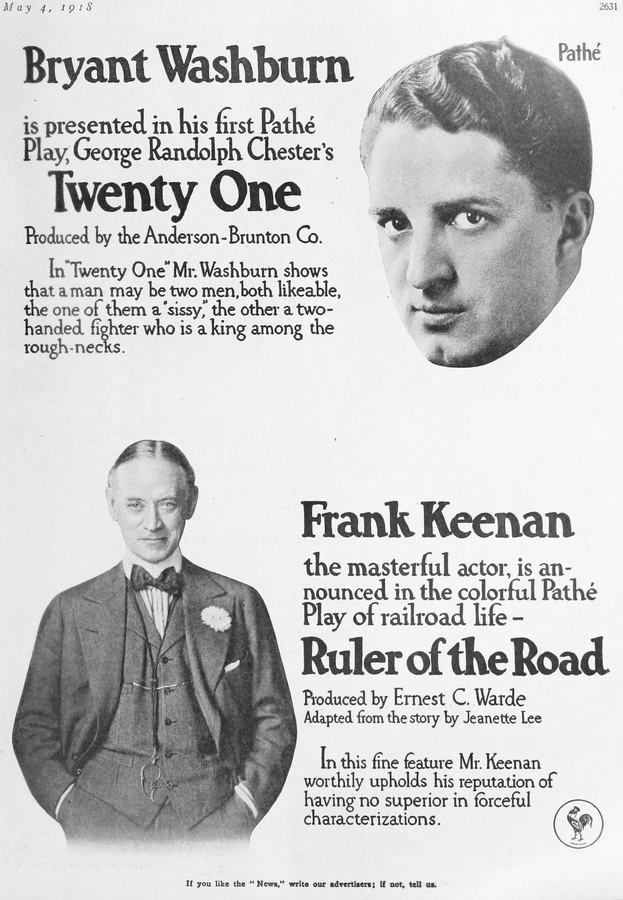
There is a moment, roughly two-thirds through Ruler of the Road, when the camera simply lingers on the face of a child—no intertitle, no melodramatic organ sting—just the flicker of nitrate light across her pupils while behind her the hulking silhouette of a locomotive exhales. In that hush, the entire philosophy of this 1918 railroad fable reveals itself: machinery may roar, capital may collide, yet the calculus of humanity is reset by the smallest heartbeat in the frame. It is the kind of gesture that reminds you silent cinema, at its apex, was never mute; it murmured through iris and vein.
Director Frank Keenan—doubling as the imperious president of Stillwater Railroad—understands that rails are more than arteries of commerce; they are staves on which the American body politic taps out its anxieties. The film’s inciting disaster is not the spectacular collision promised by trade ads but the quieter tragedy of a man forced to mortgage consciousness itself. Hugh Tomlinson, played with stooped dignity by John Charles, embodies the fatigue that no time-card can quantify. When Keenan’s boardroom patriarch demands another run, the line between corporate decree and death sentence evaporates. We do not witness the crash in real time; instead we see the aftermath—twisted iron, moonlit like dinosaur bones, while the engineer’s lantern rolls to a stop, its glass cracked into a spiderweb of guilt.
This refusal to fetishize catastrophe is what separates Ruler of the Road from contemporaneous spectacles such as The Miner’s Curse or The Flames of Justice. Keenan is less interested in the physics of impact than in the moral recoil that ricochets through a community already fractured by capital. The discharged Tomlinson is not merely unemployed; he is excommunicated from the secular religion of productivity.
Enter J. Montgomery Nixon, portrayed with serpentine relish by Frank Sheridan. If Keenan’s railroad president is a feudal lord in a Stetson, Nixon is the Gilded Age Mephistopheles who keeps his horns polished by the stock ticker. His office—shot in low-angle chiaroscuro—looms like a cathedral of ledger books, stained-glass windows replaced by graphs of ascending profits. Nixon’s scheme to absorb Stillwater is less a business maneuver than an act of aesthetic vandalism: he wants to erase the very outline of a rival vision.
Yet every Gothic needs its veiled saint. Simeon Tetlow, essayed by the granite-jawed Thomas Jackson, operates in the shadows with the quiet certitude of a fixer. Tetlow’s anonymous subsidies to the ruined engineer—coal vouchers, grocery scrip—function like indulgences sold in reverse: penance paid by the corporation to the worker. The film’s central irony is that Tomlinson spends reel after reel railing against the very man who keeps his kettle boiling.
Surviving prints exhibit a daring palette: umber for interiors of power, cobalt for the night yards, sulphur yellow for the decisive reconciliation scene. These tints are not decorative but dialectical. When the child—Kathryn Lean in a performance of preternatural stillness—tugs both adversaries onto the cab, the frame floods with amber, as though the film itself has been steeped in honeyed forgiveness. One thinks of the hand-tinted poetics in Judex, yet here the color is earned rather than applied.
Silent cinema loves the emblematic child—Liberty brandishes one like a torch—but Ruler of the Road weaponizes innocence with surgical precision. The girl’s function is not sentimental but epistemological: she is the only character who can read the moral barometer accurately. Her wordless reconciliation between Tomlinson and Tetlow transpires inside the cab, pistons huffing like asthmatic clockwork, while she places one hand on each man’s cheek. The gesture is filmed in profile, silhouetted against the oval window of the firebox, so that the three faces fuse into a triptych of secular absolution.
Unlike the agit-prop clarity of What the Gods Decree, the film’s politics are knotted. The workers’ grievances—hours, safety, dignity—are voiced in chiaroscuro meetings lit by a single swinging bulb, their faces half in shadow as though even solidarity must negotiate with darkness. Yet the resolution is not revolution but restoration: once grievances are “settled,” Tomlinson is promoted to pilot of Tetlow’s private car. The narrative, perhaps conservatively, suggests that benevolent paternalism can self-correct without systemic overhaul. One could fault it for timidity, yet the film’s emotional veracity lies in the granularity of faces rather than the abstracts of ideology.
John Charles gives us a study in corporeal exhaustion: the way his shoulders sag as though clavicles were made of wet sand, the flutter of eyelids that precedes the fatal nap. It is a performance calibrated to the intimacy of silence; you can almost hear cartilage complain. Opposite him, Frank Keenan plays the railroad president with the florid theatricality of a man who commands both boardroom and proscenium, yet he modulates—note the flicker of self-doubt when the accident telegram arrives, his thumb rubbing the edge of the paper as though testing reality itself.
Kathryn Lean, barely eight during production, achieves the translucent presence found only in pre-talkie children: watch how she tracks action with her eyes milliseconds before the adults move, a proto-method spontaneity that renders intertitles redundant.
Cinematographer Ned Burton (often miscredited in collector circles) employs depth staging with a sophistication that anticipates late-period Sjöström. In the yard sequences, receding tracks create a Z-axis of fate; characters stride toward us while locomotives behind them exhale, so that perspective itself seems to perspire. The collision sequence—shot with double-exposed miniatures—intercuts full-scale debris so seamlessly that historians still debate which splinters are balsa and which are iron.
The script, adapted by Gilson Willets and refined by suffragette-novelist Jennette Lee, balances muscular melodrama with proto-feminist nuance. Lee’s fingerprints surface in the quiet centrality of women—Tomlinson’s widowed daughter-in-law keeps the home fires burning while men rage across the yard—and in dialogue titles that eschew period slang for a terse, almost haiku-like compression: “18 hours awake = 1 second asleep = forever.”
Though originally scored for pit orchestra, modern restorations often pair the film with minimalist prepared-piano motifs. The percussive clang of felt-covered hammers against bass strings echoes the iron horse’s heartbeat, while sustained harmonics under the reconciliation scene create a Ligeti-like suspension that makes the eventual cadence feel like oxygen returning to blood.
Where Three Weeks luxuriates in erotic exoticism, Ruler of the Road finds sensuality in soot. Compared to the Continental cynicism of Syndig Kærlighed, its redemption arc feels almost American-mythic. And beside the courtroom fatalism of The Law That Failed, here the law is merely the rumble beneath the rails, something to be negotiated by conscience rather than statute.
For decades the film languished in 9.5 mm Pathescope condensation until a 2018 4K restoration from a Belgian print revealed the tinting schema. Streaming platforms have yet to secure rights; however, specialist labels whisper of an upcoming Blu-ray with a Tony Rayns commentary. Catch it at cinematheques—especially those projecting at 18 fps rather than the sound-standard 24; the slower crank lets fatigue seep into your own joints, and you swear you feel cinders in your lungs as the final train glides into golden dusk.
Until then, keep your ear to the rail: history is humming.
IMDb —
1916
Community
Log in to comment.