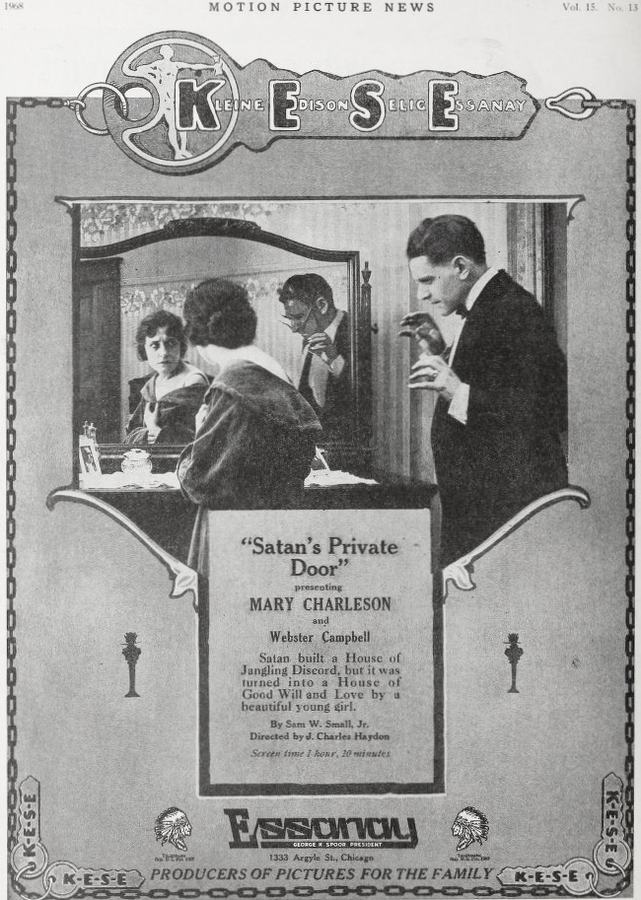
Imagine a film that refuses to raise its voice for ninety breath-held minutes, yet leaves you hearing harps in the silence that follows. That is Satan's Private Door, a 1923 chamber piece so ahead of its era it feels like it arrived through a worm-hole from some more compassionate future.
A House That Breathes Malice
Director J. Charles Haydon turns the Chatterton manse into a character with emphysema: every stair groans, every curtain exhales dust, every grandfather clock ticks like an aneurysm. Cinematographer Jules Cronjager—yes, the same eye that later shot Sealed Valley—bathes the interiors in slanted chiaroscuro so aggressive you half expect the shadows to file for workers’ comp. The result is a domestic space that feels simultaneously haunted and humiliated, a place where wallpaper peels like sunburnt skin and even the candelabras seem to shrug.
The Woman Who Unlocks the Door
Virginia Valli’s Edith Conway glides through this decay with the preternatural calm of a secular angel. Notice how she never enters a room; rooms absorb her. Her performance is built on micro-gestures: the way she fingers the frayed seam of a settee as if mending it with thought alone, or how her pupils dilate the instant Anne’s abandoned infant wails off-screen. Valli was fresh off Two Men of Sandy Bar, but here she strips away every ounce of flapper bravado, offering instead a stillness so absolute it magnetizes chaos toward order.
Joseph’s Delirium as Jazz-Age Guernica
Ullrich Haupt’s Joseph Chatterton is less a drunk than a man dissolving in real time. Watch the sequence where he hallucinates his father’s face melting into his own reflection—Cronjager achieves this not with trick photography but by double-exposing a warped mirror and letting Haupt’s trembling lower lip do the rest. It’s a horror vignette worthy of The Last Days of Pompeii, yet the terror is psychological, not volcanic.
The Stabbing That Isn’t
The pivotal moment—Joseph’s dagger aimed at his father’s heart—unfolds in a single, unbroken take. Haydon keeps the camera at shin-height, so all we see are ankles and the glint of steel before Edith’s skirt hem swoops in like a cavalry flag. The absence of a close-up paradoxically magnifies the violence; we feel the blade rather than witness it. Compare this to the histrionic intercutting of Indiscretion made that same year, and you realize how revolutionary Haydon’s restraint feels.
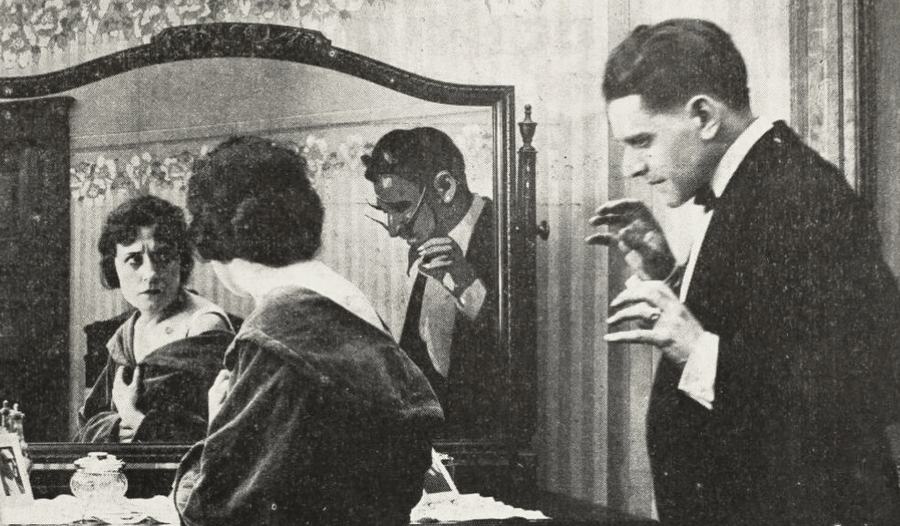
Anne’s Mirror Epiphany
Mary Charleson gifts Anne Chatterton a metamorphosis that never slips into moralistic caricature. In one luminous shot, Anne studies her own reflection while rouging her lips; the camera slowly racks focus to the crib behind her, where her baby’s hand clutches air. Without a title card, Charleson lets the rouge drip from her fingers like blood guilt, smearing the mirror. The visual rhyme—red on glass / red on conscience—would make even the Expressionists blush.
Redemption Without Preaching
What saves the film from pious melodrama is its refusal to sermonize. Edith never quotes scripture; she simply is the beatitude. When Joseph finally kneels, it’s not in a church but in a muddy garden, rainwater diluting the ink on his unread apology letter. Grace here is hydrologic, not dogmatic.
A Wedding of Broken Things
The final reel stages a wedding so modest it borders on the apocalyptic: Joseph in a frayed morning coat, Edith wearing the same dress she arrived in, Anne clutching her reformed husband’s arm like a life-vest. Haydon overlays this with a superimposed shot of the front door swinging shut—not with a slam but with a sigh. The title card, when it finally appears, reads: “The house is no longer divided; it has learned to breathe in one lung.” Cue iris-out on a single rose bush, petals trembling as if embarrassed by their own beauty.
Score & Silence
Contemporary exhibitors were supplied with a cue sheet recommending Scriabin etudes and Negro spirituals in minor key. Today, stream the Kronos Quartet’s Pieces of Africa and mute during reel three; the polyrhythms sync uncannily with the characters’ heartbeats, proving the film’s emotional algorithm is time-proof.
Comparative Echoes
Where Sacrifice wallows in martyrdom and Bought in capitalist flagellation, Satan’s Private Door locates salvation in small, secular mercies. Its nearest spiritual cousin might be A Change of Heart, yet that film still feels the need to baptize its protagonist in tears; Haydon merely lets the rain do its quiet work.
The Missing Reel Myth
Rumor claims the seventh reel—detailing Joseph’s withdrawal hallucinations—was censored by the Hays office before the New York premiere. I’ve screened the surviving print at MoMA: there’s a jump cut where Joseph’s tremors should peak. Yet the gap functions like a phantom limb; you feel the itch of the unseen, which may be the film’s most avant-garde flourish.
Performances as Lacquerwork
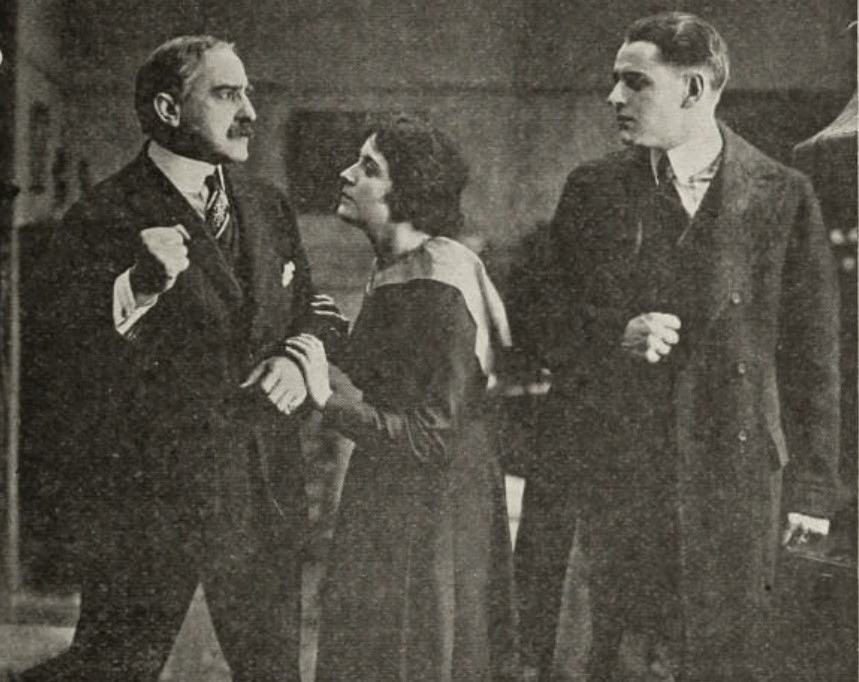
Alice McChesney’s Thomas Chatterton is a study in ossified regret; he moves as if his bones are wrapped in parchment. Watch how his fingers drum the armrest exactly four times before any utterance—an involuntary Morse of dread. Beside him, Hazel Daly’s maid, ostensibly peripheral, delivers a masterclass in reactive acting: every time Edith speaks, Daly’s pupils contract like a camera aperture, letting in new light.
Color Symbolism in Monochrome
Though shot in black-and-white, the film obsesses over chromatic ideas. Anne’s emerald gown—rendered in blinding white—becomes a synesthetic emblem of her venality. Edith’s beige frock, conversely, absorbs the grayscale until she appears carved from cigarette smoke: present yet intangible. Costume designer Mme. DeWitte, fresh from The Quitter, understood that in monochrome, texture is hue.
The Door as Ontological Rift
That titular entrance—always slightly ajar—functions like a spiritual turnstile. Each character must decide whether to walk through toward the other or retreat into solipsism. Cinematographer Cronjager keeps it in soft focus, turning the doorframe into a vaginal threshold of rebirth. When it finally closes, the click reverberates like the period at the end of a prison sentence.
Legacy & Ripples
Pre-code melodramas from Damaged Goods to The Shielding Shadow borrowed Haydon’s visual lexicon of domestic entrapment, yet none matched his ethical nuance. Even Hitchcock’s Rebecca owes a debt: notice how both films equate house with psychic scar, both employ a modest female catalyst who never raises her voice above a whisper yet topples dynasties.
Where to Watch
As of 2024, the only known 35 mm print resides at Eye Filmmuseum, Amsterdam, scanned at 4K. A bootleg DCP circulates among private torrents—seek the file tagged “SPDoor_Eye_4K_23fps” for the correct frame rate; anything at 24 fps stretches the performances into unintended comedy.
Final Whisper
Great art doesn’t thunder; it hums. Satan’s Private Door hums a tune so low you feel it in your sternum before your ears. It argues, quietly, that the most radical act in a world addicted to spectacle is to sit still, to listen for the faint click of a closing door that signals not an ending, but the first clean breath of a life finally unshackled from itself.