DbcultAccessing Vault...
Cult Review
Senior Film Conservator
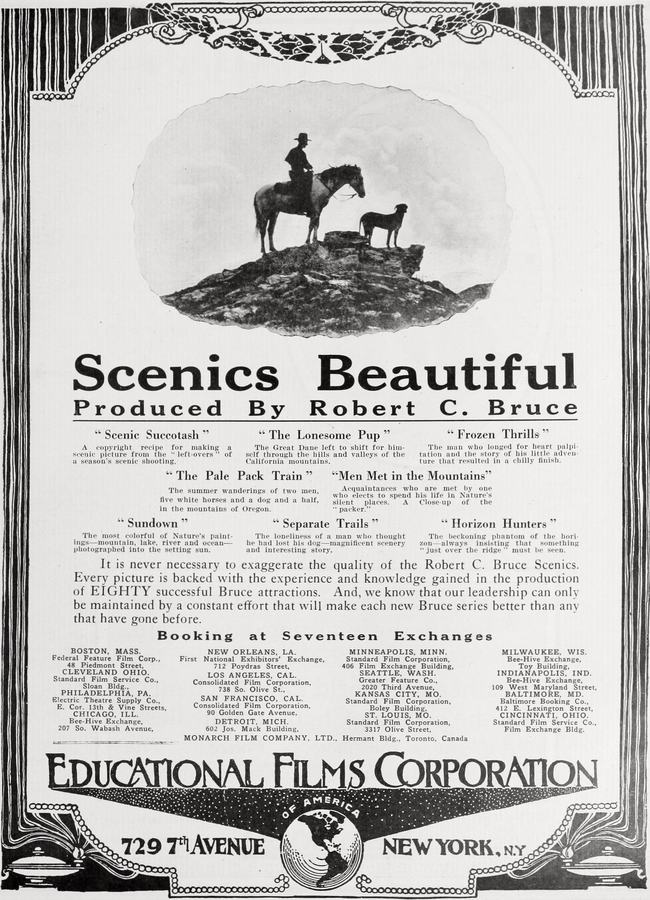
In the nascent years of the twentieth century, the cinematic medium was largely tethered to the proscenium arch, mimicking the theatricality of the stage. However, visionaries like Robert C. Bruce sought to liberate the camera from the stifling confines of the studio. Scenic Succotash stands as a monumental pivot point in this liberation. Unlike the character-driven intrigue of The Illustrious Prince, Bruce’s work discards the artifice of plot in favor of a raw, unmediated encounter with the environment. The film is a “succotash” in the most literal and metaphorical sense—a rich, hearty mixture of visual textures that nourish the viewer’s sense of wonder. It represents a departure from the sentimental tropes of Smiles, choosing instead to find emotional resonance in the stoic permanence of granite and the fluid grace of glacial runoff.
The technical constraints of 1914 were formidable, yet Bruce transformed these limitations into aesthetic virtues. Working with orthochromatic film stock, which was notoriously insensitive to red light, he managed to capture a breathtaking range of tonal values. The deep blues of the sky are rendered as ethereal whites, creating a high-contrast dreamscape that rivals the atmospheric tension found in The Unwelcome Wife. Every frame of Scenic Succotash is composed with the precision of a Hudson River School painting. Bruce utilizes the rule of thirds not as a rigid law, but as a gateway to balance, guiding the eye through dense foliage to the shimmering horizon. While narrative films like Mrs. Slacker relied on close-ups to convey intimacy, Bruce achieves a different kind of closeness through the wide shot, inviting the audience to inhabit the vastness of the American frontier.
It is tempting to categorize this film as a mere precursor to the modern documentary, but that would be a reductionist error. Scenic Succotash is an early exercise in visual phenomenology. It asks the viewer to see, rather than to look. In contrast to the frantic pacing of The Fixer, Bruce employs a meditative tempo. The camera lingers on the sway of a pine branch or the rhythmic pulse of a mountain stream, echoing the European sensibilities seen in Der Barbier von Flimersdorf, yet infused with an unmistakably American ruggedness. This film is a companion piece to Bruce’s later California Scrap Book, yet it possesses a raw, unpolished energy that feels more immediate and daring. Where The Good Bad-Man uses the landscape as a backdrop for heroism, Bruce makes the landscape the hero itself.
There is a silent narrative unfolding within Scenic Succotash—a story of geologic time versus human perception. Bruce’s editing, though primitive by contemporary standards, exhibits a sophisticated understanding of visual flow. He juxtaposes the stillness of a mountain lake with the chaotic energy of a canyon torrent, creating a dialectic of nature’s moods. This rhythmic editing is far more advanced than the static presentations found in His Only Chance. By carefully selecting his vantage points, Bruce creates a sense of depth and three-dimensionality that was rare for the era. He avoids the melodramatic shadows of Manden med Arret, opting instead for a clarity of light that feels almost spiritual. It is this clarity that separates his work from the urban grit of Madame Sphinx.
As both writer and cinematographer, Robert C. Bruce occupied a unique position in the industry. He was a nomad with a camera, a man who preferred the company of peaks to the bustle of the backlot. His singular vision is evident in every frame of Scenic Succotash. While his contemporaries were busy crafting the tropes of the Western in The Courageous Coward, Bruce was documenting the reality of the West before it was fully mythologized. His work lacks the cynical edge of Power or the youthful exuberance of Say! Young Fellow. Instead, there is a profound humility in his lens—a recognition that the camera is merely a witness to a grandeur it can never fully encompass. This humility is what gives the film its lasting power, making it a vital piece of cinematic history that deserves the same scholarly attention as Der fremde Fürst.
To watch Scenic Succotash today is to engage in a form of time travel. We are seeing a world that has largely vanished, captured through the eyes of a man who saw the beauty in the mundane. The film’s title, though whimsical, belies its serious artistic intent. Like the dish itself, the film is a collection of disparate elements that, when combined, create something greater than the sum of its parts. It is an essential document for anyone interested in the evolution of visual storytelling. It reminds us that before there were stars, there were mountains; before there were scripts, there was the wind; and before there was Hollywood, there was the tireless, wandering eye of Robert C. Bruce. This film is not just a relic; it is a living breathing testament to the enduring power of the natural world and the human desire to capture its fleeting essence on a strip of celluloid.
Final Verdict:
A seminal work of landscape cinematography that remains as visually arresting today as it was over a century ago. It is a masterclass in composition and a poignant reminder of the cinematic potential of the great outdoors.
IMDb —
1920
Community
Log in to comment.