DbcultAccessing Vault...
Cult Review
Senior Film Conservator
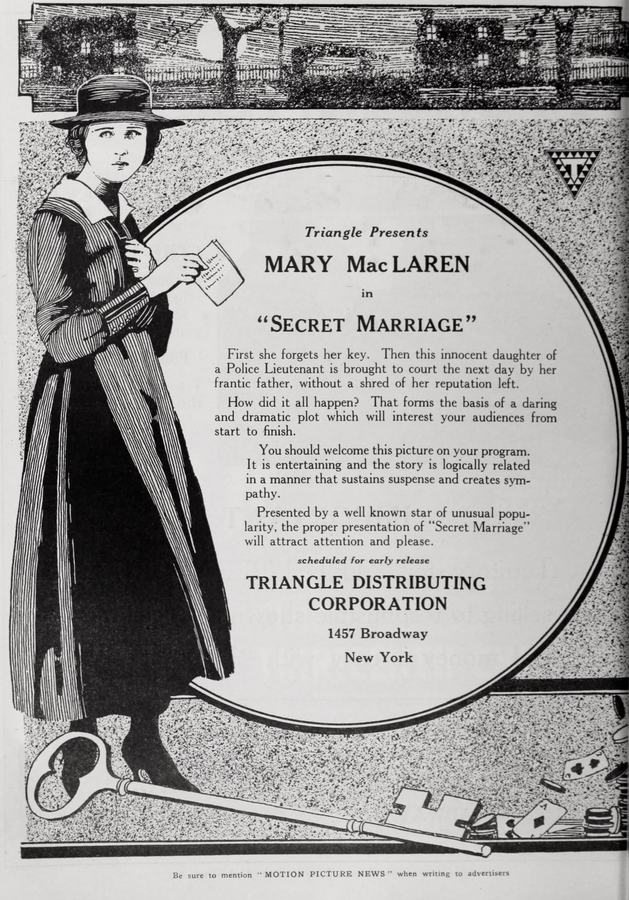
The silent cinema of the late 1910s often flirted with the boundaries of Victorian prudery and the burgeoning cynicism of the Jazz Age. In Secret Marriage (1919), we witness a quintessential example of this ideological friction. Mary MacLaren, an actress whose face possessed an ethereal yet grounded quality, navigates a screenplay that feels like a precursor to the film noir obsession with the 'wrong man'—or in this case, the 'wronged woman.' The film’s structure, utilizing the witness stand as a framing device, immediately elevates the stakes from a simple domestic drama to a judicial autopsy of a woman’s character.
The plot, penned by Richard Bennett, is a masterclass in the 'comedy of errors' transformed into a 'tragedy of circumstances.' We see Mary, the daughter of a police lieutenant, pressured by Helen, the captain's daughter, into environments that clash with her inherent caution. This social hierarchy—the daughter of the subordinate following the lead of the superior’s offspring—adds a layer of class-based pressure that is often overlooked in contemporary critiques. When Mary inadvertently consumes spiked punch, the film shifts its tone from light social maneuvering to a claustrophobic nightmare. The loss of her house key, hidden in a coat she generously loans to a friend, becomes the linchpin of her downfall. It is a narrative device that reminds one of the high-stakes moralism found in The Cheat (1915), though Secret Marriage trades in subtle social alienation rather than overt, shocking cruelty.
Mary MacLaren’s performance is the gravitational center of this production. Unlike the histrionics common in some of her contemporaries' work, MacLaren employs a restrained, almost somnambulistic intensity. On the witness stand, her eyes convey a profound exhaustion, a weariness of a soul that has been dissected by the public gaze. This performance style echoes the vulnerability she displayed in The Unattainable, yet here it is sharpened by the bitterness of the legal setting. She isn't just playing a victim; she is playing a woman who is forced to perform her own trauma for the benefit of a judgmental gallery.
The supporting cast, including B.W. Hopkinson and Frederick Vroom, provide a sturdy, if somewhat archetypal, framework for MacLaren to shine. Vroom, in particular, captures the agonizing conflict of the father who is both a protector and an agent of the state. The moment he discovers his daughter in a hotel room during a raid is a sequence of pure cinematic irony. It’s a collision of the private and the professional that feels as modern today as it did a century ago. This thematic exploration of the 'law vs. blood' is a recurring motif in the era, often seen in works like The District Attorney, yet rarely is it executed with such personal, agonizing intimacy.
Visually, the film utilizes the limited technology of 1919 to maximize atmospheric tension. The hotel raid, in particular, is shot with a kinetic energy that disrupts the previously static domestic scenes. The use of shadows—specifically the way they play across MacLaren’s face during her testimony—suggests a world that is not black and white, but a murky gray. This visual ambiguity mirrors the film's central conceit: that truth is often obscured by the superficiality of appearance. One might compare this visual gloom to the European sensibilities found in Nattliga toner or the psychological depth of Das Todesgeheimnis.
The 'spiked punch' sequence is handled with a delicate touch, avoiding the heavy-handed temperance propaganda that plagued many films of the time. Instead, it focuses on the psychological disorientation of the protagonist. Mary’s subsequent wandering through the night, locked out of her own home because of a misplaced key, serves as a powerful metaphor for her exclusion from the respectable society she once inhabited. The coat, which carries the key to her safety, is literally and figuratively out of reach, worn by another woman who is off celebrating a 'secret marriage' of her own. This juxtaposition—one woman’s joy leading directly to another’s ruin—is a biting critique of the interconnectedness of human fortune.
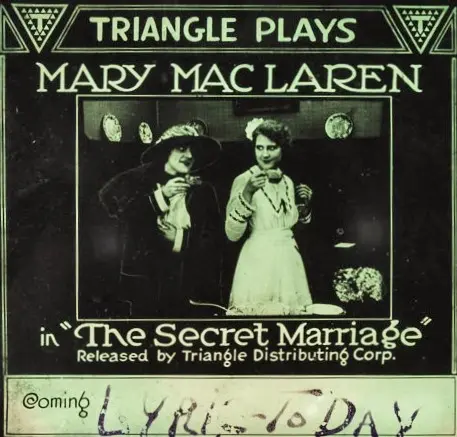
What makes Secret Marriage particularly compelling is its refusal to let the audience off the hook. We are positioned as jurors, watching Mary’s life be disassembled. The film asks us to consider the fragility of our own reputations. How many of us are one 'spiked punch' or one 'loaned coat' away from a similar catastrophe? This existential dread is what elevates the film above mere melodrama. It shares a thematic DNA with The Weakness of Man, yet focuses specifically on the feminine experience of social policing.
The resolution of the film, where Mary manages to 'unravel the chain of circumstantial evidence,' is less a triumphant victory and more a somber restoration. The damage, one feels, is already done. Even with her reputation legally cleared, the psychic scars of the witness stand and the betrayal by her peers remain. This nuance is what differentiates Richard Bennett’s writing from the more simplistic 'happily ever after' narratives of the period. There is a lingering sense of melancholy that persists even as the credits roll, a feeling that the world Mary returns to is still the same one that was so quick to condemn her.
In the broader context of 1919 cinema, Secret Marriage stands as a precursor to the more complex social dramas of the 1920s. It lacks the pastoral simplicity of The Little Shepherd of Bargain Row or the sweeping romanticism of María. Instead, it resides in the gritty, uncomfortable space of the urban legal system and the domestic sphere. It is a film that demands attention, not through spectacle, but through its relentless focus on the human cost of social conformity.
To watch Secret Marriage today is to engage with a ghost of early Hollywood that still has much to say. The film’s exploration of peer pressure, the fallibility of the law, and the resilience of the individual is timeless. While some of its plot points might seem contrived to a modern viewer—the 'missing key' trope has certainly been overused in the century since—the emotional core remains potent. Mary MacLaren’s ability to communicate internal devastation through a single look is a reminder of why she was such a significant star for Universal during this era.
The film also serves as a fascinating companion piece to other works of the time that explored the 'frivolity' of the upper classes, such as The Secretary of Frivolous Affairs. However, where that film might find humor or light romance, Secret Marriage finds only the cold machinery of social judgment. It is a starker, more honest portrayal of the stakes involved for women of the era. Whether compared to the moral weight of Im Zeichen der Schuld or the adventurous spirit of The Victoria Cross, MacLaren’s vehicle remains uniquely focused on the domestic-legal intersection.
Ultimately, Secret Marriage is a testament to the power of silent storytelling. It doesn't need dialogue to explain the terror of a woman caught in a hotel raid, nor does it need a narrator to describe the shame of a daughter facing her father in a courtroom. The images speak with a clarity that transcends the decades. For those interested in the evolution of the social drama, or for fans of Mary MacLaren’s uniquely haunting screen presence, this film is an essential piece of the puzzle. It reminds us that while the laws may change and the social mores may shift, the struggle to maintain one's dignity in the face of overwhelming circumstance is a universal human experience. It is a film that, like The Mail Order Wife, examines the transactional nature of women's lives in the early century, but does so with a sharper, more critical edge. A truly remarkable, if harrowing, journey through the labyrinth of early 20th-century morality.
IMDb —
1920
Community
Log in to comment.