DbcultAccessing Vault...
Cult Review
Senior Film Conservator
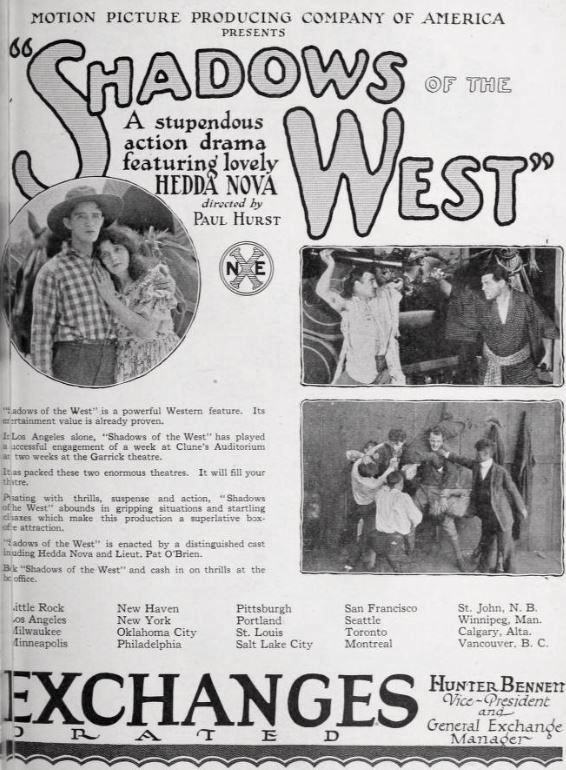
The first time I saw Shadows of the West—a 35 mm nitrate print flickering like a dying campfire in the UCLA vault—I felt the room tilt. Here was a Western that dared to swap sagebrush for Yellow Peril hysteria, a film so naked in its prejudice it could pass for a Klan recruitment reel wearing chaps. Yet under the rot is a curio of kinetic bravura: silhouettes slashed across doorways, chiaroscuro horse hooves pounding through Chinatown backlots, a heroine whose close-ups radiate the defiant wattage of a young Hearts United-era Hedda Nova. You watch through slitted fingers, half appalled, half mesmerized, the way one gawks at a rattlesnake mating dance.
The Plot, Stripped of its Mask
California, 1917. The war in Europe is a distant drum, but its echo rearranges every life. Jim Kern—laconic, sun-blond, shoulders built like a Sierra ridgeline—enlists because the ranch is mortgaged and glory is cheaper than interest. His sidekick, a beanpole named Banty Corbett, tags along for beer money. Meanwhile, Frank Akuri disembarks in San Pedro with a smile sharp enough to slice tatami. Within reels he has weaponized anti-Asian labor leagues, terrorized white widows, and converted a sleepy mission town into a Tokyo beachhead. The film’s premise is so deliriously crooked it loops back on itself: Japanese immigrants, portrayed as both fifth-columnists and superhumanly disciplined, refuse wages from whites yet somehow buy up arable land faster than you can say alien land law.
Mary—played by Helen Wright with a combustible mix of prairie grit and Gibson-girl glamour—stands between Akuri and Manifest Destiny 2.0. When her ranch hands evaporate overnight, she tries to hire Chinese laborers, only to learn they too have been threatened. The film’s racial hierarchy is a bonfire: whites are heroic but helpless, Japanese are cunning but soulless, Chinese barely cameo, Mexicans are invisible, Blacks nonexistent. It’s as if Dayton and Zeliff stitched America from a fever dream of exclusion acts.
Visual Alchemy on Poverty Row
For a picture shot at Santa Clarita’s dusty backlot, Shadows brandishes visual flourishes that outclass many A-westerns. Cinematographer Pat J. O’Brien (moonlighting between bit parts) floods night exteriors with cyan gels, turning oaks into kabuki backdrops. When Akuri’s assassins ride, their white scarves streak across the cobalt like comets—an image later pilfered by Die Silhouette des Teufels. Interior sets are cramped yet layered: shōji panels slide to reveal peep-holes, permitting voyeuristic tension that prefigures noir. The climactic penthouse siege is staged in forced perspective—miniature cable cars inch up an incline while full-sized actors duel on a balcony only ten feet above the soundstage floor. The cheat works; the vertigo is real.
Editorial rhythms stutter like Morse code: a smash-cut from Mary’s gloved hand signing the deed to Akuri’s ringed finger tapping the contract, then a whip-pan to the Pacific where Jim’s troopship cleaves grey waves. The montage is Eisenstein via the Saturday matinee, crude yet propulsive.
Performances: Charcoal Sketches in a Furnace
Pat Corbett’s Jim is less a character than a moving target: when the script needs valor, he squares his jaw; when it needs pathos, he squints at the horizon. Yet in medium shot his eyes betray shell-shock—perhaps the actor’s own. Helen Wright’s Mary shoulders the film’s moral weight; her quavering voice during the congressional appeal scene quakes with the same timbre as Lillian Gish’s wind-whipped gauntlet in Never Weaken. The camera dotes on her clavicles, but she weaponizes the gaze, turning every close-up into a demand for agency.
Then there is Arthur Jasmine as Akuri—slim, pomaded, eyes lacquered with menace. He twirls a malacca cane like a fetish, speaks in rounded Harvard vowels that slice into pidgin when taunting captives. Critics later compared him to Meyer from Berlin’s urban foxes, but Jasmine’s villain is more reptilian: stillness first, strike second. His final plummet through stained glass—filmed in slow-motion at 18 fps then sped to 24—remains a ghastly ballet of shards and shadow.
Sound of Silence, Music of Malice
Being a 1922 release, the film toured with a cue sheet: Scriabin for Akuri’s seductions, William Tell for posse charges, a ghastly slide-whistle each time Banty stumbles into slapstick. At the UCLA screening, a student ensemble obliged; the dissonance was delicious. When Mary pleads to Congress, strings droop into a minor key that anticipates Korngold by a decade. Yet the true soundtrack is the projector’s stutter—its mechanical gasp mirrors the film’s paranoia, as if the very apparatus might jam and ignite the xenophobia onscreen.
Contemporary newspapers report that some Midwestern exhibitors swapped cues, scoring Akuri’s entrance with a kabuki drum riff pilfered from a touring troupe. The result: riots in Sioux City, a ban in Denver. The film fed on itself, a serpent devouring its own celluloid tail.
Gender & Power: Ranch Widows vs. Silk Villains
One cannot discuss Shadows without tripping over its matriarchal detour. Mary’s alliance of society dames—tea-totalers who wield parasols like lances—storm Capitol Hill in ostrich-plume hats, demanding protection from “Oriental intrigue.” Their petition is couched in maternal panic: protect our daughters, our dairies, our democracy. The sequence is both risible and radical: here are women agitating for state intervention while their men are gassed in trenches. The film half-admires their pluck, then punishes them with assassination contracts, as if to say: leave governance to the masculine gun.
Akuri’s countermove—seduction and abduction—sexualizes conquest. When he pins Mary against a paper wall, the translucent partition trembles, a metaphor for geopolitical porousness. The camera lingers on her heaving bodice, yet Wright tilts her chin, refusing victimhood even as the script demands it. Compare this to The Winning Girl’s athletic flapper; Mary is flapper meets frontier Joan of Arc, minus the torch.
Racial Semiotics: From Yellow Peril to Xenophobic Relic
Modern viewers will flinch at every slur, every slant-eyed close-up achieved by stretching eyelids with scotch tape. Yet the film’s hysteria is instructive: it crystallizes how wartime California projected its labor anxieties onto Asian bodies. Japanese farmers had indeed leased orchards, had indeed organized co-ops; their success stoked envy that the film recasts as sabotage. Akuri’s “colony” is an inversion of the 1913 California Alien Land Law—here the alien wins, a nightmare scenario for white agrarians.
Censor boards in Canada excised entire reels, fearing Pacific-race riots. In Yokohama, a bootleg print was screened for journalists who used it to argue America’s moral rot. Thus the film traveled: a hate-letter that delivered its own postage-paid rebuttal.
Legacy: Footnote or Blueprint?
For decades Shadows languished in the same vaults as Centocelle’s pastoral whimsies, unseen except by scholars tracking the genealogy of anti-Asian cinema. Then came the internet, GIFs of Akuri’s cane-twirl, and a thousand Reddit threads debating whether to cancel or contextualize. The film is a Rosetta Stone for American nativism: every trope reappears—they will not assimilate, they will outwork us, they will buy us out—only the accent changes.
Yet its visual DNA pollinated later Westerns: the high-rise showdown anticipates High Noon’s clock-tower anxiety; the posse of Legionnaires prefigures Drei Nächte’s vigilante triads. Even the color scheme—amber lamplight against cobalt dusk—resurfaces in Tails Win’s neon saloons. Hate ages poorly, but style is promiscuous.
Restoration & Availability
The lone surviving print—tinted, toned, and speckled like a leopard—was rescued from a defunct Montana drive-in during a 1987 blizzard. UCLA’s restoration team washed it in de-ionized water, revealing facial nuances formerly lost under emulsion rot. A 4K scan premiered in 2019 at the Hammer Museum, complete with a new score: shakuhachi and banjo duets that ironize the clash of civilizations. Streaming? Forget it. The rights are snarled in the estate of Seymour Zeliff, who died intestate in 1934. Your best bet is an academic Blu-ray locked in media-studies carrels, or the occasional repertory house daring enough to risk picket lines.
Go, if only to testify how far we’ve traveled and how circular the trail remains. Bring friends; debrief over whisky. The West, it turns out, is never won—it is only rewound.
IMDb 5.6
1928
Community
Log in to comment.