DbcultAccessing Vault...
Cult Review
Senior Film Conservator
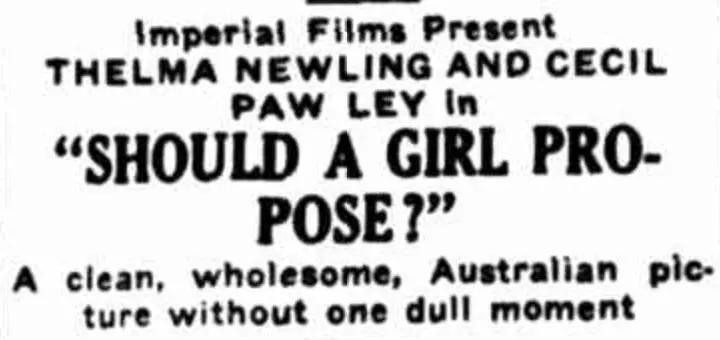
Short answer: Yes, but only if you view it through the lens of a social historian or a silent film enthusiast. Should a Girl Propose? is not a film for the casual viewer seeking thrills; it is a deliberate, often stiff exploration of 1920s Australian social mores that requires patience and a tolerance for the theatrical acting styles of the Ramster Photoplay School.
This film is for students of early cinema and those fascinated by the evolution of gender roles. It is definitively NOT for anyone who finds silent-era pacing frustrating or those who expect the technical polish of 1920s Hollywood productions like Behind the Front.
P.J. Ramster was a man of many hats, but his primary passion was his acting school. Should a Girl Propose? serves as both a narrative film and a showcase for his pupils, which explains both its charm and its amateurish edges. The film centers on a question that was legitimately scandalous in 1926: Can a woman take the lead in romance? In an era where the shadow of the Great War still loomed and gender ratios were skewed, this wasn't just a flight of fancy—it was a practical concern. The film handles this with a mix of light comedy and heavy-handed moralizing.
The film is slow. Painfully so. Unlike the kinetic energy found in Andy's Hat in the Ring, Ramster’s direction is static. He relies heavily on medium shots that feel like a filmed stage play. However, there is a certain honesty in this lack of artifice. When Thelma Newling’s character looks at the camera, there is a raw, unpolished quality that you don't see in the hyper-stylized performances of European imports like The Oath of Stephan Huller. It works. But it’s flawed.
Rex Simpson and Thelma Newling carry the weight of the film, and their chemistry is... functional. Simpson plays the traditional male lead with a stiffness that was common for the era, but he lacks the expressive range seen in contemporary stars. Newling, on the other hand, provides the film's only real spark. Her portrayal of a woman caught between her desires and the rigid social scripts of Sydney's upper class is the film's strongest asset. She doesn't have the ethereal grace of the lead in Miarka, the Child of the Bear, but she feels more like a real person you might have met in 1926.
The supporting cast, including Cecil Pawley and Jean Murray, are clearly students. There is a tendency toward over-gesticulation that feels dated even by the standards of the mid-20s. In scenes where group dynamics are at play—specifically the garden party sequence—the lack of professional timing is evident. Compared to the ensemble work in The Chauffeur, the performances here feel like they are being conducted by an invisible metronome. It is theatrical in the worst sense of the word, yet it provides a fascinating look at how acting was taught in Australia at the time.
Technically, Should a Girl Propose? is a mixed bag. The cinematography lacks the atmospheric depth of Il castello del diavolo, but it makes excellent use of local Sydney locations. There is a specific quality to the Australian sunlight that early film stock struggled to capture without blowing out the highlights. Ramster and his cameraman manage to find a balance, particularly in the outdoor scenes which feel far more alive than the cramped, poorly lit interior sets.
The pacing is where the film truly struggles. The intertitles are frequent and wordy, often explaining emotions that the actors should be showing. This creates a stop-and-start rhythm that prevents any real narrative momentum. It lacks the visual storytelling fluidness found in A Boy of Flanders. You find yourself waiting for the plot to move, only to be hit with another long title card explaining a minor social slight. It is a film that demands your attention but doesn't always reward it.
Should you spend your time on this silent Australian relic? If you are looking for entertainment that holds up to modern standards, the answer is no. However, if you are interested in the roots of Australian cinema and the social history of the 1920s, it is an essential watch. It provides a rare glimpse into the 'Marriage Question' from a non-Hollywood perspective, offering a localized view of a global shift in gender dynamics.
"Should a Girl Propose? is less a cinematic triumph and more a brave, if clunky, attempt to define Australian identity through the lens of social rebellion."
The film’s willingness to tackle a controversial social topic is commendable. In a landscape filled with simple westerns like Way of the West or jungle adventures like Bluebeard of the Jungle, a domestic drama about proposal etiquette is surprisingly bold. The location shooting in Sydney also provides a wonderful historical record of the city’s architecture and fashion. It captures the 'vibe' of the era better than many high-budget reconstructions.
The amateur nature of the production is impossible to ignore. The editing is jarring in places, and the narrative stakes feel incredibly low by modern standards. When compared to the visceral impact of The Field of Honor or the political weight of Velikiye dni Rossiiskoi revolutsii, Ramster’s film feels like a polite tea party. It lacks the universal emotional resonance found in Romeo and Juliet, opting instead for a very narrow, class-specific focus.
When we look at other films of the period, like the South African drama Moroka, we see a much stronger grasp of visual metaphor. Ramster, by contrast, is very literal. He doesn't trust the image to convey meaning. This is likely because he viewed film as an extension of the stage. Even modern films that deal with the weight of tradition, such as Birth, use silence and atmosphere to convey what Ramster tries to force through text. He wasn't a genius; he was a pragmatist. He wanted to give his students work and explore a topic that would sell tickets to the middle class.
Should a Girl Propose? is a fascinating failure. It fails as a piece of timeless entertainment but succeeds as a cultural artifact. It is a reminder that the questions we ask today about gender and initiative have been circulating for a century. The film is a clunky, earnest, and deeply Australian attempt to join a global conversation. It isn't a masterpiece, but it is a footprint in the sand of cinema history that shouldn't be washed away. Watch it for the history, stay for Thelma Newling, but keep your expectations firmly rooted in 1926.
IMDb 7.2
1932
Community
Log in to comment.