DbcultAccessing Vault...
Cult Review
Senior Film Conservator
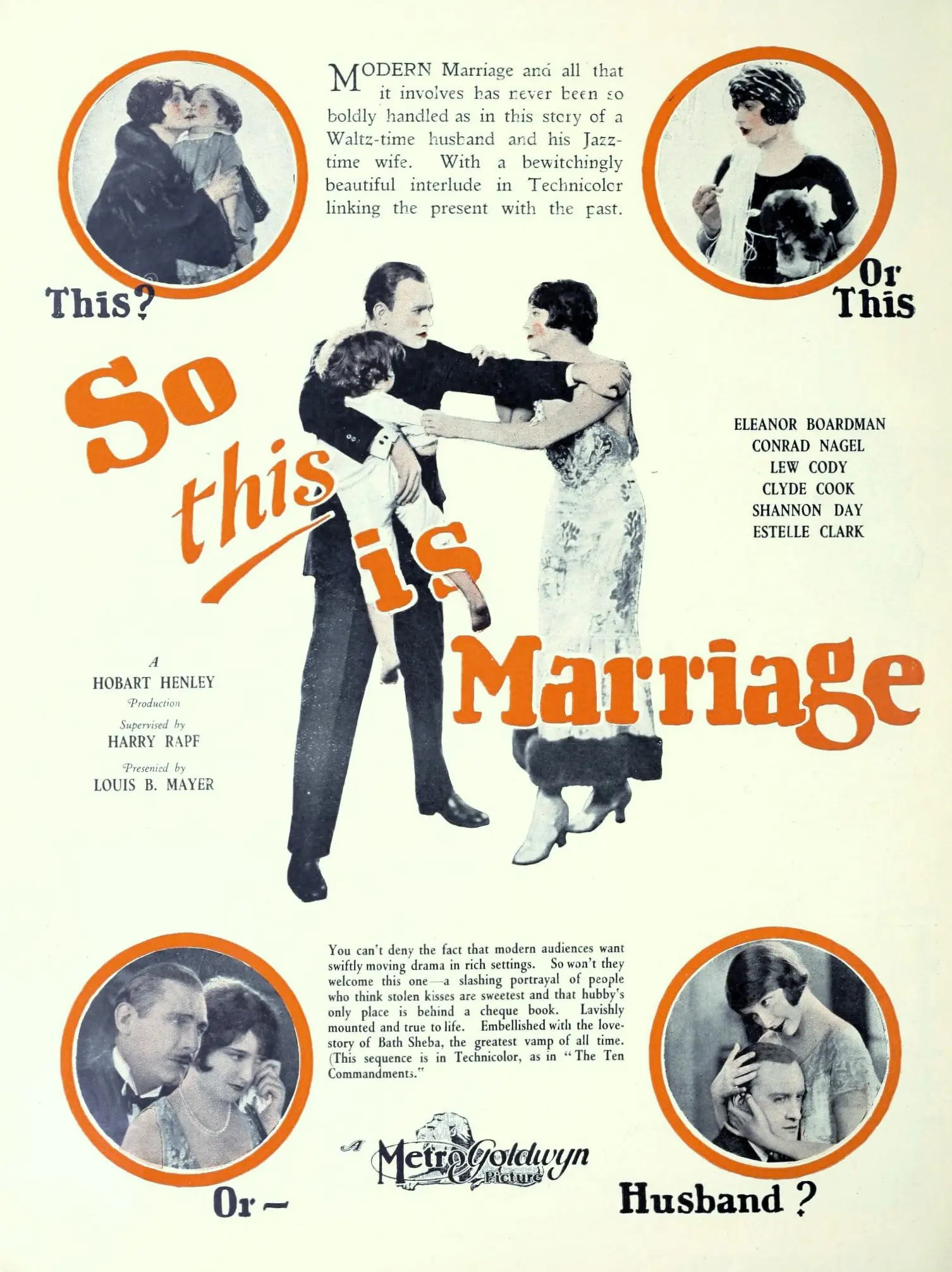
In the pantheon of 1920s domestic dramas, Hobart Henley’s So This Is Marriage? stands as a fascinating, multi-chromatic meditation on the fragility of the nuptial bond. Released in 1924, a year characterized by the burgeoning decadence of the Jazz Age, the film serves as a cautionary tale that eschews the typical flapper-era frivolity in favor of a dense, psychological exploration of resentment and reconciliation. It is a film that captures the exact moment when Victorian moralism began to collide with the nascent modernism of the twentieth century, creating a cinematic artifact that is as visually arresting as it is narratively complex.
The narrative centers on Beth and Peter Marsh, portrayed with remarkable nuance by Eleanor Boardman and Conrad Nagel. Unlike the idealized couples of earlier silent cinema, the Marshes are presented as deeply flawed, relatable inhabitants of a claustrophobic urban environment. Boardman, an actress of immense expressive range, imbues Beth with a restless energy that borders on the neurotic. Her Beth is not merely a spendthrift; she is a woman seeking agency in a world that defines her through her husband’s ledger. Conversely, Nagel’s Peter is a portrait of masculine anxiety, his domineering attitude a thin veil for the terror of financial insolvency. Their interactions are not the sweeping romances of Gypsy Love, but rather a series of sharp, jagged exchanges that mirror the reality of many long-term partnerships.
The tension between the couple is exacerbated by their differing philosophies on life. Beth’s extravagance is a rebellion against the mundanity of her existence, while Peter’s rigidity is his only weapon against the encroaching chaos of his career. This dynamic is handled with a sophistication that rivals the domestic critiques found in Gimme, where the financial underpinnings of marriage are laid bare. Henley utilizes the apartment setting as a pressure cooker, where every new bill and every social invitation becomes a catalyst for a potential explosion.
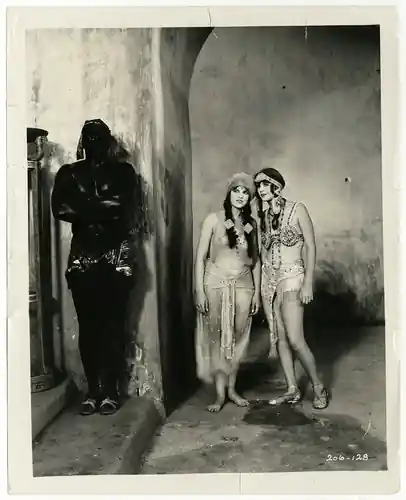
The equilibrium of this strained union is shattered by the arrival of Daniel Rankin, played with a predatory charm by Lew Cody. Rankin represents the 'other'—the man of leisure and means who exists outside the grind of Peter’s professional world. His introduction is a masterclass in silent film manipulation; by sabotaging Beth’s car, he creates a scenario of chivalry that is entirely manufactured. This deceit sets the tone for his character—a man who views the pursuit of Beth as a game of chess. Rankin’s attraction to Beth is not rooted in genuine affection but in the thrill of the conquest, a theme explored with varying degrees of intensity in films like The Fourth Musketeer.
Rankin’s invitation to the dance is the pivotal moment of the film’s second act. It is here that the power struggle between Peter and Beth reaches its zenith. Peter’s prohibition of the event is not born of a desire to protect his wife, but of a need to exert control over his dwindling domain. Beth’s decision to go with Rankin is an act of pure defiance, a declaration of independence that inadvertently places her in a position of extreme moral peril. The film brilliantly captures the seductive allure of the unknown, contrasting the drab, argumentative atmosphere of the Marsh home with the shimmering, ephemeral world of the dance hall.
The most striking element of So This Is Marriage? is undoubtedly the inclusion of a two-strip Technicolor sequence depicting the story of King David and Bathsheba. This was a common trope in silent cinema—using a historical or biblical parallel to reinforce a contemporary moral lesson—but here it is executed with a visual splendor that elevates the entire production. The transition from the monochrome reality of the 1920s to the saturated hues of ancient Israel serves as a psychological shock to the system, both for the audience and for Beth herself.
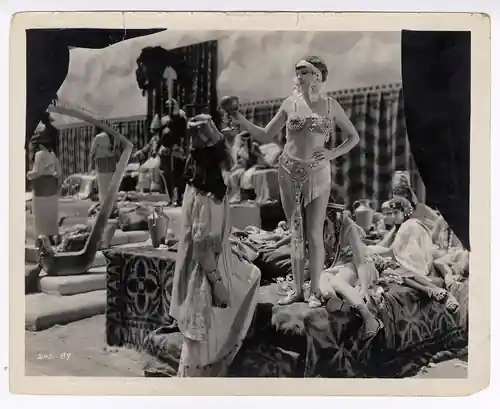
Rankin’s decision to read this story to Beth is the film’s most unexpected pivot. It transforms him from a potential home-wrecker into an accidental moralist. The tale of David’s illicit lust and the subsequent tragedy that befalls his house serves as a mirror for Beth’s own path. The visual storytelling in this sequence is breathtaking, utilizing the rich oranges and deep blues of early Technicolor to create a world of mythic weight. This sequence provides a stark contrast to the more grounded, realistic approach seen in The Greatest Question, where morality is often tied to the pastoral landscape rather than historical epic.
From a technical perspective, the film is a triumph of mid-20s studio production. The cinematography by John Arnold is fluid and expressive, utilizing shadows to emphasize the growing distance between the protagonists. The set design of the Marsh apartment is meticulously detailed, reflecting the clutter of their lives and the superficiality of their social aspirations. In contrast to the grandiosity of Marc'Antonio e Cleopatra, Henley keeps the scale intimate, ensuring that the emotional stakes remain personal even during the biblical diversion.
The editing is equally impressive, particularly in the cross-cutting between Beth’s evening with Rankin and Peter’s solitary brooding at home. This creates a rhythmic tension that builds toward their final, explosive confrontation. The film’s pacing is deliberate, allowing the audience to feel the slow erosion of the marriage before the sudden, dramatic climax. It lacks the frantic energy of Casey at the Bat, opting instead for a simmering intensity that is far more effective for its subject matter.
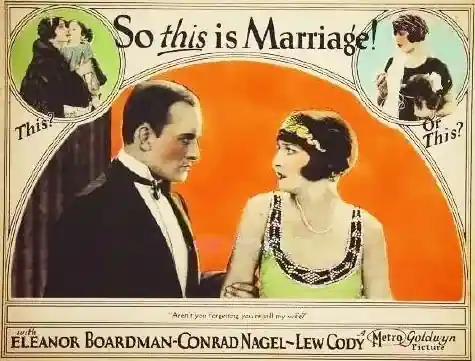
Eleanor Boardman’s performance is the undeniable heart of the film. She manages to make Beth sympathetic despite her frivolous nature, portraying her not as a villain, but as a woman lost in the expectations of her era. Her facial expressions during the David and Bathsheba sequence are particularly haunting, as she realizes the potential consequences of her choices. Boardman’s ability to convey complex internal monologues through subtle shifts in posture and gaze is a testament to her skill as a silent film thespian.
Conrad Nagel provides the perfect foil. His Peter is stiff, often unlikable, yet Nagel manages to inject a sense of vulnerability into the role. We see the fear in his eyes when he looks at the mounting bills, and the genuine pain when he realizes he is losing his wife. Their chemistry is intentionally abrasive, capturing the specific kind of intimacy that only exists between people who have spent years learning how to hurt one another. This realism sets the film apart from more melodramatic entries like Os Fidalgos da Casa Mourisca.
While the film’s conclusion—a tearful reconciliation and a return to the status quo—might seem conservative to modern audiences, it was a radical piece of social commentary for its time. It dared to suggest that marriage was not a fairy tale but a difficult, often grueling labor. The film’s didacticism is tempered by its genuine empathy for the characters’ struggles. It doesn't judge Beth for her desire for more; it merely warns her of the price of obtaining it through betrayal.
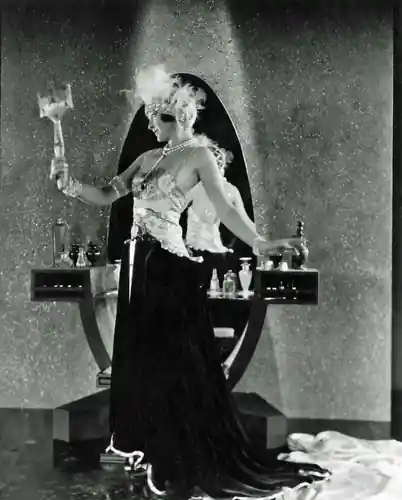
The inclusion of Rankin as the voice of reason is perhaps the film’s most subversive touch. By having the would-be adulterer be the one to uphold the sanctity of the marriage, Henley complicates the moral binary. It suggests that even those on the fringes of 'proper' society recognize the inherent value of the domestic unit. This complexity is reminiscent of the nuanced characterizations in Smiling Jim, where the lines between hero and antagonist are frequently blurred.
So This Is Marriage? is a film that deserves a prominent place in the discussion of silent era masterpieces. It is a work of significant aesthetic beauty and psychological depth, offering a window into the anxieties of a generation grappling with the rapid shifts of the 1920s. Whether viewed as a historical curiosity or a timeless exploration of human relationships, the film remains a powerful piece of cinema.
For those interested in the evolution of the domestic drama, this film is essential viewing. It bridges the gap between the moralistic shorts of the early 1910s, such as Britain's Bulwarks, No. 1, and the sophisticated 'talkie' dramas of the 1930s. It is a reminder that the struggles of the heart are universal and that the 'five-year itch' is a condition that transcends the boundaries of time and technology. In the end, the Marshes’ reconciliation is not a 'happily ever after,' but a 'happily for now,' a realistic and poignant conclusion to a remarkable film.
A cinematic journey through the labyrinth of the human heart, Henley’s work remains a vibrant, if tragic, tapestry of the silent era.
IMDb —
1928
Community
Log in to comment.