DbcultAccessing Vault...
Cult Review
Senior Film Conservator
The year 1916 stood as a pivotal juncture in the evolution of the moving image, particularly within the Scandinavian corridor where Nordisk Film was refining the grammar of visual storytelling. Spiritisten, directed during this era of aesthetic maturation, serves as a profound meditation on the fragility of the human condition when confronted with the absolute silence of death. While contemporary audiences might view the premise of a grieving widow seeking solace in a medium as a well-worn trope, one must contextualize this work within a world reeling from the industrial-scale slaughter of the Great War. The veil between life and death was perceived as perilously thin, and spiritualism was not merely a parlor game but a desperate social necessity.
Vibeke Krøyer delivers a performance of remarkable restraint as Mrs. Walken. In an era often criticized for the histrionics of pantomime, Krøyer utilizes her countenance as a canvas for the slow erosion of the self. Her grief is not a loud, boisterous thing; it is a quiet, rhythmic decay. When she encounters the advertisement for Dr. Kinley, her reaction is not one of sudden hope, but of a weary, logical surrender to the impossible. This nuance sets the film apart from more sensationalist fare of the period, such as the high-octane melodrama found in The Hazards of Helen, focusing instead on the internal landscape of the protagonist.
The cinematography by the uncredited masters of the Nordisk stable employs a chiaroscuro effect that predates the height of German Expressionism. The shadows in the Walken household are heavy, almost tactile, suggesting a house that has forgotten how to hold light. This visual language creates a sense of claustrophobia that mirrors the widow's mental state. Unlike the more sprawling investigative narratives seen in The Moonstone, Spiritisten keeps its gaze fixed on the domestic interior, turning the home into a psychological purgatory.
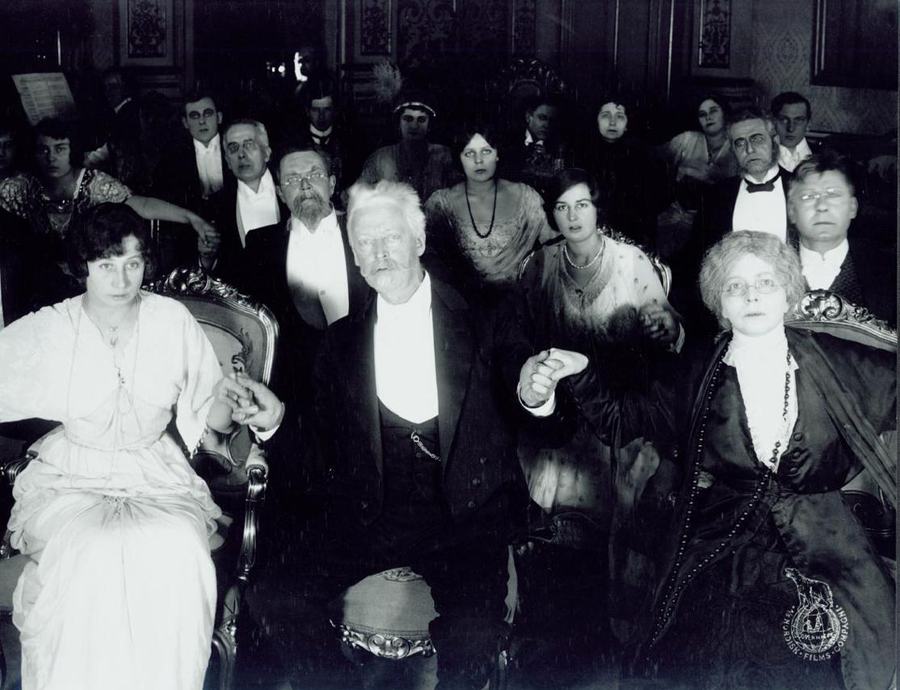
Frederik Jacobsen’s portrayal of Dr. Kinley is a masterclass in ambiguity. Is he a compassionate healer, a cynical opportunist, or a genuine conduit for the ethereal? Jacobsen plays the role with a sepulchral dignity that avoids the mustache-twirling villainy often found in early cinema. He provides a fascinating contrast to the characters found in The House of Mystery, where the enigmatic figures often lean into the overtly sinister. In Kinley, we see the archetype of the modern guru—a figure who thrives on the intersection of faith and vulnerability.
The supporting cast, featuring Robert Schyberg and Carl Alstrup, provides a grounded reality that prevents the film from floating away into pure abstraction. Alstrup, in particular, brings a groundedness that anchors the more fantastical elements of the plot. The social dynamics at play during the seance scenes are captured with a keen eye for class and etiquette, reminding us that even in the presence of the supernatural, the rigid structures of early 20th-century society remained unshaken. This attention to social realism is a hallmark of the era, comparable to the thematic depth explored in East Lynne.
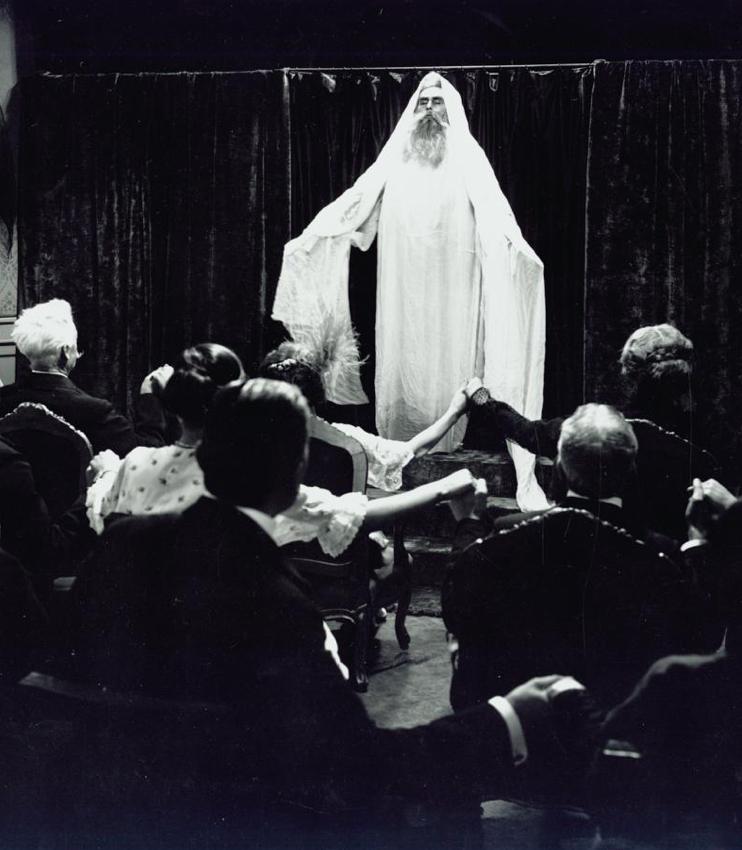
The centerpiece of the film—the seance itself—is a triumph of atmosphere over artifice. Rather than relying on the crude double exposures or stage tricks that characterized many early ghost stories, the director focuses on the reactions of the participants. We see the flickering candlelight reflected in wide, expectant eyes; we feel the tension in the joined hands around the table. It is a sequence that understands that the true horror, and the true wonder, of spiritualism lies in the *expectation* of the miracle, rather than the miracle itself. This psychological approach is far more sophisticated than the overt thrills of Le Cirque de la Mort.
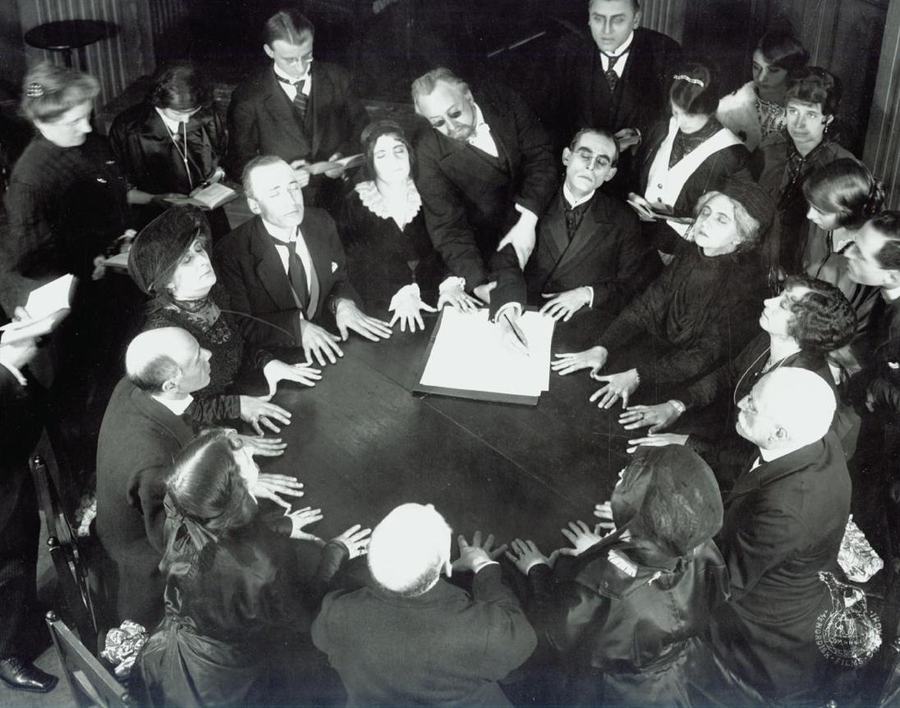
The film’s pacing is deliberate, almost liturgical. It does not rush toward a climax but instead allows the viewer to sit in the discomfort of Mrs. Walken’s longing. This slow-burn technique is reminiscent of the tension found in The Red Circle, though applied here to a much more intimate, emotional mystery. The script, while sparse in its intertitles, allows the visual composition to carry the weight of the subtext. We are witnessing the commodification of grief, a theme that remains uncomfortably relevant in our modern age of self-help and spiritual tourism.
When comparing Spiritisten to other contemporary works like The Ragged Princess or A Girl of Yesterday, one notices a distinct lack of sentimentality. While those films often resolve their conflicts through fortunate coincidences or moral triumphs, Spiritisten offers no such easy catharsis. It is a colder, more analytical look at the human heart. It shares more DNA with the sombre reflections of The Other's Sins, where the past acts as a relentless weight upon the present.
The film also touches upon the gendered nature of spiritualist practice. Mrs. Walken’s vulnerability is framed not as a weakness of character, but as a byproduct of a society that offers women few outlets for their agency or their sorrow. In this way, the film subtly critiques the patriarchal structures that leave a widow so isolated that her only recourse is the occult. This thematic layer adds a level of sophistication that elevates the work above a mere genre exercise like Little Jack or the romanticism of Bettina Loved a Soldier.
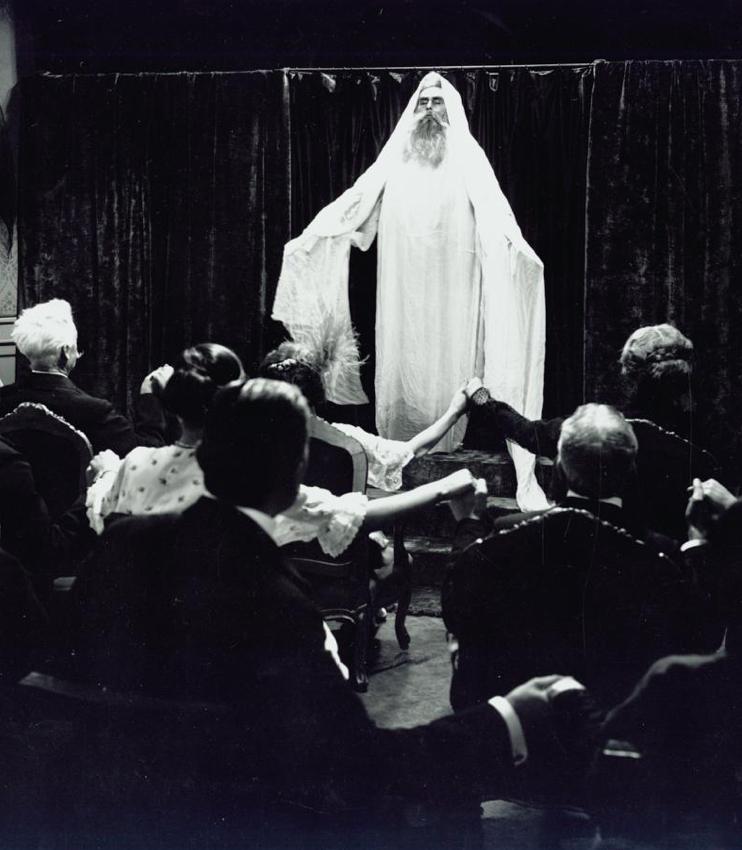
The use of mirrors and reflective surfaces throughout the film is particularly noteworthy. They serve as visual metaphors for the duality of the spiritualist experience—the reflection of the self and the perceived presence of the 'other.' These motifs are handled with a subtlety that rivals the visual storytelling in Her Shattered Idol. Every frame feels meticulously composed, from the arrangement of the mourning flowers to the specific angle of Dr. Kinley’s head as he enters a 'trance.'
Furthermore, the film’s exploration of faith and deception draws parallels to the moral complexities found in Liberty Hall and the rugged ethical dilemmas of When the Mountains Call. However, Spiritisten is unique in its focus on the *metaphysical* ethical dilemma. Is it a sin to give a grieving person a false hope if it prevents their total collapse? The film doesn't provide a didactic answer, choosing instead to leave the audience in the same state of uncertainty as its protagonist.
In the final analysis, Spiritisten is a hauntingly beautiful artifact of a bygone era that speaks with surprising clarity to the present. Its exploration of the intersection between technology (the newspaper, the camera) and the ancient human need for the supernatural creates a compelling tension. It avoids the procedural dryness of The Traffic Cop, opting instead for a poetic, almost ethereal flow.
The performances, particularly from Jacobsen and Krøyer, remain evocative over a century later. They bypass the barriers of time and language to deliver a story that is fundamentally about the universal experience of loss. To watch Spiritisten is to step into a world of velvet shadows and whispered hopes, a place where the boundaries of reality are as fluid as the flickering light of the projector. It remains an essential viewing for anyone interested in the psychological roots of cinema and the eternal dance between the living and the ghosts they refuse to release.
As the credits roll—or would have, in a modern context—one is left with the lingering image of Mrs. Walken’s face, a haunting reminder that the most profound ghosts are not those summoned by mediums, but those we carry within the hollow spaces of our own hearts. This film is a testament to the power of silent cinema to capture the invisible, making it a cornerstone of early 20th-century artistic achievement.
IMDb 6.1
1936
Community
Log in to comment.