DbcultAccessing Vault...
Cult Review
Senior Film Conservator
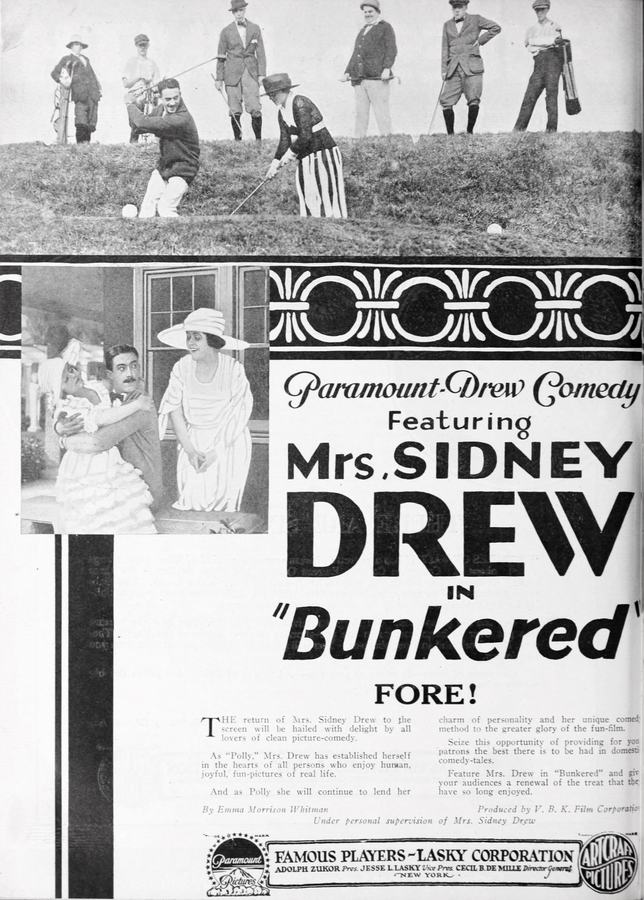
In the pantheon of silent cinema, few creative entities captured the granular frustrations of the middle-class household with the surgical precision of Mr. and Mrs. Sidney Drew. Their 1916 effort, Bunkered, stands as a quintessential artifact of this era, a period where the burgeoning medium of film began to pivot from slapstick spectacle toward the nuanced comedy of manners. Unlike the broad, kinetic energy found in contemporary works like The Janitor, the Drews specialized in a sort of polite anarchy. Bunkered is not merely a film about golf; it is a profound exploration of the 'separate spheres' doctrine that governed Edwardian social life, rendered through the lens of a sport that has long served as a bastion for male insecurity.
The film opens with a sequence that establishes Jimmie’s worldview as one of rigid compartmentalization. To Jimmie, the golf course is a secular cathedral, a space where the complexities of the domestic world are replaced by the binary logic of the hole and the hazard. This thematic preoccupation with male-only spaces is a recurring trope in early 20th-century narratives, often mirroring the anxieties found in The Girl Dodger, where the intrusion of the feminine into masculine enclaves creates a friction that is both comedic and existential. Jimmie’s disdain for women on the course is presented not as a personal quirk, but as a fundamental law of his universe.
When Polly introduces Angela, the film deftly employs a bait-and-switch. Angela is initially framed as the antithesis of the 'New Woman' who might demand entry into the clubhouse. Her lack of interest in golf is her primary virtue in Jimmie's eyes—a blank slate upon which he can project his ideal of a wife who remains safely anchored at home while he pursues his leisure. This dynamic creates a fascinating parallel to the marital tensions explored in Wife Number Two, though here the conflict is rooted in proximity rather than replacement.
The narrative pivot occurs during the honeymoon, a traditional site of romantic bliss that the Drews transform into a site of creeping horror. Angela’s decision to take up golf is presented as an act of extreme altruism. She believes that a successful marriage requires total synchronization of interests. This 'merging' of identities is a recurring nightmare in silent comedy, where the well-intentioned spouse becomes a parasitic shadow. The irony, of course, is that Jimmie’s love for Angela was predicated on her otherness—the fact that she represented a world apart from the bunkers and greens.
As Angela begins to accompany Jimmie, the visual language of the film shifts. The wide, expansive shots of the golf course, which previously suggested freedom, begin to feel claustrophobic. The presence of the spouse transforms the hobby into a chore. The film utilizes a series of medium shots to capture Jimmie’s deteriorating psyche as he watches Angela struggle with the mechanics of the game. It is a slow-motion car crash of social etiquette. We see the same kind of performative femininity gone wrong that characterizes Sylvia on a Spree, where the effort to conform to an ideal results in a grotesque distortion of the self.
One of the most striking aspects of Bunkered is its focus on the physical degradation of the female protagonist. In an era where the cinematic image of the woman was often one of porcelain perfection—as seen in the idealized frames of The Artist's Model—the Drews choose to highlight calloused hands and a peeling nose. This is a radical use of makeup and performance to underscore the narrative’s central irony. Angela’s attempt to be the 'perfect wife' literally destroys her beauty, which was the very thing Jimmie initially sought to protect and possess.
This physical toll serves as a visceral reminder of the labor involved in maintaining the facade of the domestic ideal. Angela’s suffering is self-inflicted, yet it is a direct response to the social pressure to 'be everything' to her husband. The peeling nose is not just a comedic prop; it is a symbol of the friction between the natural self and the performative spouse. It echoes the themes of sacrifice found in more dramatic works like The Slave, though here the 'slavery' is to a misguided sense of marital harmony.
Sidney Drew’s performance as Jimmie is a marvel of understated exasperation. He does not resort to the histrionics common in the 1910s; instead, he uses a repertoire of sighs, eye-rolls, and slumped shoulders to convey a man being slowly crushed by his own fortune. Mrs. Sidney Drew (Lucille McVey) is equally brilliant as Angela, playing the role with a wide-eyed sincerity that makes her character’s accidental cruelty all the more effective. Her Angela is not a villain, but a victim of her own earnestness, a trait that makes the film’s resolution both satisfying and melancholic.
The chemistry between the two is palpable, born from years of real-life partnership and professional collaboration. They understand the rhythm of the domestic argument better than almost any other duo of the time. While films like Bal gospoden might offer more grand, operatic emotions, the Drews find the profound in the mundane. Their work in Bunkered anticipates the sophisticated domestic comedies of the 1930s and 40s, laying the groundwork for the 'comedy of remarriage' and the battle of the sexes.
Technically, Bunkered is a testament to the efficiency of the Vitagraph style. The cinematography, though stationary by modern standards, makes excellent use of the natural light and the undulating topography of the golf course. The 'bunker' itself becomes a recurring visual motif—a pit of despair where the characters are literally and figuratively stuck. This use of landscape as a psychological mirror is something we see in more rugged settings like A White Wilderness, though here the stakes are social rather than survivalist.
The editing rhythm is dictated by the beats of the comedy. The cuts between Angela’s disastrous swings and Jimmie’s pained reactions are timed with the precision of a metronome. There is a specific sequence where Angela describes her 'progress' to Polly that utilizes intertitles not just for dialogue, but as a rhythmic counterpoint to the visual evidence of her physical decline. It is a sophisticated use of the medium that demonstrates how far film had come from the simplistic 'point-and-shoot' aesthetic of the previous decade.
The climax of the film, where Angela finally begs Jimmie to go golfing without her, is a moment of profound liberation for both characters. It is a rare instance in early cinema where the 'happy ending' is the restoration of distance rather than the achievement of closeness. The film suggests that the secret to a successful marriage is not total immersion, but the maintenance of individual sanctuaries. This conclusion is surprisingly modern, rejecting the Victorian ideal of the 'angel in the house' who shares every breath with her husband.
In this sense, Bunkered is a more progressive film than many of its contemporaries. While The Silent Lady might deal with the suppression of the female voice in a more literal sense, Bunkered explores the suppression of the self through the guise of devotion. It is a cautionary tale for any couple that believes a shared hobby is the foundation of a lasting union. The final shots of the film, with Jimmie returning to the course with a renewed sense of vigor, are not an indictment of Angela, but a celebration of the necessary boundaries that keep a personality intact.
Viewing Bunkered today requires an appreciation for the social context of 1916. The film was released at a time when the role of women in society was in a state of rapid flux. The 'golfing wife' was a figure of both ridicule and anxiety. By framing Angela’s foray into the sport as a failure, the film could be seen as conservative, yet by highlighting Jimmie’s misery when his wish for a 'devoted wife' is granted, the film subverts its own premise. It suggests that men who want a woman with 'no business on the golf course' should be careful what they wish for, as they might end up with a woman who makes their business her business.
When compared to the exoticism of L'écrin du rajah or the high drama of The Despoiler, Bunkered may seem slight. However, its longevity lies in its relatability. The 'golf widow' and the 'hunted husband' are archetypes that have persisted through a century of media. The Drews didn't just make a movie; they codified a genre of domestic observational humor that continues to thrive today. Whether one looks at the gritty realism of The Great Leap: Until Death Do Us Part or the adventurous spirit of The Romance of Tarzan, Bunkered remains a vital touchstone for understanding how early cinema navigated the complexities of the human heart through the simplicity of a game.
In the final analysis, Bunkered is a masterstroke of silent comedy that uses the verdant fairways of the golf course to map the treacherous terrain of the human heart. It is a film that understands that sometimes, the greatest hazard in a relationship isn't the distance between two people, but the lack of it.
IMDb —
1926
Community
Log in to comment.