DbcultAccessing Vault...
Cult Review
Senior Film Conservator
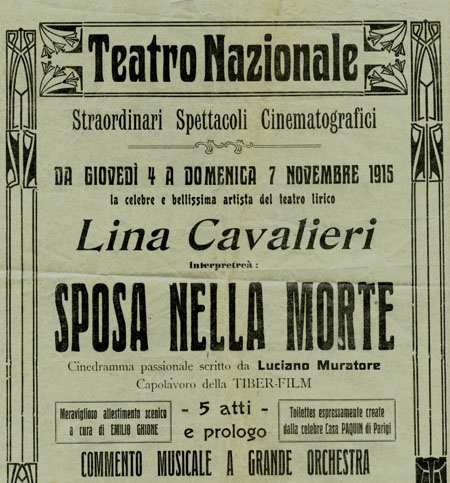
There are films that whisper through the annals of cinema history, and then there are those that sing with the operatic fervor of a bygone era, demanding to be heard anew. 'Sposa nella morte!' is unequivocally the latter. This silent Italian melodrama, a testament to the era's dramatic sensibilities and visual artistry, emerges from the shadows not merely as a historical artifact, but as a vibrant, emotionally charged experience that continues to resonate. Its title alone, 'Bride in Death!', portends a narrative steeped in tragedy and the ethereal, a promise it delivers upon with an almost breathtaking intensity. This isn't merely a tale of love lost; it's an exploration of societal strictures, the psychological torment of a soul entrapped, and the transcendent, perhaps even supernatural, power of an affection that defies mortality itself.
The film plunges us into a world where personal desires frequently collide with the unyielding demands of family honor and financial solvency. Our protagonist, Elena, embodied with a haunting grace by the incomparable Diomira Jacobini, is a figure of exquisite fragility and inner strength. Her heart, pure and untainted, belongs wholly to Marco (Alberto Collo), a young man of artistic temperament and passionate spirit, whose only failing, in the eyes of society, is his lack of worldly wealth. Their love story, however idyllic, is tragically short-circuited by the grim realities faced by Elena's aristocratic, yet financially beleaguered, family. The solution, as dictated by the cold calculus of the era, is a marriage of convenience – or rather, a marriage of necessity – to the formidable Count Valeriano (Alfonso Cassini). His age and stern demeanor are stark contrasts to Marco's youthful ardor, painting a stark picture of the sacrifice Elena is compelled to make.
The dramatic fulcrum of the narrative pivots on the devastating news of Marco's untimely demise, occurring with a cruel irony on the very precipice of Elena's forced wedding. This cataclysmic event transforms the impending nuptials from a reluctant duty into a grotesque charade. Elena, now a bride cloaked in mourning, walks down the aisle not towards a future with her beloved, but into a gilded cage, her spirit already interred with Marco. The film excels in portraying this psychological shift, where the physical act of marriage becomes a symbolic death for Elena's soul. She is, quite literally, a 'bride in death,' her vows uttered to a living man while her heart remains eternally tethered to the departed. This profound sense of loss and the subsequent psychological unraveling of Elena form the melancholic core of 'Sposa nella morte!', a theme that resonates deeply with the harrowing emotional journeys depicted in films like Chained to the Past, where characters are similarly shackled by indelible memories and unfulfilled destinies.
The power of 'Sposa nella morte!' is undeniably amplified by a cast that embodies the very essence of silent-era performance, where every gesture, every flicker of the eye, conveyed volumes. Diomira Jacobini, in particular, delivers a masterclass in emotional expression. Her portrayal of Elena is a delicate balance of vulnerability and an almost ethereal resilience. One can almost feel the weight of her sorrow, the suffocating pressure of her circumstances, and the nascent madness that begins to creep into her consciousness. Jacobini’s ability to convey profound inner turmoil without a single spoken word is simply mesmerizing, elevating Elena beyond a mere victim to a tragic heroine whose suffering is palpable. Her performance stands as a powerful testament to the 'diva' tradition of Italian cinema, where actresses commanded the screen with their sheer presence and dramatic prowess.
Alfonso Cassini's portrayal of Count Valeriano is equally compelling, albeit in a different register. He avoids the caricature of a mustache-twirling villain, instead crafting a character whose sternness hints at a certain tragic loneliness, a man who perhaps seeks companionship in a transactional world. His presence is imposing, a stark visual counterpoint to Jacobini's delicate frame, thereby amplifying the sense of imbalance in their forced union. Alberto Collo, as the doomed Marco, injects the early scenes with a youthful exuberance and passionate intensity that makes his eventual fate all the more heart-wrenching. His brief appearance leaves an indelible mark, ensuring that his memory, and Elena's devotion to it, feels entirely earned.
The ensemble cast further enriches the film's texture. Ida Carloni Talli, a stalwart of early Italian cinema, likely lends her gravitas to a supporting role, perhaps as a matriarch torn between affection and pragmatism. The luminous Lina Cavalieri, a famed opera singer and beauty icon, adds a layer of star power, her presence alone a visual feast, even if her role is a supporting one. It speaks to the film's ambition and production values that such a constellation of talent was assembled. Lucien Muratore, Luigi Scotto, and Angelo Bonfanti complete this intricate human tapestry, each contributing to the film's rich dramatic landscape, ensuring that even minor characters feel integral to the unfolding tragedy. The nuanced interplay between these performers creates a vibrant, breathing world, a feat particularly impressive given the technological constraints of the era.
'Sposa nella morte!' is a triumph of visual storytelling, a testament to the burgeoning artistry of silent film directors who understood that cinema’s true power lay in its ability to communicate through images. The direction, though uncredited in many historical records (a common oversight for early cinema, where collective effort often eclipsed individual recognition), is remarkably sophisticated. The film employs a rich visual lexicon, utilizing dramatic lighting, evocative set designs, and meticulously composed frames to convey mood and narrative. The contrast between the sun-drenched scenes of Elena and Marco’s courtship and the somber, almost gothic interiors of Count Valeriano’s estate is particularly striking, effectively mirroring Elena’s internal journey from light to shadow.
The cinematography is equally impressive, capturing the grandeur of the settings while also focusing intimately on the actors' faces, allowing their nuanced expressions to carry the emotional weight. Close-ups are employed judiciously, amplifying moments of despair, longing, or hallucinatory vision. The use of shadow and light, a hallmark of early cinema, is masterfully deployed to create an atmosphere of foreboding and psychological distress, particularly as Elena's grief deepens. One can draw parallels to the atmospheric depth found in films like The White Terror, which similarly leverages visual tension to underscore its dramatic stakes. The costumes, too, are not mere adornments but integral elements of characterization, from Elena's bridal gown, which transforms from a symbol of joy to one of sorrow, to the stark, formal attire of Count Valeriano, each detail meticulously crafted to enhance the narrative's emotional resonance.
Beyond its melodramatic surface, 'Sposa nella morte!' delves into profound thematic territory. At its heart, it is a searing critique of the societal pressures that often sacrificed individual happiness at the altar of familial reputation and financial stability. Elena’s plight is a poignant reflection of the limited agency afforded to women of her era, forced to navigate a labyrinth of expectations and obligations. This theme echoes the struggles seen in films such as The Traitress or The Lady Outlaw, where female protagonists often find themselves in conflict with established norms.
However, the film transcends mere social commentary by venturing into the psychological and possibly the supernatural. Elena's progressive descent into grief-fueled hallucinations, where Marco's spectral presence becomes increasingly vivid, blurs the line between the tangible and the ethereal. Is she merely succumbing to madness, or is Marco's spirit truly reaching out from beyond the veil? The film cleverly leaves this ambiguous, allowing the audience to grapple with the enduring power of love that defies even death. This exploration of the psychological toll of profound loss, and the potential for a spiritual connection that transcends physical boundaries, gives 'Sposa nella morte!' a depth that elevates it beyond a simple tearjerker.
The title itself, 'Bride in Death!', is a potent symbol. It speaks to Elena's ultimate devotion, her refusal to let go of Marco, even in the face of her forced reality. Her fidelity is not just to a memory, but to an idealized love that becomes more real to her than her present circumstances. This kind of unwavering, almost obsessive, devotion to a lost love is a recurring motif in tragic romances, finding echoes in narratives like The Last Dance, where characters are forever entwined with past passions. The film's conclusion, whether interpreted as a literal reunion in the afterlife or a final surrender to a beautiful delusion, offers a poignant, if heartbreaking, affirmation of love's eternal flame.
While the exact details of its original reception may be obscured by time, 'Sposa nella morte!' stands as a compelling example of early Italian cinema's capacity for grand narrative and profound emotional impact. It is a film that, despite its age, speaks to universal human experiences: love, loss, sacrifice, and the search for meaning in the face of overwhelming despair. For enthusiasts of silent film, particularly those drawn to the rich tapestry of Italian melodramas and the 'diva' films of the era, this picture offers a treasure trove of artistic and historical insight.
The absence of specific writers credited in many historical accounts is a common characteristic of early cinema, where stories often evolved through collaborative efforts on set, and star power frequently overshadowed the contributions of the nascent screenwriting profession. Yet, the coherence and emotional arc of 'Sposa nella morte!' suggest a strong guiding vision, whether from an uncredited author or the director themselves. Its intricate plot, its compelling characters, and its visually arresting presentation all contribute to a work that transcends its historical context, speaking to audiences across generations.
In an age of rapid cinematic evolution, 'Sposa nella morte!' reminds us of the foundational power of storytelling through pure visual and emotional expression. It's a film that deserves to be rediscovered, studied, and celebrated not just as a relic, but as a vibrant, living work of art that continues to move and provoke. Its haunting beauty, its tragic romance, and its profound exploration of the human heart ensure its place as a truly unforgettable cinematic experience. It is a testament to the enduring allure of narratives that dare to gaze into the abyss of sorrow and find, within its depths, the glimmer of an eternal, if tragic, love.
IMDb —
1917
Community
Log in to comment.