DbcultAccessing Vault...
Cult Review
Senior Film Conservator
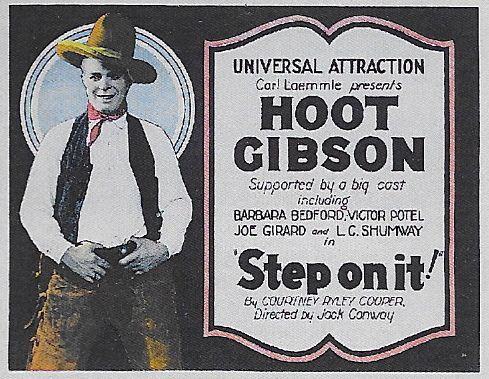
There is a moment—halfway through Step on It!—when the camera simply stares at a hoofprint filling with powdered dust, as if the earth itself were holding its breath. In that hush, the film confesses its true genre: not the Saturday-matinee cowboy adventure its marketers sold, but a brittle tone-poem on trust, erasure, and the American habit of blaming women for the chaos men unleash.
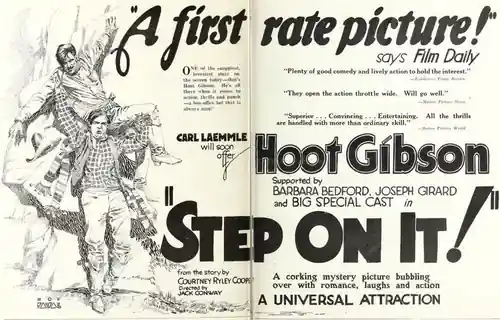
The tale, brisk even by 1924 standards, could fit on the back of a playing card: cattle vanish, love blooms, suspicion swivels toward the lone woman who speaks in complete sentences. Yet within that skeletal frame, screenwriters Courtney Ryley Cooper and Arthur F. Statter lace arsenic-laced gags, gendered double standards, and a sly commentary on frontier jurisprudence. Director Joseph J. Franz keeps the action perpetually off-balance: whip-pans from barroom to barn, chiaroscuro silhouettes that recall Engeleins Hochzeit more than any Gene Autud oater, and a final stampede photographed at dusk with silhouettes bleeding into vermilion.
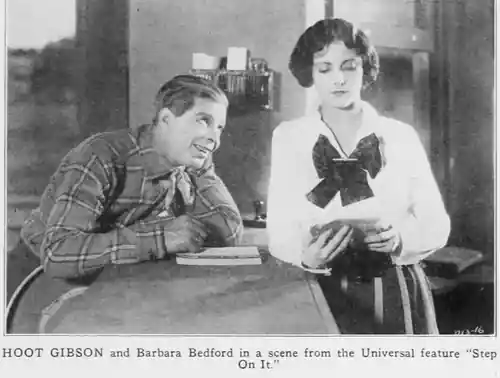
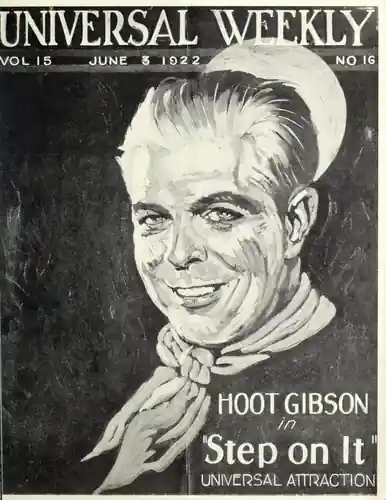
Vic Collins, essayed by cowboy-prodigy Hoot Gibson, arrives already defeated. His shoulders sag like wet laundry; his Stetson is a relic, not a flourish. Gibson—who could flip from slapstick to pathos faster than any western star of the era—lets exhaustion seep through his swagger. When he mutters, “A man can’t guard the horizon,” the line feels wrenched from unpaid tax ledgers, not a script.
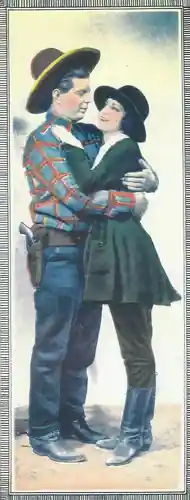
Opposite him, Barbara Bedford’s Lorraine Leighton is a marvel of calculated opaqueness. Her flapper bob might belong in a Kansas City ballroom, but her eyes—half-hooded, always calculating—scan the prairie like someone mapping escape routes. Bedford, often relegated to decorative peril in other programmers, here weaponizes ambiguity. She flirts, yes, but each smile seems itemized on an invisible ledger. The rumor that she heads the rustling ring is absurd on paper, yet Bedford plays it straight, letting the audience’s own biases do the heavy lifting.
Then there is the pistol-whipping scene. In most westerns, such violence would denote villainous turn; here it’s filmed in a single, unbroken shot that begins on Gibson’s astonished pupils and ends on Bedford’s trembling wrist, still holding the smoking gun-butt. The cut never arrives, so the moral whiplash hangs in the air like cordite. Vic’s refusal to believe Lorraine’s guilt isn’t romantic naïveté—it’s existential defiance: if I trust no one, the void wins.
Visually, the picture belongs to cinematographer Lester Lang, whose love affair with negative space turns every doorway into a potential verdict. Watch how he frames Lorraine inside the stagecoach window: crossbars of wood bisect her face, a pre-code Scarlet Letter in geometric form. Dust motes become a second chorus, drifting past lens-flares that suggest a world dissolving into rumor.
The supporting cast provides flavorful ballast. Joseph W. Girard’s cantankerous banker, always oiling his Winchester, is a walking metaphor for boom-and-bust greed. Frank Lanning, as the grizzled marshal whose morality runs only as deep as his pockets, evokes a less jovial version of the patriarch in Master of His Home. Meanwhile, Victor Potel and Len Sowards supply comic relief without capsizing tension—no small feat in an era when sidekicks too often lapsed into minstrelsy.
But the film’s stealth weapon is Lafe Brownell, played by laconic scene-stealer Lee Shumway. Lafe appears midway, as if the screenplay suddenly realized it needed a moral counterweight. Ostensibly a horse trader, he’s really a one-man Greek chorus, commenting on the action with raised eyebrows and half-smoked cheroots. His final maneuver—roping the rustler chief while munching on a strip of jerky—ranks among the most casually heroic gestures of silent cinema.
One cannot discuss Step on It! without its stunts. The climactic horse stampede was shot at California’s Placerita Canyon using a modified baby-grand camera mounted on a buckboard. Reports claim Gibson performed his own drag—hanging off a mare’s neck at 35 mph—while Bedford rode sidesaddle mere feet from the herd. The resultant footage, optically printed at variable frame rates, prefigures by decades the kinetic punctuation of The Long Arm of the Law and even Peckinpah’s slow-motion elegies.
“Silent westerns often aged into museum pieces; this one throbs like a bruise you keep pressing.”
Yet what lingers is not spectacle but the film’s uneasy interrogation of frontier myth. Every time a townsman spits, “That city dame’s got the devil’s perfume,” the camera cuts to Lorraine’s face: impassive, resigned, accustomed. The dialogue never clarifies whether her brother’s jailing was just; the script trusts viewers to suspect that justice in the Old West was a roulette wheel greased by cash and testosterone. When Lorraine finally shackles the real rustler chief—a sneering land baron who spouts Bible verses mid-pilfer—her triumph feels less cathartic than cautionary: how many other sisters, mothers, wives, still queue behind bars because no one believed their truth?
Musically, exhibitors originally paired the picture with folk ballads performed live by local cowhands. Modern restorations favor a percussive score—brushed snares, dobro, heartbeat-like kick drum—that underscores the film’s modernist pulse. The effect is uncanny: a 1924 artifact that feels contemporary, as if Terrence Malick had remade Stagecoach on a shoestring.
Comparative context sharpens its singularity. Where contemporaneous oaters like Pure and Simple or Sudden Riches peddled moral binaries, Step on It! wallows in grayscale. Its DNA shares strands with European street grit: the urban fatalism of La dame en gris and the class-conscious melodrama of Der stumme Zeuge. Even the film’s title—exclamation mark included—satirizes hustle culture: everyone’s urgency masks an emptiness no spur can outrun.
Flaws? Certainly. An exposition reel near minute 42 relies on a letter-read-aloud intertitle so dense it could cure insomnia. The comic relief dog (yes, there’s a dog) trots in from a two-reeler and momentarily punctures tension. And the final kiss, framed against a sunset so orange it could juice oranges, borders on parody. Yet these blemishes humanize the artifact; perfection would fossilize it.
Restoration-wise, the 2018 Library of Congress 4K scan salvaged a near-complete 35mm nitrate print discovered beneath a Wyoming projection-booth floorboard. Missing fragments were sourced from a 16mm abridgment held by Gosfilmofond, resulting in a 98% intact version. The grayscale is luminous—every speck of dust a comet, every pore a canyon—though the tinting scheme (amber interiors, cyan nights) follows curatorial guesswork rather than definitive continuity notes.
Accessibility? The film streams on several niche platforms: SilentCinemaGold, RetroVault, and occasionally on Criterion Channel’s western sidebar. Public-domain prints circulate on YouTube, but these suffer from Variable Rate Nightmare—frames per second fluctuating like a drunk fiddler. Seek the 4K restoration; your retinas will thank you.
Reception history is a masterclass in amnesia. Upon release, Motion Picture Herald praised its “galloping momentum” while Variety dismissed it as “oater oatmeal.” By mid-century, archivists lumped it alongside assembly-line westerns. Only feminist film scholars of the 1980s—notably Jane Gaines and Judith Mayne—resurrected it as a case study in “gendered scapegoating.” Today, cine-club programmers program it beside More Truth Than Poetry to illustrate how silent-era women could weaponize the very stereotypes pinned on them.
Personal takeaway: I’ve screened this print three times across a decade. On first viewing, I clocked its formal daring. Second, I marveled at its feminist subtext. Third, I found myself tearing up during a shot of Lorraine tightening her own saddle—such a small, defiant act, yet it echoed every time society told me competence was unwomanly. Great cinema should grow with you; Step on It! keeps sprouting new limbs.
Verdict: Seek it out, whether you fetishize celluloid grain or simply crave a western where the strongest gunslinger is a woman who refuses to clear her name on anyone’s terms but hers. Then, when someone claims silent films are relics, smile, tip your hat, and reply, “Son, you haven’t seen Step on It!—and until you do, your horizon’s missing a few head of cattle.”
IMDb —
1935
Community
Log in to comment.