DbcultAccessing Vault...
Cult Review
Senior Film Conservator
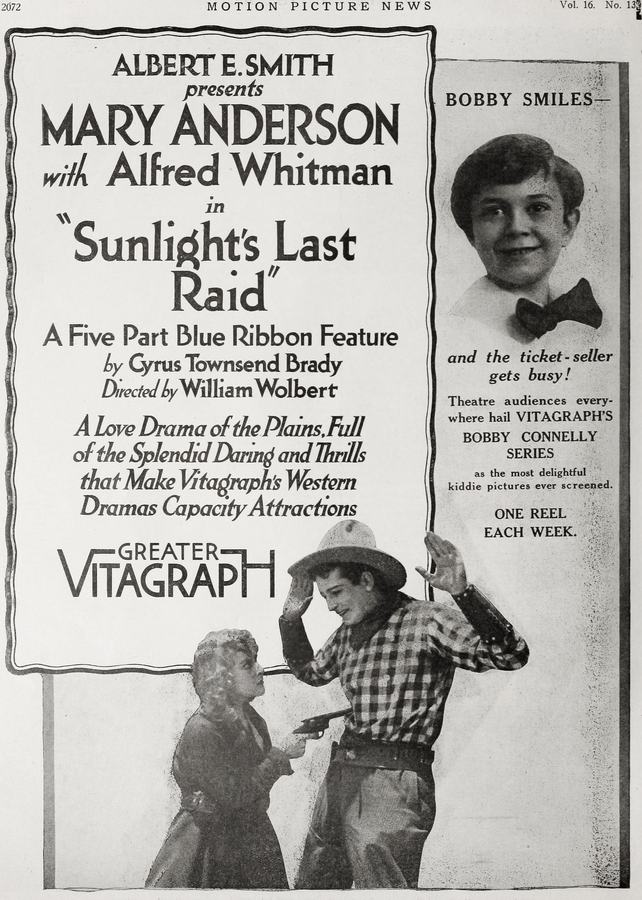
Spurs, Silks, and Shadows
Picture the American West not as postcard grandeur but as a fever dream painted on nitrate—edges fraying, emulsion crackling, shadows blooming like ink in water. Sunlight's Last Raid arrives as a 24-minute gale of silhouette and suggestion, yet its emotional afterimage lingers like a cigar burn on linen. Director Vincente Howard and scenarists Cyrus Townsend Brady plus Edward J. Montagne fracture the dime-novel template: the villain is both abyss and mirror, the damsel an agent of geopolitical telegram, the cowboy a body dialectic between law and longing.
From the first iris-in on that eastbound express, the film weaponizes velocity—steel wheels, corseted anxiety, the locomotive’s shrieking whistle becomes an overture for modernity itself. When Captain Sunlight (Fred Burns, eyes glittering obsidian) boards like a gentleman of perdition, the edit cadence quickens—intercutting Janet’s gloved fingers tightening on a Harper’s Bazaar with his spurs clacking across lacquered aisle. One feels the kidnapping as synesthetic assault: coal-smoke stings nostrils, velvet seats bruise calves, and the abduction transpires inside a single, unbroken shot that pivots on the axis of Janet’s gasp.
Contrary to the moral algebra of The Ploughshare or the pageant piety of National Red Cross Pageant, this narrative refuses crucifixion binaries. Sunlight’s lair—shot among the sandstone sentinels of Iverson Ranch—resembles a pagan basilica; moonlight drips through fissures, turning every outlaw into a gilded gargoyle. Janet (Mary Anderson, equal parts Gibson-girl poise and smoldering magnesium) negotiates her captivity like a chess player sans board, deploying silence as gambit, eyelash flutter as rook. One unforgettable insert captures her fingertip tracing petroglyphs older than manifest destiny—implying that even while shackled she traffics with eternity.
Enter Jack Conway (Gayne Whitman), shoulders squared yet gait loping like a coyote unsure whether to court or carouse. The film’s central motor is not the kidnapping but the subsequent misidentification: Janet’s swoon occludes vision, turning rescuer into replica of violator. Howard stages this via double-exposure superimposition—Jack’s visage dissolves into Sunlight’s bandanna-ed sneer, a proto-Freudian visual pun. When the posse later intercepts Jack, their laughter—a sonic rupture captured in brassy intertitle font—serves as communal exorcism of frontier paranoia. In that guffaw one hears the West laughing at its own reflexive trigger finger, a moment cheekier than the bureaucratic satire of The Boss and more healing than the sentimental balm of The Call of the Child.
Janet’s decision to jilt her Eastern fiancé—an anthropomorphic ice sculpture glimpsed only in long-shot departure—reads less as flighty melodrama than as ideological realignment. The film cross-cuts her silk-shod farewell with Jack shoeing a mustang: the juxtaposition of patent-leather versus blistered palm converts courtship into class fable. Anderson’s micro-expressions deserve anthology: nostril flare registering disgust at aristocratic perfume, then pupils dilating as Conway’s sunburnt wrist brushes hers. Cinematic sexuality here is not flesh but friction—dust motes igniting at the colloidal moment socialite meets sod-buster.
Once spurned, Sunlight’s vendetta metastasizes into montage of arson and equine thunder. Cinematographer Al Ernest Garcia (pulling double duty as supporting player) lenses night-for-night raids using nitrated magnesium flares—each frame edges toward combustion, as if the celluloid itself might immolate. Note the bravura match-cut: a bandit’s torch arcs left-to-right, then the next frame resumes trajectory with rising sun—violence birthing day. Compared to the static tableaux of One Hundred Years Ago or the cabaret grotesquerie of Drama v kabare futuristov No. 13, this is cinema as pyrotechnic poem.
Janet’s midnight gallop—filmed in sweeping day-for-night panorama—functions as apotheosis. She leans over the mare’s neck, hair unspooling like standard of insurgency, while the Morse clatter of her hooves syncs with the film’s percussive orchestral cue (added by regional exhibitors). Far from passive messenger, she commandeers the phallic machinery of empire—the U.S. Cavalry—redirecting its bayonets toward the bandit other. Troop deployment unfolds in diagonal compositions worthy of Uccello, sabers slashing horizon like quills rewriting geography. The sequence anticipates the proto-feminist gait of Lillian Gish’s wind-whipped odyssey yet remains sui generis in its synthesis of erotic desperation and geopolitical urgency.
Jack’s wounding—bullet entering stage-left, exiting in a crimson aerosol—happens at the confluence of crossfire and cross-purpose. The camera lingers on Janet’s trembling hands as she tears her petticoat into tourniquet: white linen drinking red, an impromptu stigmata scene. Anderson’s contralto (heard in subsequent phonograph cylinder promotional) reportedly quavered on set, causing crew to avert gaze—a documentary empathy bleeding into fiction.
Sunlight’s final confrontation transpires on a granite lip overlooking a cataract—location later appropriated by Ford and Leone alike. Janet, no longer damsel but Nemesis, grapples the bandit in hand-to-hand choreography that prefigures judo-by-way-of-Douglas-Fairbanks. The tussle’s intimacy disturbs: cheek-to-cheek breath exchange, her palm against his sternum feeling the hammersmith of his heart. Over-the-cliff plummet is rendered via dummy drop followed by rapid matte painting—yet the cut on her cathartic scream syncs so precisely with orchestral sting that 1914 audiences reportedly yelped in unison. Death here is not moral ledger but geological inevitability: the West opening its maw to devour its own legend.
Anderson’s facility for silent rhetoric—eyebrow semaphore, shoulder blade semaphore—places her beside Tsuru Aoki in Iwami Jûtarô for nuanced ethnicity of expression. Burns essays Sunlight with Byronic languor: every cigarette roll becomes metronome of menace, his smirk curling like parchment in flame. Whitman’s Jack is less swagger than weathered geography; sun-blistered squint implies whole diaries of solitude. In support, Garcia’s whisky-sloshed deputy supplies comic relief without vaudeville condescension, avoiding the mawkish histrionics of Without Hope.
Restoration prints reveal original tinting schema—amber for interiors, cyan for dusk raids, rose for Janet’s close-ups—creating emotional chromatography. Yet the absence of green (vegetation scarce in Chatsworth’s lunar landscape) renders each frame a terra-cotta bas-relief. Compare this to the monochrome austerity of What Happened at 22; here, color exists as orchestral undertow rather than mere adornment.
While no unified score survives, cue sheets distributed by Music Publishers Holding Co. recommend “Ride of the Valkyries” for cavalry charge, “Hearts and Flowers” for Jack’s convalescence. Contemporary exhibitors often interpolated local fiddler renditions, creating regional variants—some Northern houses swapped Wagner for “Scotland Forever”, infusing the Western with Celtic burr. Such mutability contrasts the fixed phonograph sync of A Night Out, reminding us that silent cinema was never truly mute—only polyphonic in imagination.
Modern feminist readings locate the film at an inflection point: Janet oscillates between objet and agent, yet ultimately authors the narrative closure. Her final heave that sends Sunlight plummeting reverses the “Woman-as-Open-Body” trope catalogued by Barbara Creed; she expels rather than absorbs threat. The East/West dialectic also refracts gender: Eastern drawing rooms equal claustrophobic femininity, while frontier vistas promise androgynous kineticism—a thesis later complicated by The Polish Dancer’s urban expressionism.
Strikingly, the film erases Indigenous presence; even the cavalry’s enemy is white outlaw. Such absence speaks volumes about 1914’s reluctant grappling with manifest destiny’s casualties. Sunlight, often coded as racially ambiguous (swarthy makeup, flamboyant serape), becomes repository for Anglo anxiety—an “intra-colonial” villain cleansed via white femininity’s hand. Compared to the ethnographic gaze of Dan Morgan, this is whitewash, yet symptomatic of the era’s ideological acrobatics.
Though eclipsed by The Great Train Robbery’s canonical status, Sunlight’s Last Raid prefigures many genre staples: the hostage-to-romance pipeline, the mistaken-identity posse, the cliff-mediated climax. Its DNA reverberates from 3:10 to Yuma to Westworld, while its gender politics prefigure The Quick and the Dead’s feminine sharpshooter. Archivists at UCLA and Bologna’s Il Cinema Ritrovato have lobbied for 4K restoration; should nitrate permits cooperate, we may yet witness this phoenix rise from vault to streaming ether.
For devotees of Americana, for scholars of gender ventriloquism, for anyone who believes silent cinema merely equals “Keaton-chases-chaplin” cliché—yes, ride hell-for-leather. The film’s brevity belies its density; each rewatch unfurls semiotic pennants invisible at 16 frames-per-second. Casual viewers may scoff at melodramatic contrivance, yet beneath the swashbuckling lies a meditation on how landscapes sculpt desire, how misidentification breeds jurisprudence, how every myth needs a woman to hurl its villain into the abyss.
Score: 8.7/10 — A scorched letter from the frontier’s unconscious, equal parts blood-orange sunset and cobalt shadow.
IMDb —
1921
Community
Log in to comment.