DbcultAccessing Vault...
5.4/10
Senior Film Conservator
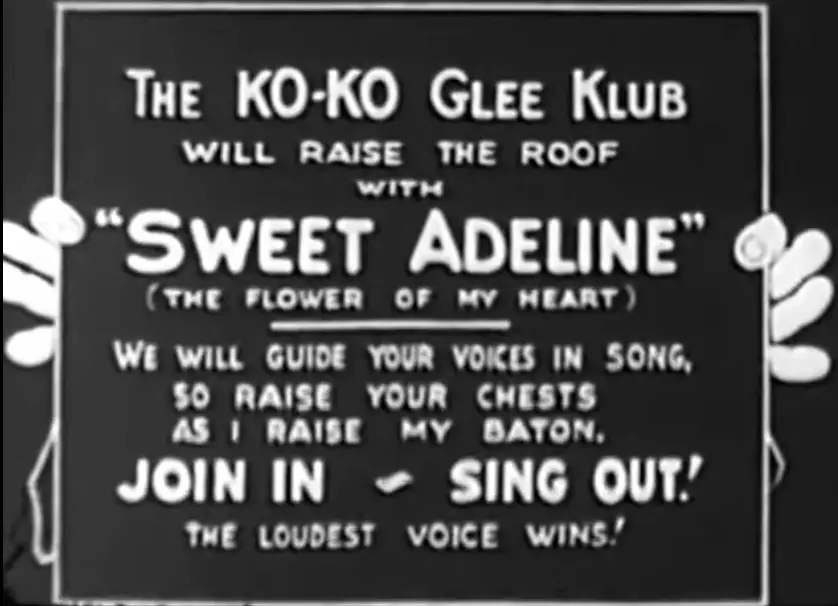
A definitive 5.4/10 rating for a film that redefined the boundaries of cult cinema. Sweet Adeline remains a cornerstone of transgressive art.
Should you devote three minutes of your life to a century-old bouncing ball? Short answer: Yes, but only if you care about the DNA of modern entertainment. This isn't a movie in the traditional sense; it is a blueprint for interactivity. For the casual viewer seeking a plot, this will feel like a screensaver. For the historian, it is a holy relic.
Sweet Adeline (1926) is for the animation nerd, the karaoke enthusiast, and the student of early sound-on-film technology. It is absolutely not for the person who needs a three-act structure or character development to stay awake.
1) This film works because it successfully bridges the gap between passive viewing and active participation through a simple visual cue.
2) This film fails because, outside of its technical novelty, it lacks the surrealist wit found in later Fleischer works.
3) You should watch it if you want to witness the exact moment the 'bouncing ball' changed how audiences interact with the screen.
Dave Fleischer wasn't just drawing; he was engineering. In 1926, the concept of sound-on-film was a terrifying frontier. While other studios were still struggling with the silence of films like The Waif, the Fleischers were collaborating with Lee de Forest to make the screen speak—or in this case, sing. The technical precision required to sync the 'bouncing ball' with the Phonofilm audio track cannot be overstated. It was a mechanical nightmare that yielded a seamless result.
In one specific moment, Ko-Ko the Clown gestures toward the lyrics with a fluidity that feels remarkably modern. This isn't the jittery, primitive movement often associated with the mid-20s. Instead, there is a rhythmic confidence here. Compare this to the more static presentation found in A Celebrated Case, and you see how the Fleischers were light-years ahead in terms of making the frame feel alive. They understood that sound wasn't just an add-on; it was an environment.
Ko-Ko is the anchor of this experiment. Unlike the heavy emotional lifting required in a film like Just a Woman, Ko-Ko’s job is purely functional. He is the master of ceremonies. His design in 'Sweet Adeline' is crisp, high-contrast, and perfectly suited for the low-fidelity projection systems of the era. He doesn't need to speak; his movements dictate the energy of the room.
There is a brutal simplicity to his presence. He pops out, sets the stage, and lets the 'Glee Club' take over. The Glee Club itself is a masterclass in repetitive, rhythmic animation. Each character bounces in a loop that mimics the cadence of the song. It’s a hypnotic effect that masks the technical limitations of the time. While a film like The Dream Cheater relied on atmosphere and shadows, Fleischer relied on the sheer joy of a synchronized beat.
We often think of interactive media as a product of the 21st century, but 'Sweet Adeline' proves that the desire to break the fourth wall is as old as the medium itself. The bouncing ball is, quite literally, the grandfather of the modern subtitle. It is a visual metronome. When you watch the ball land on the word 'Sweet,' there is a psychological trigger that compels the viewer to join in. It’s an early form of gamification.
Contrast this with the viewing experience of Faint Hearts or The Bigger Man, where the audience is expected to sit in reverent silence. Fleischer wanted a riot. He wanted a theater full of strangers singing in unison. This social aspect of the 'Song Car-Tune' series is what made it a staple of the cinema-going experience. It turned a dark room of individuals into a singular, vocal collective. It is a social prompt disguised as a cartoon.
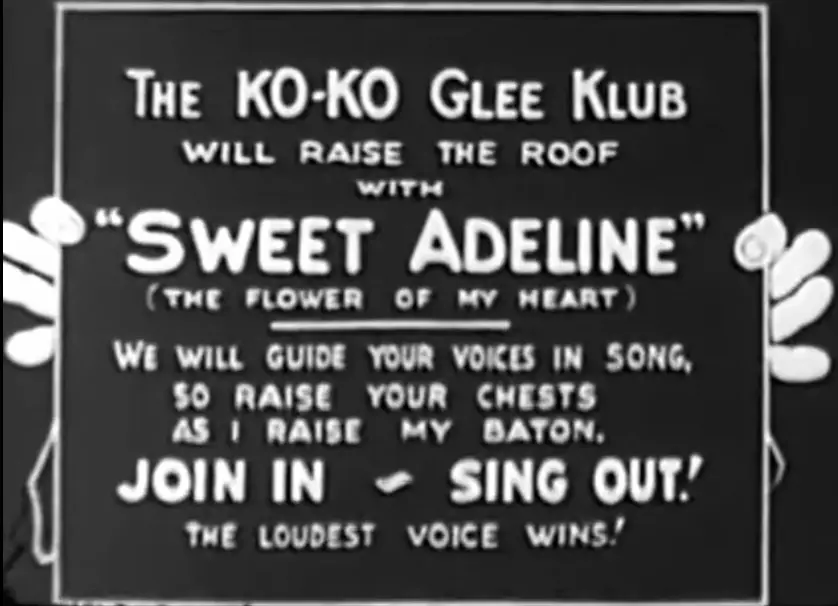
Yes, it is relevant because it represents the first successful attempt to synchronize music, animation, and audience participation. It is a short, sharp burst of history. You do not watch it for the story; you watch it to see the birth of a technique that is still used in every karaoke bar on the planet today. It is a three-minute window into the soul of the 1920s.
The pacing is, by necessity, dictated by the music. There is no room for the sprawling narratives found in La marcia nuziale. Instead, the film moves with a brisk, military-like precision. The tone is light, almost airy, which stands in stark contrast to the grit of A Debtor to the Law. It’s a palette cleanser.
The cinematography—if one can call it that in an animated short—focuses entirely on clarity. The background is a void, ensuring that nothing distracts from the lyrics or the ball. This minimalism is a choice. By stripping away the clutter seen in films like Hearts and Let Us, Fleischer directs the eye with total authority. It works. But it’s flawed. The lack of variety in the 'Glee Club' animation can feel repetitive even within a three-minute runtime.
Pros:
- Historically significant use of the Phonofilm process.
- Charming, iconic character design of Ko-Ko the Clown.
- Pioneered the interactive 'sing-along' format.
- Extremely efficient pacing.
Cons:
- Zero narrative substance.
- Visuals are secondary to the technical gimmick.
- The song itself is a dated relic of the barbershop era.
When you place 'Sweet Adeline' alongside its contemporaries, its uniqueness shines. While Off the Trolley was exploring slapstick comedy, and A Tale of the Far North was documenting the fringes of the world, 'Sweet Adeline' was exploring the relationship between the viewer and the screen. It was less interested in 'what' we were watching and more interested in 'how' we were watching it.
Even compared to later sound experiments like Film 19, there is a purity here. It isn't trying to be high art. It isn't trying to be a moral lesson like Saint, Devil and Woman. It is a machine designed to produce a specific result: a room full of people singing. In that sense, it is one of the most successful films ever made. It achieves 100% of its goal with zero waste.
Sweet Adeline (1926) is a fascinating artifact. It is the primitive ancestor of every lyric video on YouTube and every karaoke machine in Tokyo. It lacks the soul of a feature film like An American Widow or the visual spectacle of Sawdust, but it possesses a technical audacity that is infectious. It is a relic of a time when the cinema was a laboratory. It is short, punchy, and historically vital. It is a minor miracle of engineering. Watch it once to see where the ball started bouncing, and then you’ll likely never need to see it again.
IMDb —
1929
Community
Log in to comment.