DbcultAccessing Vault...
4.2/10
Senior Film Conservator
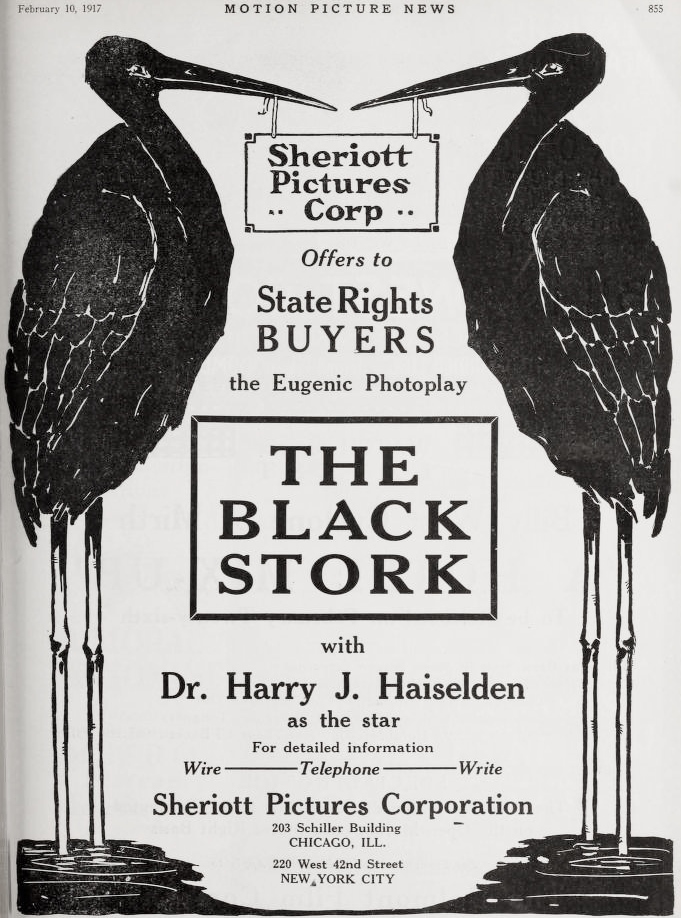
A definitive 4.2/10 rating for a film that redefined the boundaries of cult cinema. The Black Stork remains a cornerstone of transgressive art.
Stepping back into the nascent years of the 20th century, we confront films that often serve not just as entertainment, but as stark reflections of societal anxieties and prevailing intellectual currents. Among these, The Black Stork (1917) stands out, not merely for its cinematic qualities, but for its audacious, and frankly disturbing, embrace of eugenics. This is a film that demands dissection, not just appreciation, for it offers an unvarnished look into a chapter of human history many would prefer to forget, yet one that profoundly shaped public discourse and policy.
At its core, The Black Stork unfurls a narrative that is as straightforward as it is ethically complex. We are introduced to a young couple, their love blossoming, oblivious to the biological 'imperfections' that, according to the film's guiding philosophy, render their union ill-advised. Enter Dr. Harry J. Haiselden, a figure who, in a remarkable blurring of reality and fiction, plays himself. Haiselden, a real-life physician notorious for advocating for the non-treatment of 'defective' infants, assumes the role of a prophetic figure within the film. He warns the couple, with an almost chilling certainty, that their impending marriage is a recipe for genetic disaster, destined to produce offspring deemed 'defective.'
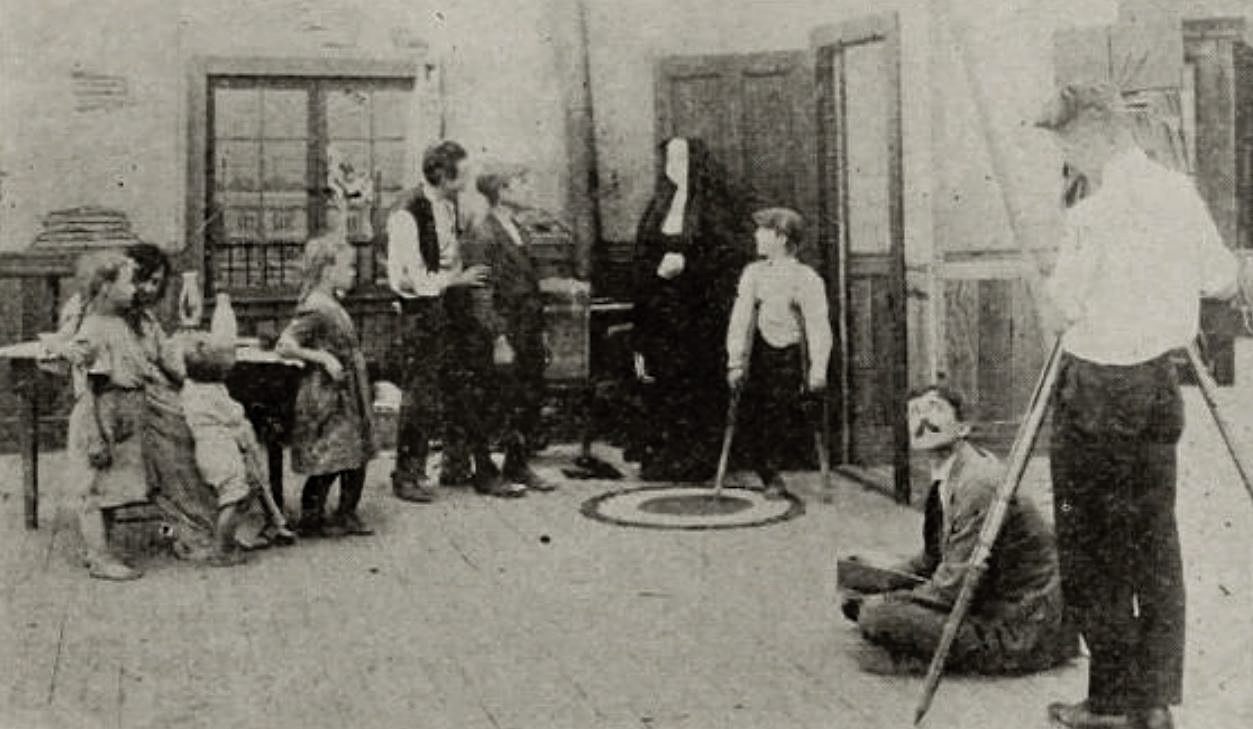
The film then proceeds to validate Haiselden's dire prognosis with a disturbing swiftness. The couple marries, and their baby is indeed born with severe congenital defects. The infant's life is tragically brief, a rapid decline leading to an untimely death. The cinematic resolution to this tragedy is perhaps the most unsettling aspect: the baby's spirit is depicted ascending to heaven, a visual metaphor intended to imply that its premature demise was not only merciful but, in some twisted sense, divinely sanctioned. This imagery serves to normalize, even sanctify, a eugenic viewpoint that would, in later decades, be recognized as profoundly unethical and dangerous.
The decision to cast Dr. Harry J. Haiselden as himself is a critical dimension of The Black Stork's historical significance and controversy. Haiselden was a medical practitioner who openly advocated for allowing 'defective' infants to die, famously letting the 'Boland baby' perish without surgical intervention in 1915. His actions ignited a firestorm of public debate, pitting medical ethics against the burgeoning eugenics movement. By appearing in the film, Haiselden transformed a fictional narrative into a potent piece of propaganda, lending the weight of his real-world notoriety to the film's message. This self-portrayal blurs the lines between documentary and drama, transforming the film into a direct address from a controversial public figure, urging audiences to consider his radical views. It’s a fascinating, albeit troubling, example of early celebrity endorsement influencing public opinion on a matter of profound ethical import.
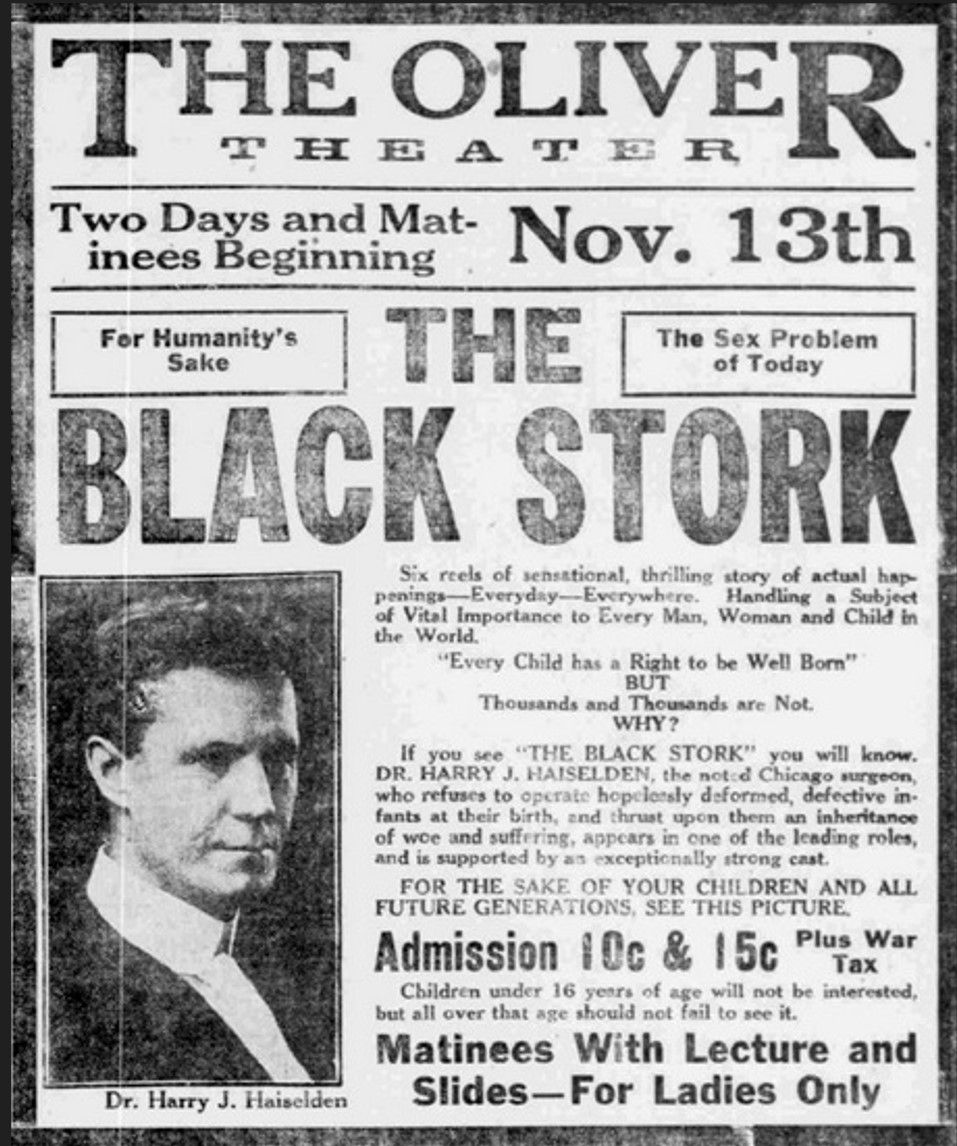
Given the film's overt propagandistic agenda, it is perhaps unfair to judge the performances of George Moss and Elsie Esmond, who portray the ill-fated couple, by conventional dramatic standards. Their roles are largely archetypal, serving to embody the tragic consequences of 'unwise' unions as dictated by eugenic principles. Moss and Esmond, alongside supporting players such as Edgar L. Davenport, Elsie Baker, Henry Bergman, and Bessie Wharton, deliver performances that are characteristic of the silent era: often broad, melodramatic, and designed to convey emotion through exaggerated gesture and facial expression. The emotional arc of their characters – from hopeful lovers to grieving parents – is designed to elicit sympathy, but ultimately, that sympathy is channeled towards accepting the film's eugenic conclusion.
The presence of other actors like Frances White, Jane Fearnley, Allan Murnane, Hamilton Revelle, and John Miltern further populates the world of the film, creating a tableau that feels both intimate and broadly societal. However, it is Haiselden's own performance that truly captivates, not for its artistic merit, but for its sheer audacity. He is not merely acting; he is proselytizing, using the cinematic medium to amplify his controversial medical philosophy. This makes his scenes particularly uncomfortable to watch today, as we grapple with the historical weight of his actions and beliefs.
The screenplay, penned by Jack Lait, is a masterclass in persuasive narrative, albeit one with a deeply problematic message. Lait crafts a story that is designed to be emotionally resonant, drawing viewers into the plight of the young couple before offering the eugenic solution as a logical, even compassionate, outcome. The plot progression is linear and direct, with minimal narrative detours, ensuring that the central message remains crystal clear. Lait's writing, while perhaps not celebrated for its literary finesse in the way a contemporary drama might be, is incredibly effective in its propagandistic intent. It skillfully frames Haiselden's warnings as wisdom, the baby's death as a release, and the ascent to heaven as a justification, all within a coherent, albeit morally skewed, framework. The film's impact lies not in subtle character development or intricate plotting, but in its blunt, unwavering advocacy for a particular ideology.
Visually, The Black Stork utilizes the cinematic language prevalent in the late 1910s. Expect intertitles to convey dialogue and exposition, dramatic close-ups to emphasize emotional states, and somewhat static camera work compared to later periods. Yet, within these constraints, the film manages to convey its message with striking clarity. The scene depicting the baby's ascent to heaven, likely achieved through simple special effects of the era, would have been particularly impactful for contemporary audiences, offering a spiritual veneer to a very secular and scientific (albeit pseudoscientific) argument. The visual storytelling, though rudimentary by today's standards, was powerful enough to sway public opinion in a time when cinema was rapidly becoming a dominant form of mass communication. It shows how early filmmakers understood the power of the moving image to shape perceptions, even on subjects as sensitive as human life and death.
To truly understand The Black Stork, one must place it firmly within its historical milieu. The early 20th century witnessed a widespread, and alarmingly popular, eugenics movement across the United States and Europe. Influenced by misinterpretations of Darwinian theory and a fear of 'racial degeneration,' eugenicists advocated for selective breeding to improve the human race. This involved encouraging reproduction among 'fit' individuals and, conversely, discouraging or preventing it among those deemed 'unfit' – often immigrants, the poor, the mentally ill, or people with disabilities. The film's message was not an outlier but rather a reflection of mainstream scientific and social thought of the time, endorsed by prominent academics, politicians, and even religious leaders. It's a sobering reminder of how easily scientific discourse can be co-opted for morally dubious ends.
This era also saw other films grappling with social issues, though perhaps none as directly and controversially as The Black Stork. For instance, films like Tess of the Storm Country (1914) explored themes of poverty and social injustice, often with a more sympathetic lens towards the marginalized. However, the explicit advocacy for a eugenic solution, as seen in The Black Stork, sets it apart from many of its contemporaries that might have addressed social problems without prescribing such a radical and ultimately harmful 'remedy.' While a film like The Man of Shame might delve into personal failings and societal judgment, The Black Stork ventures into the realm of biological determinism with unsettling confidence.
Today, The Black Stork serves as a powerful, albeit deeply uncomfortable, historical document. It forces us to confront the dark underbelly of early 20th-century progressivism and the horrific consequences that can arise when scientific authority is combined with social prejudice. The film is not merely a curiosity; it's a testament to the persuasive power of media and a stark warning about the dangers of dehumanization. Its message, once considered cutting-edge and enlightened, is now rightly condemned for its ethical bankruptcy and its contribution to a movement that led to forced sterilizations and, ultimately, influenced the atrocities of Nazi Germany.
Viewing The Black Stork today requires a critical lens, an understanding of its context, and a firm rejection of its core ideology. It is a film that challenges us to reflect on how far society has come in recognizing the inherent dignity of all human life, regardless of physical or mental ability. It also prompts us to remain vigilant against the resurgence of pseudoscientific ideas that seek to categorize and devalue individuals. This film, far from being a forgotten relic, remains a vital piece of cinematic history for its ability to provoke thought, spark discussion, and serve as a cautionary tale against the seductive, yet ultimately destructive, allure of eugenic thought.
Its existence reminds us that even art, in its various forms, can be weaponized for ideological purposes, and that critical engagement with media, both past and present, is an essential civic responsibility. While other films of the era, such as The Price or Five Nights, might explore personal dilemmas or romantic intrigues, The Black Stork delves into a societal dilemma with a proposed solution that chills to the bone. It is a film that, despite its age, continues to resonate with a haunting relevance, urging us to never forget the lessons of history.
IMDb 6.7
1936
Community
Log in to comment.