DbcultAccessing Vault...
Cult Review
Senior Film Conservator
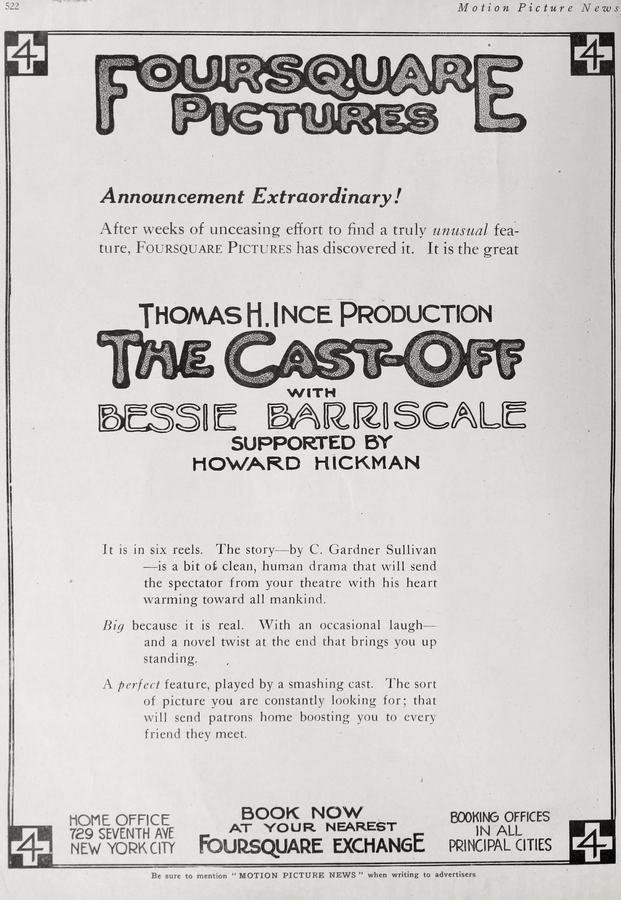
Aggie Herring’s face—angular, sorrow-bitten, capable of fracturing into a thousand silent screams—carries the entire moral freight of The Cast-Off. Under the direction of William Worthington, that face becomes a battlefield where vengeance and mercy hack at each other with bayonets made of light. From the first iris-in on her profile, framed against a fogged dressing-room mirror littered with yellowing clippings, we sense we are not in for a routine melodrama. We are, instead, witnessing a ghost story told by the living: a woman haunted by the echo of her own cancelled applause.
The narrative skeleton sounds almost too tidy—spurned actress contemplates revenge, spares target because of child—but the flesh hung upon those bones quivers with contradictions. C. Gardner Sullivan’s screenplay refuses the era’s standard binaries of vamp or virgin. Vera Lynde has already been both, exhausted both, and found both wanting. She prowls through rain-slick alleyways in a cloak the color of dried blood, but the film repeatedly juxtaposes that menace with flashbacks of her onstage as Juliet, mouth trembling under the weight of a love too large for the proscenium. The irony is razor-sharp: the same society that once swooned at her fictional devotion now jeers at her real-world fury, branding her hysterical, passé, expendable.
Jack Livingston’s Geoffrey Hale is no cardboard cad. He exudes the easy carnivorous charm of a man who has learned that ruthlessness is simply another form of choreography. Watch the way he practices his smile in a gilt mirror before a fundraiser, adjusting the curve by millimeters as if calculating compound interest. Yet even he is given a shard of humanity: a solitary scene where he reads a bedtime story to Christopher, voice hushed, eyes glossy with terror that the boy will one day hear the rumors. The film declines to forgive him, but it does grant him the dignity of self-recognition—an honesty Vera herself will only reach at great cost.
Howard Hickman’s cinematography turns Los Angeles into a Germanic dreamscape borrowed from the toolbox of Expressionism. Buildings lean inward like gossiping elders; streetlamps vomit cones of sulphuric light that barely dent the tar-black asphalt. When Vera stalks Hale’s limousine, the camera adopts her POV: the vehicle swells and shrinks with each panting breath, its chrome grille morphing into a metallic grin. These distortions feel organic, never gimmicky, because they mirror the protagonist’s pulse. Meanwhile, intertitles are used sparingly, often no more than haiku—"Tomorrow the curtain falls twice"—allowing the visuals to shoulder the emotional heft.
Child performances in silent cinema can be saccharine minefields, but Dorcas Matthews sidesteps the trap by underplaying. Christopher never cloyingly tugs at Vera’s hem; instead he offers her a cracked marble, a paper boat, a trusting hand—gifts that feel both accidental and sacramental. The moment that tilts the plot arrives wordlessly: the boy, having lost his nanny in a department-store crush, spots Vera across the toy aisle. Their gazes lock; a music box begins to play in the soundtrack of our imagination. Without cutting away, Herring’s face cycles through shock, recognition, and something akin to physical pain. She sees in his eyes not Hale’s DNA but her own forsaken innocence. The pistol in her purse becomes suddenly monstrous, a steel tumor she must excise.
Contemporary viewers might bristle at the gendered implication that motherhood—latent, surrogate, however you parse it—is the only force potent enough to defang a woman’s rage. Yet the film complicates that read. Vera’s choice is less maternal instinct than existential arithmetic: she realizes that murdering Hale would orphan Christopher in the same way the industry orphaned her. By refusing revenge, she breaks a cycle rather than fulfills a biologically scripted destiny. The final shot—Vera’s silhouette receding into a downpour as the marquee bulbs sputter out one by one—feels neither triumphant nor defeatist. It registers as the quietest of revolutions: a woman rewriting her own third act without studio notes.
Film historians often overlook The Cast-Off when charting the lineage of Hollywood revenge narratives, preferring to cite A Fool There Was or The Yaqui. That neglect is unjust. Where those films externalize revenge through exoticized seduction or guerrilla warfare, this picture internalizes it until the barrel of a gun becomes a mirror. Its DNA can be traced in everything from Stage Door’s toxic mentorships to the scalding self-interrogations of All About Eve. Even Pals First, though tonally lighter, borrows the motif of a personal vendetta dissolving in the solvent of unexpected empathy.
Aggie Herring never again received a role this multilayered; within five years she was relegated to copper-haired landladies and ill-fated aunts. One wonders what private disappointments she carried to those bit parts, whether she recognized in each minor character the ghost of Vera Lynde. Bessie Barriscale, playing Vera’s loyal dresser, delivers a curtailed but luminous performance, etching whole backstories with a single arched eyebrow. Margaret Thompson, as the vindictive columnist eager to fan every flame, supplies the chorus of public scorn without descending into caricature. Together these women form a triptych of early-1920s femininity: the outcast, the servant, the gatekeeper.
The restoration available on streaming platforms stems from a 2018 4K scan of a Czech nitrate print, and the upgrade is revelatory. The subtle gradations of Herring’s powder—once a washed-out grey—now shimmer like crushed pearls. Flickers of hand-tinted amber ignite the footlights during the flashback play-scene, reminding us that early audiences experienced color as punctuation, not ornament. The new score, composed by Serena Moreau for a nine-piece chamber ensemble, eschews nostalgic pastiche. Instead she employs prepared piano and bowed vibraphone to translate Vera’s interior monologue into sound. Listen for the moment when a detuned music box motif tries to resolve but collapses into dissonance; it is the sonic equivalent of a withheld bullet.
Comparative context sharpens the film’s edge. Released the same year as The Slave Market and Der Geheimsekretär, both of which trade in lurid excess, The Cast-Off opts for emotional minimalism. Even One Touch of Nature, though lauded for its pastoral restraint, ultimately capitulates to sentimental providence. Sullivan’s script, by contrast, offers no deus ex machina—only the hard-won recognition that the most formidable prison is the story we repeat about ourselves. In that sense the movie feels closer in spirit to A gyanú, another forgotten gem that interrogates the cost of suspicion.
Modern critics obsessed with the Bechdel Test may note that The Cast-Off technically passes: Vera and Bessie’s dresser discuss rehearsal schedules, not men. Yet the more radical intervention lies in its refusal to punish female ambition. Vera’s downfall is engineered not by her hunger for roles but by a studio system that treats actresses as perishables. The film indicts that apparatus without providing a safe haven; its happy ending is merely the absence of gunfire. One leaves the experience rattled, reminded that mercy can itself be a form of revenge—an act so unexpected it upstages the original crime.
So if your algorithm keeps steering you toward the same flapper comedies and dusty Westerns, hack a new path to The Cast-Off. Let its shadows pool in the corners of your 4K display; let Herring’s mute howl puncture the armor of your streaming fatigue. You will emerge raw, perhaps even grateful for the bruise. And should you later glimpse a child’s marble rolling across pavement, you might—like Vera—choose to pocket it instead of hurling it at the past. That, ultimately, is the quiet radicalism of this buried treasure: it transforms the architecture of revenge into a corridor of mirrors, then dares us to walk through unarmed.
IMDb —
1932
Community
Log in to comment.