DbcultAccessing Vault...
5/10
Senior Film Conservator
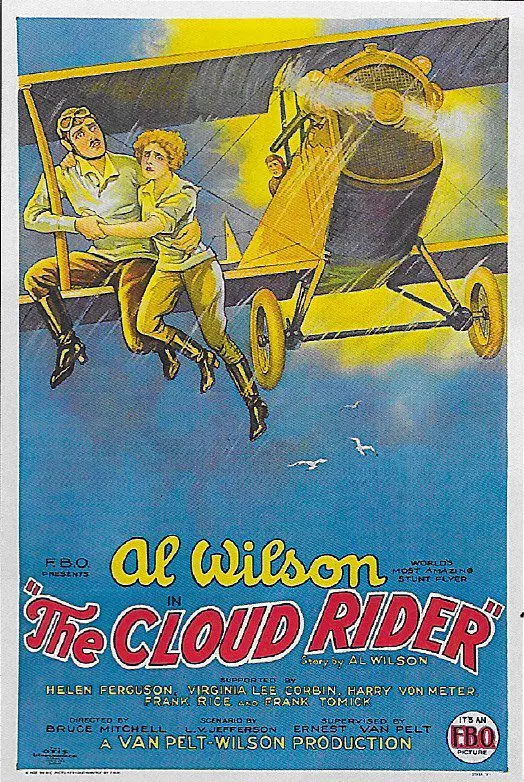
A definitive 5/10 rating for a film that redefined the boundaries of cult cinema. The Cloud Rider remains a cornerstone of transgressive art.
In the pantheon of silent-era celluloid, few genres captured the public’s thirst for adrenaline quite like the aviation melodrama. The Cloud Rider (1925) stands as a towering, if somewhat overlooked, monument to the days when stuntmen were the true kings of the silver screen. Directed with a frantic energy that mirrors the rattling vibrations of a biplane’s cockpit, the film serves as a visceral reminder that before CGI and green screens, cinema was a medium of genuine, life-threatening peril.
At the heart of this high-altitude opera is Al Wilson, a name that should be whispered with the same reverence as Buster Keaton when discussing physical bravery. Playing Bruce Torrence, an aviator-cum-Secret Service agent, Wilson isn't merely acting; he is performing a ballet of barnstorming that defies the very laws of physics. Unlike the more grounded dramas of the period, such as Youth to Youth, The Cloud Rider treats the sky not as a backdrop, but as a primary character—volatile, unforgiving, and endlessly cinematic.
The plot, while ostensibly a tale of narcotics smuggling and romantic rivalry, is really a scaffolding for some of the most audacious aerial photography ever captured on orthochromatic stock. When the villainous Juan Lascelles (played with a delicious, oily menace by Harry von Meter) sabotages Bruce’s plane by loosening a wheel, the stakes shift from the personal to the spectacular. The sequence where Zella Wingate (Helen Ferguson) takes the compromised vessel into the clouds is a masterclass in suspense. But it is Wilson’s response—strapping a spare wheel to his back and giving chase—that elevates the film into the realm of the legendary. The mid-air transfer, executed without the safety net of modern technology, remains one of the most harrowing sights in silent cinema, rivaling the mechanical ingenuity seen in A Petticoat Pilot.
While the stunts provide the visceral thrills, the narrative layers of The Cloud Rider offer a fascinating look at the shifting moralities of the mid-1920s. The romantic triangle between Bruce, Zella, and Juan Lascelles is initially presented as a standard melodrama. However, the film takes a sharp, almost cynical turn when Bruce discovers Zella in Juan’s embrace. This moment of clarity doesn't lead to a typical sulk; instead, it prompts a psychological pivot toward Blythe (Virginia Lee Corbin). This shift in affection feels remarkably modern, eschewing the "damsel in distress" trope for a more nuanced realization of character compatibility.
"The sky in 1925 was the ultimate frontier of the American psyche, and Torrence was its most vigilant sentinel, patrolling the clouds for both criminals and his own salvation."
The chemistry between Al Wilson and Virginia Lee Corbin provides a necessary emotional anchor. While films like Heart of Gold focused on terrestrial sentimentality, The Cloud Rider suggests that true love is forged in the crucible of shared danger. Blythe isn't just a passive observer; her role in the climax—tampering with Juan’s controls—shows a level of agency that was often missing from the contemporary heroines of The Impossible Mrs. Bellew.
Technically, the film is a marvel of its time. The cinematography by Frank Clarke and Frank Tomick captures the scale of the Pacific coastline and the dizzying heights of the aerial dogfights with a clarity that is often lost in surviving prints of this era. The use of natural light and the genuine spray of the ocean during the final crash sequence give the film a documentary-like grit. It lacks the stylized gothic shadows of The Forbidden Room, opting instead for a bright, sun-drenched realism that underscores the precariousness of the flight.
The pacing, managed by writers Al Wilson and L.V. Jefferson, is relentless. From the moment the Secret Service mission is established, the film moves with the velocity of a prop-driven engine. There is little room for the languid pacing found in European imports like Mästerkatten i stövlar. Instead, the American sensibility of "action as character" is on full display. Every bank and roll of the aircraft tells us more about Bruce Torrence’s internal state than a dozen intertitles ever could.
The final act is a masterstroke of cross-media action. By moving the conflict from the air to the water, the film explores a different kind of physical peril. The image of the plane crashing into the ocean is a haunting one, a violent collision of the elements that serves as a fitting end for Juan Lascelles’ ambitions. Bruce’s leap into the water is the final exclamation point on a performance that defines the term "action star." It is a sequence that would not look out of place in a modern blockbuster, yet it possesses a soulfulness that is uniquely silent-era.
The resolution—a marriage followed by an aerial honeymoon—might seem cliché to modern eyes, but in 1925, it was the ultimate symbol of progress. The airplane, once a tool of war and then a vehicle for smugglers, is reclaimed as a vessel for love and domesticity. It’s a thematic bookend that mirrors the optimism of the Roaring Twenties, a stark contrast to the more somber tones of Pay Me! or the domestic struggles in Men.
To watch The Cloud Rider today is to witness the birth of the modern action hero. Bruce Torrence is a precursor to the Bonds and the Hunts of the future, a man defined by his competence and his willingness to stare death in the face for the sake of duty and love. The film’s influence can be seen in every aviation film that followed, from the technical precision of Wings to the stunt-heavy spectacles of the 1930s. While it may not have the literary depth of Madeleine de Verchères, it possesses a raw, unadulterated power that is impossible to ignore.
In the end, The Cloud Rider is more than just a historical curiosity. It is a vibrant, thrumming piece of entertainment that demands to be seen on the largest screen possible. It captures a moment in time when the sky was still a mystery and the men who flew through it were nothing short of gods. For fans of silent cinema, it is an essential watch; for fans of action, it is a foundational text. It reminds us that while technology changes, the human desire for adventure—and the courage required to pursue it—remains eternally constant.
Whether compared to the whimsical nature of Dandy Lions or the domestic drama of La moglie di Claudio, The Cloud Rider carves out its own unique space in the celluloid landscape. It is a film of grit, gears, and grace, soaring high above its contemporaries and leaving a trail of smoke and wonder in its wake. If you haven't experienced the sheer terror of Al Wilson dangling from a wingtip, you haven't truly experienced the magic of the movies.
A triumph of early stuntwork and a thrilling example of how the silent era utilized the sky to tell stories of unparalleled scale. A must-watch for anyone interested in the evolution of the action genre.
IMDb 5.5
1933
Community
Log in to comment.