DbcultAccessing Vault...
Cult Review
Senior Film Conservator
There is a moment early in The Commuters when the camera glides past a row of identical porches, each one cradling its own hummingbird of anxiety: the husband late for the 7:46, the wife measuring coffee with the mechanical precision of a hanging judge. That single, wordless tableau anticipates every marital farce that will follow, from Home, Sweet Home to the Technicolor screamers of the fifties. Yet nothing in the suburban silents prepared audiences for the anarchic velocity with which James Forbes’s screenplay detonates propriety.
George LeGuere’s Larry Brice has the doughy optimism of a man who believes the world ends at the ticket barrier. When Rolliston—Charles Judels gleaming with mischief like a freshly waxed apple—invites him to sample the city’s forbidden cabarets, Larry’s consent is filmed in a sly iris shot that closes around his face as though even the lens were complicit in the lie. One quick telephone call—“business pressing, darling”—and the iris opens onto a kaleidoscope of gin-soaked neon, cigarette girls whose smiles arrive a fraction sooner than their eyes, and jazz that rattles the sprocket holes of the celluloid itself.
The picture’s comic engine is velocity, not logic. A paper streamer, flicked with innocent bravura, ricochets off the gleaming scalp of Sammy (Charles Judels again, this time in a dual role that lets him duel with his own silhouette). The cut from Sammy’s apoplectic glare to a steaming platter of spaghetti is so abrupt it feels like a punchline in linguine form. Reconciliation arrives via chianti and a mandolin serenade, but the real alchemy is the way the film turns spatial confusion into moral vertigo: the farther Larry strays from the commuter timetable, the more linear time itself frays.
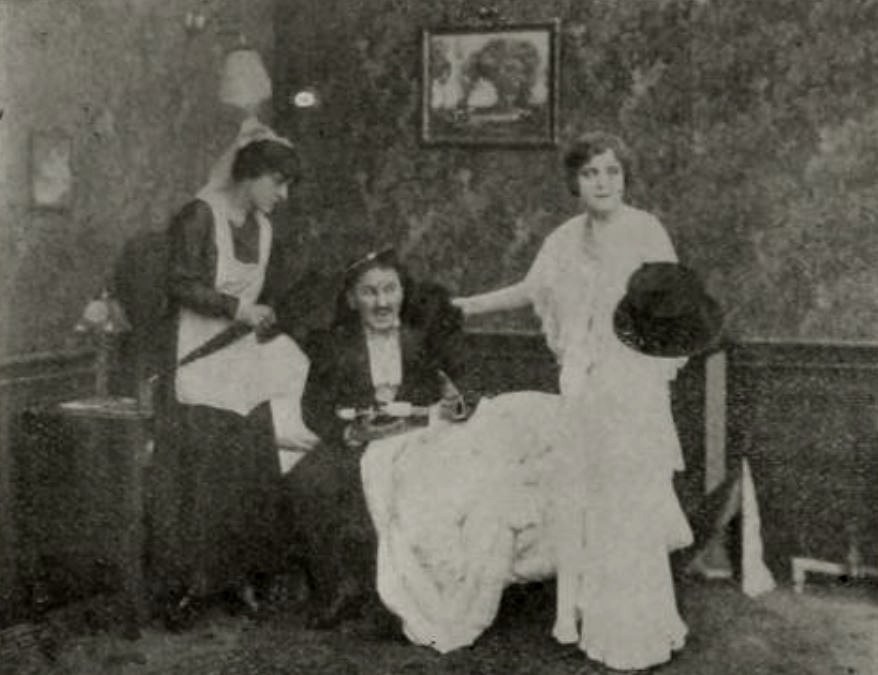
Director James Forbes stages domestic spaces like a diorama of social panic. The Brice home is all perpendicular lines—wallpaper stripes, stair rails, the harsh rectangle of morning light slicing across the marital bed—until Sammy invades, a soft, dissonant curve in a silk bathrobe. The moment Carrie the maid (a scene-stealing Rosa Gore) lifts the quilt and emits a shriek worthy of The Mystery of Room 13, those perpendiculars collapse into a slapstick spiral. Suffragettes pour through the doorway like confetti, parasols raised like jousting lances, and suddenly the set resembles a playground more than a domicile.
Notice how the camera height drops for each escalating humiliation: at the start we hover at waist-level, polite; by the time Sammy is sprinting from bedroom to bedroom in borrowed pajamas, the lens crouches at ankle-height, turning hallways into canyons and doorknobs into weapons of psychological warfare. It’s Keystone logic filtered through Lubitsch’s spatial elegance.
The film’s most savage joke is the commuter train itself, that iron-clad god demanding obeisance. Every time Larry sprints for the 7:46, the soundtrack (in the surviving MoMA restoration) layers a locomotive whistle atop a jaunty foxtrot, fusing duty and escape into a single breath. The telephone booth—an Edwardian glass coffin—becomes the confessional where suburban guilt is laundered into corporate euphemism. Forbes repeatedly frames Larry’s face reflected in the booth window, superimposed over the receding city lights so that conscience itself appears double-exposed.
Compare this to the telegraph wires that haunt The Nation’s Peril or the riderless horse in The Boundary Rider: technology in these silents rarely liberates; it reminds characters how tethered they remain. When Hetty hears nightclub horns bleeding through the receiver, the marriage contract is technically breached by sound waves alone—a modern anxiety worthy of Antonioni.
Marie Collins’s Hetty begins as the archetype of patient spouse, filmed in soft key-light that glints off her wedding ring like a tiny handcuff. Once suspicion germinates, her performance pivots: eyes narrow, shoulders square, she becomes a general marshaling suffragette troops. The scene where four sturdy club members tackle Sammy plays like a gender-swapped Peril of the Plains—only instead of lassoes, we have hatpins and rhetoric. Their synchronized march out the door, eyebrows raised in synchronized moral arbitration, is the film’s most subversive sight gag: patriarchy undone by its own guest list.
Yet Forbes refuses easy triumph. Hetty’s final half-faint onto the settee is filmed in lingering close-up, the camera cradling her ambivalence: victory tastes of aspirin and cold coffee. The suffragettes exit clucking, but the marital wound remains open, a reminder that political progress does not automatically translate to domestic détente.
Charles Judels’s dual casting is more than stunt; it dramatizes the split personality of the Jazz Age. As Rolliston he is suburban id incarnate; as Sammy he embodies the Mediterranean volatility that Prohibition-era America both craved and criminalized. His accent ricochets between Neapolitan arias and Bowery slang, a linguistic strobe that makes every line sound like it’s being invented on the spot. When small boys pelt him with refuse, the moment carries the sting of xenophobia, yet the film undercuts pathos with pratfall: Sammy slips on a banana peel of his own hubris.
The C.O.D. suit—an entire plot motor wrapped in brown paper—becomes a symbol of capitalistic absurdity: clothing commodified, identity bartered, dignity shipped postage-due. Sammy’s refusal to vacate until properly attired plays like a comic inversion of The Royal Imposter; here the commoner demands wardrobe validation before abdicating the premises.
Forbes’s visual puns operate like a Swiss watch hurled down a flight of stairs—precise yet chaotic. Watch how the confetti that triggers Sammy’s wrath reappears hours later, stuck to Larry’s overcoat lapel as he sneaks into his own house, a pastel breadcrumb of guilt. Or the way the mother-in-law’s bedtime bonnet—an absurd lace beehive—echoes the chamber-pot silhouette in Sammy’s subsequent nightmare insert. These rhymes are not mere whimsy; they suggest the universe mocking propriety with its own symmetrical sense of humor.
The editing rhythm deserves study: average shot length hovers around 3.4 seconds, faster than most 1924 features, predating the screwball cadence Hawks would perfect in Twentieth Century. Action match-cuts across axis lines, generating spatial whiplash that mirrors alcoholic disorientation. When Sammy vaults from guest room to master suite, the jump cut is masked by a whip-pan over a flickering hallway lamp—continuity suborned to comedic propulsion.
Place The Commuters beside Through the Valley of Shadows and you witness American cinema’s bipolar 1924 psyche: one film wrestles with spiritual penance in lonesome expanses, the other detonates propriety in a suburban powder keg. Both are preoccupied with sin and restitution, yet where Valley seeks absolution through landscape, Commuters seeks it through velocity—speed as secular absolution.
Likewise, the maritime swagger of On the Spanish Main finds its ironic counterpoint here: instead of pirates plundering doubloons we have husbands plundering nightlife, both governed by codes of plunder that collapse under domestic scrutiny.
Scholars routinely cite It Happened One Night (1934) as ground zero for screwball, yet the chromosomes are visible here a decade earlier: the battling spouses, the stranger who catalyzes latent marital fault lines, the accelerating set-pieces that hinge on mistaken identity and public humiliation. What The Commuters lacks in Depression-era class commentary it compensates with Prohibition-era liquid courage, a manic energy that sprints so fast it outruns moral consequence until the final reel.
Modern viewers may flinch at the immigrant caricature, but Judels infuses Sammy with a performative self-awareness—eyebrow arched at the audience as if to say, “You paid for the stereotype, here it is, stuffed and mounted.” That Brechtian wink rescues the film from mere ethnic burlesque, positioning Sammy as both trickster and mirror.
Watch The Commuters at midnight with a tumbler of something illicit and you will feel the same centrifugal tug that hurled 1924 audiences from their velvet seats: the suspicion that respectability is a costume easily doffed, that marriage is a high-wire act performed over an abyss of saxophones and strangers’ smiles. The film survives only in fragmentary 35mm at MoMA and a 9-minute Czech print, yet what remains is more than archive curio—it’s a kinetic blueprint for every subsequent comedy that dared suggest the suburbs were not sanctuaries but launchpads for nocturnal rebellion.
So here’s to Larry Brice, to Sammy’s defiant mandolin, to Hetty’s suffragette army wielding umbrellas like broadswords. Their train may have left the station a century ago, but the echo of its whistle—half warning, half invitation—still reverberates through the commuter lines of our own meticulously mapped lives.
IMDb 6.3
1932
Community
Log in to comment.