DbcultAccessing Vault...
6.9/10
Senior Film Conservator
A definitive 6.9/10 rating for a film that redefined the boundaries of cult cinema. The Einstein Theory of Relativity remains a cornerstone of transgressive art.
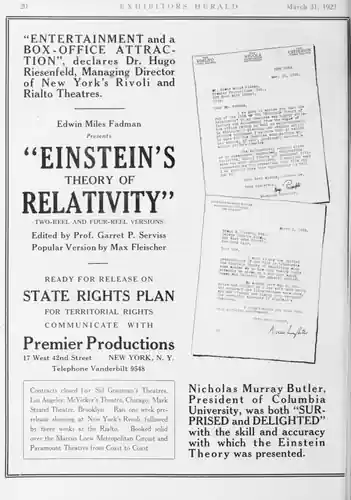
In the nascent years of the twentieth century, the global consciousness was undergoing a violent recalibration. While the carnage of the Great War had shattered political certainties, Albert Einstein’s theories were simultaneously dismantling the Newtonian foundations of reality itself. Into this whirlpool of intellectual upheaval stepped Dave Fleischer, a man whose name is more commonly associated with the rubber-hose antics of Popeye or Betty Boop. However, in 1923, Fleischer undertook a project of staggering intellectual ambition: The Einstein Theory of Relativity. This film is not merely an educational short; it is a monumental bridge between the abstract rigors of theoretical physics and the visceral accessibility of the moving image.
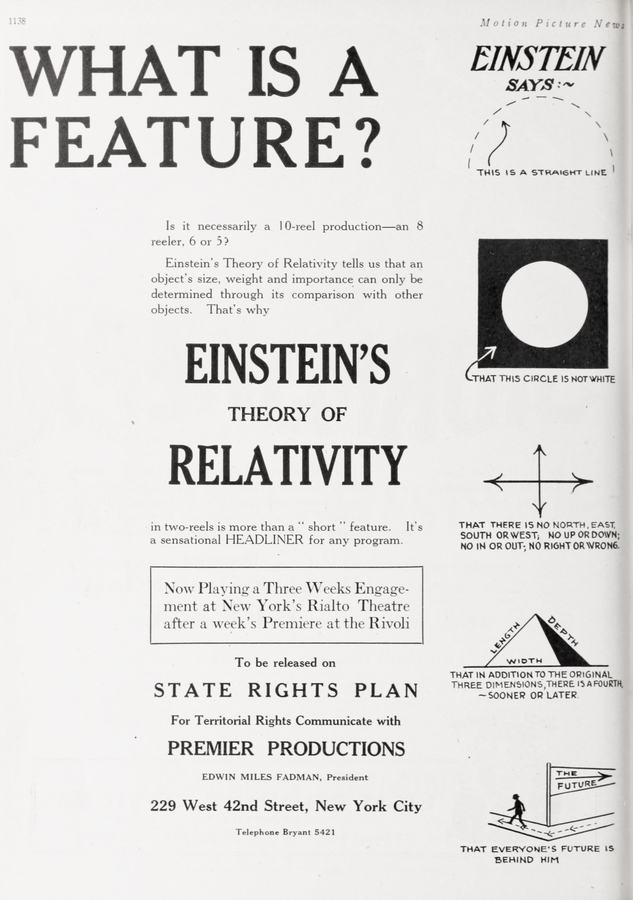
To watch this film today is to witness the birth of a new visual language. Fleischer avoids the melodramatic excesses found in contemporary works like The Crimson Circle, opting instead for a minimalist, almost architectural clarity. The screen becomes a laboratory. There are no heroes here, only observers. The animation serves a higher purpose than entertainment; it acts as a surrogate for the human imagination, which often stumbles when confronted with the paradoxes of spacetime. By utilizing clean lines and rhythmic pacing, Fleischer manages to illustrate the Special and General theories with a grace that defies the density of the subject matter.
The film’s structure is meticulously organized, moving from the intuitive to the counter-intuitive. We begin with simple demonstrations of relative motion—a man on a train, a person on an embankment. These sequences possess a quiet, rhythmic beauty that echoes the structural precision of Harakiri, though where that film explores the rigid codes of human honor, Fleischer explores the immutable laws of the cosmos. The comparison is not as far-fetched as it seems; both films are concerned with the frames of reference through which we judge reality, whether those frames are moral or mathematical.
What distinguishes this work from a mere filmed lecture is Fleischer’s innate understanding of the kinetic potential of the medium. The way light beams are depicted—as pulsing, purposeful entities—prefigures the experimental cinema of the mid-century. There is a sequence involving a falling elevator that is more harrowing in its conceptual implications than the staged peril found in Thunderclap. In that film, danger is a narrative device; in Fleischer’s hands, the elevator is a philosophical tool used to dissolve the distinction between gravity and acceleration.
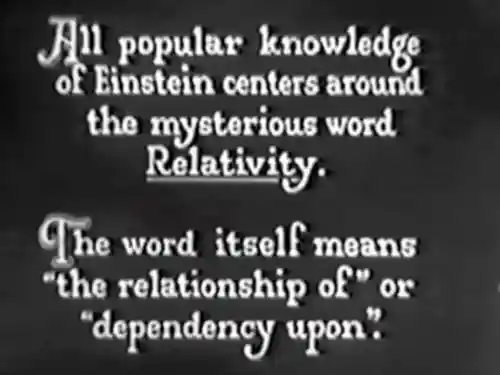
The use of text cards is equally sophisticated. Rather than interrupting the flow, they act as rhythmic anchors, grounding the viewer before the next visual leap. This balance of word and image is far more harmonious than the often-clunky exposition found in Beauty and the Rogue. Fleischer trusts his audience’s intelligence, a rarity in an era where cinema was often dismissed as a low-brow diversion for the masses. He treats the viewer as a collaborator in a grand intellectual detective story.
The most haunting segments of the film deal with the dilation of time. As we watch a clock travel through space at near-light speeds, only to return out of sync with its stationary counterpart, the film touches upon a profound existential dread. This manipulation of time is a central theme in many narrative films of the period, such as the haunting journey in The Dark Road, but Fleischer strips away the artifice of plot to show us the literal, physical reality of time’s instability. It is a sobering reminder that our perception of a "steady" life is a localized illusion.
Consider the way the film handles the concept of the fourth dimension. It doesn't rely on the mystical overtones often found in early speculative fiction like La nave. Instead, it uses the geometry of the screen to suggest what lies beyond it. The curvature of space is illustrated through the deflection of starlight during an eclipse, a visual that is both scientifically accurate and aesthetically sublime. The black background of the space sequences serves to emphasize the isolation of these celestial bodies, creating a sense of cosmic scale that dwarfs the domestic concerns of The Apple-Tree Girl.
One cannot discuss this film without acknowledging its place in the history of the documentary. Long before Carl Sagan or Neil deGrasse Tyson, Fleischer was utilizing the most advanced technology of his day to explain the frontier of human knowledge. The film lacks the cynical manipulation found in The Liar; its goal is transparency, not deception. Yet, in its quest for truth, it achieves a level of poetic resonance that many fictional dramas fail to reach. The sight of a planet warping the space around it is as visually arresting as any set piece in Baccarat.
The film also serves as a fascinating counterpoint to the social realism of Uncle Tom's Cabin or the rugged individualism of The Hard Rock Breed. While those films are rooted in the specificities of the human condition and the struggles of the terrestrial world, The Einstein Theory of Relativity reminds us that we are all subject to forces far greater than our social or economic structures. It is a humbling experience, one that shifts the focus from the "man" in Man and Woman to the atoms and energy that compose them.
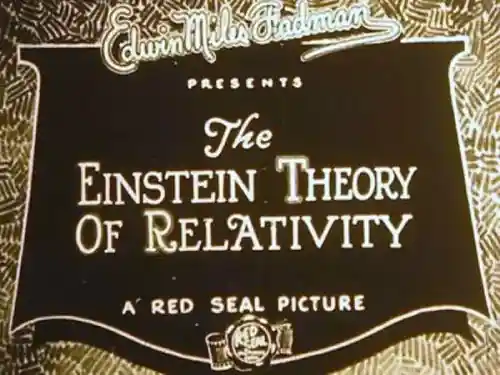
Why does this film matter a century later? It matters because it represents a moment of pure, unadulterated curiosity. In an industry that was already becoming obsessed with star power and formulaic plots—the kind of escapism seen in Mile-a-Minute Romeo—Fleischer’s work stands as a testament to the educational potential of the medium. It doesn't treat the audience as consumers, but as students of the universe. It shares the earnestness of Something to Do, but applies that energy to the most complex questions ever posed by the human mind.
The technical execution, considering the limitations of 1923, is nothing short of miraculous. The clarity of the superimposed images and the smooth transitions between live-action and animation suggest a filmmaker at the height of his powers. Fleischer’s ability to visualize the invisible—to make the curvature of a four-dimensional manifold as tangible as the landscape in The Grail—is a feat of creative translation that has rarely been equaled. He took the esoteric scribblings of a Swiss patent clerk and turned them into a shared visual experience.
Ultimately, The Einstein Theory of Relativity is a film about perspective. It challenges us to step outside our parochial viewpoints and see the universe as a dynamic, interconnected whole. It is a work of profound optimism, suggesting that the universe is not a chaotic mess of random events, but a structured, elegant system that can be understood through reason and observation. In a world that often feels as fractured as the plot of a silent thriller, Fleischer’s film offers the cold, beautiful comfort of the truth.
Final Thoughts for the Modern Cinephile:
While the pace may feel deliberate to those raised on the frenetic editing of the digital age, the rewards of this film are immense. It demands a different kind of attention—a contemplative, analytical engagement. It is a reminder that cinema can be a tool for enlightenment, a window into the infinite, and a bridge between the most brilliant minds in history and the curious public. Dave Fleischer may have given us cartoons that made us laugh, but with this film, he gave us a universe that made us think.
IMDb —
1922
Community
Log in to comment.