DbcultAccessing Vault...
6.6/10
Senior Film Conservator
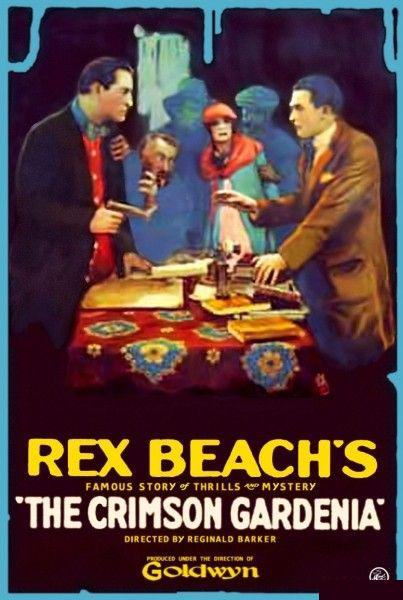
A definitive 6.6/10 rating for a film that redefined the boundaries of cult cinema. The Crimson Gardenia remains a cornerstone of transgressive art.
The 1919 cinematic landscape was often dominated by theatrical artifice, yet The Crimson Gardenia emerges as a fascinating anomaly, blending the high-society tropes found in The Richest Girl with the gritty, subterranean tension of a burgeoning crime thriller. Directed with a surprising eye for atmospheric detail, this Rex Beach adaptation transcends its 'mistaken identity' premise to offer a searing critique of class, identity, and the transformative power of peril.
Owen Moore, an actor whose range often oscillated between the charming rogue and the stoic lead, finds a unique frequency here. As Roland Van Dam, he embodies the 'wastrel' not as a caricature of vice, but as a man suffering from a spiritual vacuum. Much like the protagonist in New York Luck, Van Dam is a product of his environment—stifled by the predictability of wealth. When he travels to New Orleans, the film utilizes the Mardi Gras setting not merely as a backdrop, but as a psychological externalization of his internal chaos.
The crimson gardenia itself acts as a vibrant MacGuffin, a splash of blood-red against the monochrome shadows of the New Orleans night. It is the catalyst for a narrative pivot that shifts the film from a romantic comedy of errors into something far more sinister.
The mistake—being confused for the fugitive Emile Le Duc—is handled with a narrative dexterity that avoids the slapstick tendencies of the era. Instead, the tension builds through a series of increasingly dangerous encounters with a counterfeiting gang. This gang isn't the bumbling group of thieves one might expect from a 1919 production; they possess a visceral lethality that reminds modern viewers of the grit seen in The Girl from Frisco. The stakes are tangible, and the threat of the counterfeiters' den provides a sharp contrast to the buoyant festivities occurring just blocks away on the parade routes.
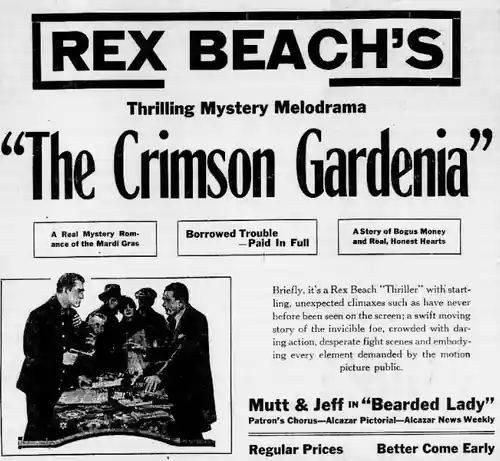
Rex Beach’s writing is the backbone of the film's success. Known for his rugged adventures, Beach brings a sense of physical consequence to the script. In The Crimson Gardenia, the dialogue—conveyed through intertitles—is sharp and devoid of the flowery sentimentality that plagued many silent films like The Primrose Ring. There is a muscularity to the prose that suits the New Orleans underworld. The inclusion of the 'long-lost cousin' (played with a haunting vulnerability by Hedda Nova) adds a layer of familial obligation that complicates Roland’s desire to simply flee back to the safety of New York.
Hedda Nova’s performance is particularly noteworthy. She avoids the 'damsel in distress' archetype, presenting instead a woman caught in a web of criminal intrigue that predates her arrival. Her chemistry with Moore is built on a shared sense of displacement. While Roland is displaced by choice, she is displaced by circumstance, creating a thematic resonance that elevates the film above standard genre fare. This dynamic is far more sophisticated than the romantic arcs in The Amazing Wife.
Visually, the film is a triumph of early location and set design. The recreation of Mardi Gras captures the ephemeral nature of the celebration—the masks, the floats, and the sense of impending revelry. However, it is in the shadows of the counterfeiting dens where the cinematography truly shines. The lighting evokes a sense of claustrophobia, a technique used effectively in other dark dramas of the time such as The Raven. The contrast between the bright, over-exposed streets of New Orleans and the murky, low-key lighting of the criminal hideouts serves as a visual metaphor for Roland’s descent.
The pacing is relentless. Once the gardenia is pinned to Roland’s lapel, the film accelerates with a momentum that mirrors the frantic energy of a jazz funeral. There is little room for the languid character studies found in Das Bildnis des Dorian Gray. Every scene serves to tighten the noose around Roland, forcing him to utilize his wit and eventually his fists. The action sequences are choreographed with a realism that was quite advanced for 1919, eschewing the stagey fights of The Prodigal Liar in favor of more desperate, unpolished brawling.
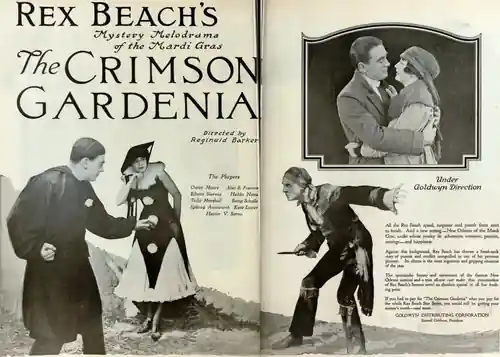
The ensemble cast provides a rich tapestry of early 20th-century archetypes. Alec B. Francis and Gertrude Claire bring a grounded dignity to their roles, providing a necessary counterweight to the flamboyant villainy of the counterfeiting gang. Tully Marshall, often a master of the grotesque or the sinister, delivers a performance that lingers in the mind long after the credits roll. His presence adds a layer of authentic menace that makes the stakes feel genuinely life-threatening.
The film also manages to sneak in subtle social commentary. The fact that a wealthy man can so easily be mistaken for a hardened criminal suggests a fluidity of identity that would have been quite provocative to a 1919 audience. It challenges the notion that character is inherent to one's social standing—a theme Beach explored in different contexts in Tempered Steel. Roland discovers that his millions mean nothing in a room full of men who deal in forged currency; in that space, he is only as valuable as the lies he can maintain.
Comparing The Crimson Gardenia to contemporary works like Mrs. Leffingwell's Boots reveals a significant shift in cinematic priorities. While the latter focuses on the intricate social faux pas of the elite, the former is interested in the collision of worlds. It is a precursor to the noir films of the 1940s, where an innocent man is pulled into a vortex of crime through a singular, seemingly insignificant choice. The 'gardenia' is the ancestor of the 'black bird' or the 'letter of transit'—an object that carries the weight of destiny.
The film’s resolution is satisfying without being overly saccharine. Roland does not emerge from the ordeal unchanged; the wastrel has been burned away, replaced by a man who has looked into the abyss and survived. It lacks the simplistic moralizing of Peggy Leads the Way, opting instead for a gritty realization of self-worth. Even the minor characters, such as those played by Sidney Ainsworth and Edwin Stevens, contribute to a sense of a fully realized world, a rarity in an era where many films felt like filmed stage plays.
Final Critical Analysis
Ultimately, The Crimson Gardenia is a vital piece of silent cinema that deserves a place in the pantheon of early thrillers. It manages to balance the spectacle of Mardi Gras with a tight, suspenseful plot that never loses its way. Rex Beach's narrative provides a sturdy framework for Owen Moore to deliver one of his most compelling performances. For fans of the era who enjoyed the rustic charm of The Cook of Canyon Camp or the dramatic intensity of Vendetta, this film offers a sophisticated blend of both. It is a reminder that even in 1919, cinema was capable of exploring the dark, complicated corners of the human experience with style and substance. While some might find the 'mistaken identity' trope well-worn, the execution here is so fresh and the atmosphere so thick with New Orleans humidity and danger that it feels entirely original. It stands alongside The Spindle of Life as a testament to the creative fertility of the late 1910s.
IMDb 5.9
1930
Community
Log in to comment.