DbcultAccessing Vault...
8.6/10
Senior Film Conservator
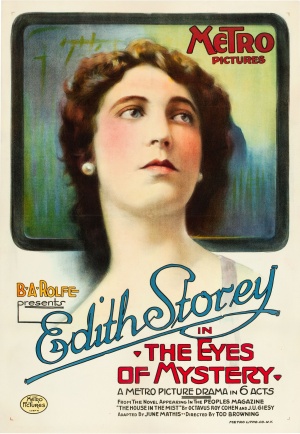
A definitive 8.6/10 rating for a film that redefined the boundaries of cult cinema. The Eyes of Mystery remains a cornerstone of transgressive art.
The year 1918 stood as a pivotal juncture in the evolution of American cinema, a time when the medium began to shed its stage-bound origins in favor of a more nuanced, visually driven storytelling language. Amidst this transformation, The Eyes of Mystery emerged as a sophisticated exploration of identity, heredity, and the encroaching darkness of the American South. Directed by Tod Browning and penned by the formidable trio of J.U. Giesy, June Mathis, and Octavus Roy Cohen, this film transcends the typical melodrama of its era, offering instead a proto-noir atmosphere that feels remarkably ahead of its time. Much like the complex moral landscapes explored in The World and the Woman, this production interrogates the stability of the family unit when confronted by external corruption.
At the heart of this labyrinthine plot is Carma Carmichael, portrayed with a haunting vulnerability by Edith Storey. Storey, a luminary of the silent screen, manages to convey a spectrum of emotion—from the placid comfort of her life with Uncle Quincy to the visceral terror of her abduction—without ever resorting to the over-the-top gesticulation that plagued many of her contemporaries. Her performance provides the emotional anchor for a story that frequently threatens to descend into chaos. When her father, Roger, returns to claim her, the audience is immediately struck by a sense of uncanny dread. This is not the joyous reunion of a prodigal parent, but the arrival of a predator. The film masterfully utilizes the Southern plantation setting, not as a nostalgic relic, but as a crumbling tomb of secrets, reminiscent of the atmospheric tension found in Saint, Devil and Woman.
The narrative brilliance of June Mathis is on full display here. Mathis, who would later become one of the most powerful women in Hollywood, understood that the most effective mysteries are those that play with the audience's perception of truth. The central conceit—that the man claiming to be Roger is actually an impostor who murdered the real father—is handled with a slow-burn intensity. This isn't just a plot twist; it is a thematic exploration of the 'impostor' archetype that has fascinated storytellers since the dawn of literature. The impostor’s presence in the ancestral home acts as a cancer, polluting the lineage and the land itself. This thematic weight elevates the film above standard fare like The Reform Candidate, which, while competent, lacks the psychological depth found in the Carmichael saga.
"In the silent era, the eyes were the windows to the soul, but in this film, they are the mirrors of a profound and terrifying deception."
Uncle Quincy, played with a strategic gravitas by Frank Andrews, serves as the narrative’s shadow-weaver. His decision to fake his own death and go into hiding is a brilliant tactical maneuver that shifts the film from a straightforward rescue mission into a complex game of espionage. By removing himself from the board, Quincy forces the villains to reveal their true colors. This level of narrative sophistication is something we often associate with later thrillers, yet it is present here in 1918, showcasing the ingenuity of Giesy and Cohen’s source material. The introduction of Jack Carrington (Kempton Greene) as the surrogate investigator adds a layer of youthful dynamism to the proceedings. Jack is not merely a hero; he is a catalyst for the film’s eventual social explosion.
Visually, The Eyes of Mystery utilizes chiaroscuro lighting to emphasize the duality of its characters. The plantation, with its long corridors and shadowed corners, becomes a physical manifestation of the impostor’s psyche. The cinematography captures the isolation of the Southern landscape, making the Carmichael estate feel like an island cut off from the rest of civilization. This sense of geographic and social isolation is a hallmark of the Southern Gothic genre, a precursor to the works of Faulkner and O'Connor. When compared to the urban grit of Social Quicksands, The Eyes of Mystery feels more elemental, more rooted in the primal fears of blood and soil.
The interaction between Jack and the group of thugs living on the plantation provides a fascinating subtext regarding class and loyalty. These men, initially presented as mindless muscle for the impostor, are eventually swayed by Jack’s rhetoric and the sheer illegitimacy of their leader. This internal revolt is perhaps the film’s most satisfying sequence. It suggests that even in a world governed by deception, there is a fundamental human instinct for justice that can be ignited. The climax, featuring the attack on the house, is edited with a rhythmic urgency that keeps the viewer on the edge of their seat, a testament to the directorial prowess of the era. It lacks the mystical overtones of Spiritisten, but replaces them with a grounded, visceral tension that is arguably more effective.
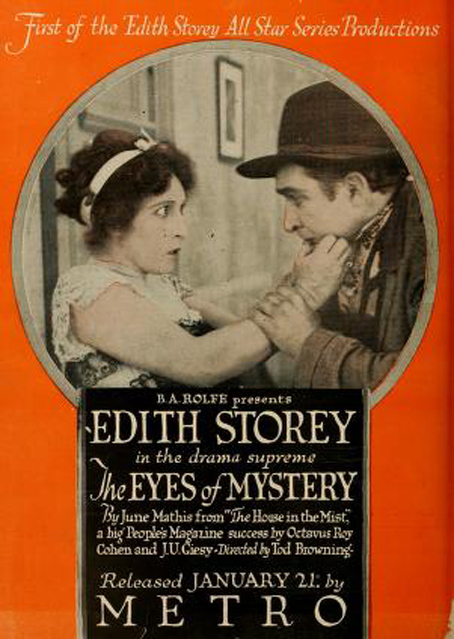
While often overshadowed by the larger-than-life epics of the time, such as Parsifal, The Eyes of Mystery remains a vital piece of cinematic history because of its focus on character-driven suspense. It doesn't rely on massive sets or thousands of extras; it relies on the twitch of a lip, the narrowing of an eye, and the oppressive weight of an unspoken secret. The chemistry between Edith Storey and Kempton Greene is palpable, providing a romantic resolution that feels earned rather than tacked on. Their final embrace is not just a cliché of the genre, but a symbolic restoration of order after a period of profound moral upheaval.
The film also invites comparison to Toys of Fate in its depiction of characters caught in the gears of a destiny they cannot control. However, where Toys of Fate leans into the tragic, The Eyes of Mystery offers a more proactive vision of humanity. Jack and Carma are not merely victims; they are agents of their own liberation. This agency is a recurring theme in the work of June Mathis, who consistently wrote female characters with more backbone and complexity than was standard for the period. Carma’s transition from a suspicious captive to a defiant participant in the impostor’s downfall is a narrative arc that continues to resonate with modern audiences.
In the broader context of 1918 releases, including the lighthearted Everybody's Girl or the adventurous Danger, Go Slow, The Eyes of Mystery stands out for its somber tone and its willingness to gaze into the darker aspects of the human condition. It explores the fear of the 'other' within the family, the anxiety of lost heritage, and the fragility of the social contract. The 'eyes' of the title serve as a dual metaphor: they are the eyes of the impostor watching his prey, but they are also the eyes of the audience, tasked with seeing through the facade to the rot beneath.
One cannot discuss this film without acknowledging the technical constraints of 1918 and how the production team turned those limitations into strengths. The use of tinting—common in the silent era—is employed here with surgical precision. Deep blues for the night sequences on the plantation create a sense of cold, unyielding dread, while the warmer amber tones of the interior scenes suggest a false security that is constantly being threatened. The pacing is deliberate, eschewing the frantic action of The Ring and the Man for a more psychological build-up. This allows the audience to marinate in the atmosphere, to feel the humidity of the Southern air and the claustrophobia of the Carmichael house.
The supporting cast, including Louis Wolheim and Pauline Dempsey, provide the necessary texture to make the world feel lived-in. Wolheim, in particular, brings a rugged physicality that contrasts sharply with Greene’s more refined presence. These character dynamics create a microcosm of society, where the struggle for power is played out on a personal scale. It is a far cry from the bohemian escapades of Az utolsó bohém, focusing instead on the gritty realities of greed and survival.
As we look back at The Eyes of Mystery, we see a film that acted as a bridge between the simplistic moralities of early cinema and the complex, shades-of-gray narratives that would define the 1920s and beyond. It is a work of significant lexical diversity in its visual language, telling a story of profound betrayal and ultimate redemption. For those interested in the roots of the thriller genre, or for those who simply appreciate a well-crafted tale of Southern intrigue, this film is an essential viewing experience. It reminds us that even when the world is silent, the eyes—and the truth they reveal—speak volumes.
In conclusion, the film remains a testament to the collaborative power of Mathis, Giesy, and Cohen. Their ability to weave a tale that is both a gripping mystery and a poignant character study is a feat that few modern blockbusters manage to achieve. Whether compared to the social commentary of A World Without Men or the romantic tensions of After the Ball, The Eyes of Mystery holds its own as a masterpiece of silent storytelling. It is a haunting, beautiful, and ultimately triumphant exploration of the human spirit’s ability to see through the darkness and reclaim what is rightfully its own.
IMDb —
1920
Community
Log in to comment.