DbcultAccessing Vault...
Cult Review
Senior Film Conservator
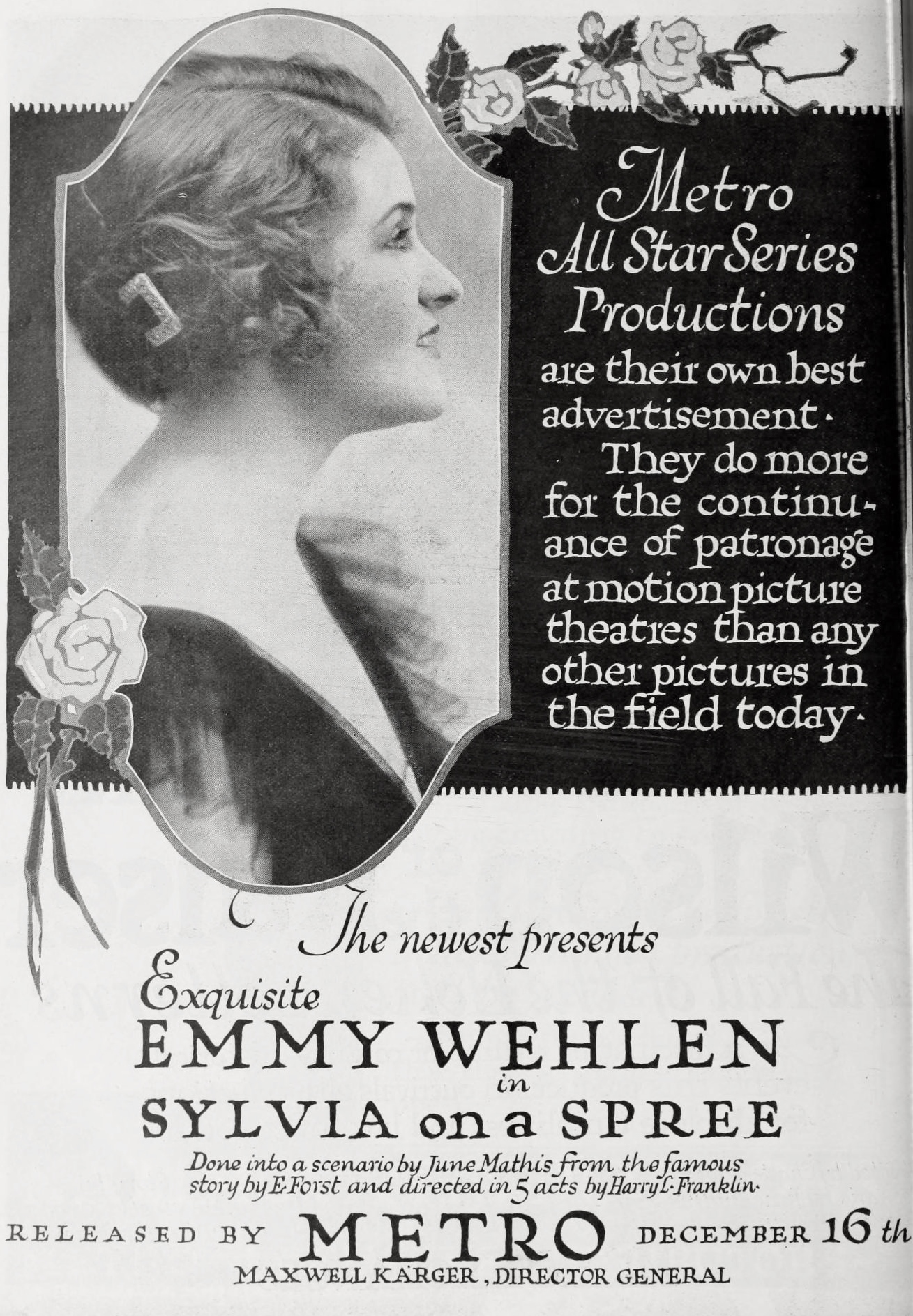
The year 1918 occupied a precarious threshold in the history of American cinema, a moment where the Victorian moral imperatives of the past began to collide with the burgeoning, jazz-inflected hedonism of the roaring twenties. It is within this cultural friction that Sylvia on a Spree emerges not merely as a lighthearted comedy of manners, but as a fascinating artifact of social engineering and gendered curiosity. Directed with a keen eye for the performative, the film serves as a vehicle for the luminous Emmy Wehlen, whose portrayal of Sylvia Fairponts captures the quintessential 'New Woman' in a state of arrested development, yearning for a transgression she cannot fully comprehend.
One cannot discuss Sylvia on a Spree without acknowledging the formidable presence of June Mathis in the screenwriting credits. Mathis, who would later achieve immortality by discovering Rudolph Valentino and penning The Four Horsemen of the Apocalypse, brings a sophisticated narrative structuralism to what could have been a pedestrian farce. Her script navigates the delicate balance between Sylvia’s genuine existential angst and the absurdity of her solutions. Unlike the darker explorations of female agency found in The Clemenceau Case, Mathis opts for a satirical lens, examining how the bourgeois imagination constructs its own versions of 'sin' when denied the reality of it.
The film opens with a stifling portrait of Sylvia’s domestic life. The cinematography emphasizes the verticality of her cage—tall windows, high-backed chairs, and the looming presence of tradition. When she reads of the Beaulieu Inn, it isn't just a location; it is a mythic space of liberation. This desire for the 'other' is a recurring theme in silent cinema, often explored with more tragic overtones in films like Redemption. However, Sylvia’s rebellion is filtered through the commercialized mysticism of the era, personified by the clairvoyant Mme. Claire St. Claire. This scene is a biting critique of how the spiritualist movement exploited the anxieties of the wealthy, a theme also touched upon in the thematic undercurrents of The Light Within.
The centerpiece of the film is the elaborate ruse orchestrated by Jack Bradley (Walter Percival). Horrified by Sylvia's request to witness depravity, Jack decides to 'cure' her by providing a hyper-realized, grotesque version of her fantasies. This meta-theatrical element—a play within a film—is where Sylvia on a Spree finds its visual rhythm. Jack hires a troupe of performers to enact a fever dream of profligacy. The imagery here is striking: exotic dancers whose movements are choreographed to be unsettling rather than alluring, and the infamous 'champagne shampoo' administered to Edwin Booth D'Aubrey (Frank Currier).
This sequence serves as a fascinating precursor to the expressionistic madness seen in He Who Gets Slapped, though here the madness is a calculated artifice. The 'champagne shampoo' is particularly evocative—a symbol of wasteful excess that borders on the ritualistic. It is a moment of pure cinematic decadence that manages to be both hilarious and slightly grotesque. The film suggests that the 'seamy side of life' is often just another form of theater, a sentiment that echoes the disillusionment found in The Foolish Virgin.
The genius of the climax lies in the collision of Jack’s fake raid and the arrival of the actual police. As Sylvia’s disgust turns to genuine panic, the film shifts gears from a comedy of errors to a frantic social satire. The night court scene is a masterpiece of silent ensemble acting. The cast, including Joseph Sweeney and Isabel O'Madigan, populate the courtroom with a gallery of urban archetypes that wouldn't look out of place in The Upstart. Here, the consequences of Sylvia’s 'spree' are laid bare. While the film eventually retreats into the safety of a conventional ending, the chaos of the courtroom suggests a world that is far less ordered than Jack’s staged morality play would imply.
In comparing this to other works of the period, such as Daughter of Maryland or the European sensibilities of Die Börsenkönigin, we see that Sylvia on a Spree is uniquely American in its obsession with the 'reformation' of the female spirit. It lacks the melodrama of East Lynne, opting instead for a brisk, almost cynical pacing that feels surprisingly modern.
Emmy Wehlen is the gravitational center of the film. Her ability to convey nuanced transitions from boredom to curiosity, then to horror and finally to a resigned contentment, is a testament to her skill. She possesses a comedic timing that rivals the greats of the era, avoiding the over-the-top histrionics that often plagued silent dramas like The Unforseen. Her interactions with Walter Percival are characterized by a sparkling chemistry that keeps the audience invested in their eventual union, even when Jack’s paternalistic 'lesson' feels somewhat abrasive to modern sensibilities.
Visually, the film utilizes lighting to distinguish between the 'safe' domestic spaces and the 'dangerous' environment of the inn. The use of shadows in the Beaulieu Inn sequences creates a sense of depth and mystery that mirrors the protagonist's own confused perceptions. This stylistic choice is far more sophisticated than the flat lighting found in contemporary B-pictures like A Rough Shod Fighter. The editing, too, is remarkably tight, particularly during the raid sequence where the parallel action between the fake and real police creates a mounting sense of hysteria.
When we look at Sylvia on a Spree through the lens of international cinema, such as the French La voix d'or or the Italian Ivonne, la bella danzatrice, we see a divergence in how 'the fallen woman' or the 'curious woman' is treated. European films of the time often leaned into the tragic inevitability of the woman's downfall. Sylvia on a Spree, however, is firmly rooted in the American tradition of the 'moral lesson'—the idea that experience, even when simulated, is the ultimate teacher. It shares a certain DNA with The Little Pirate in its adventurous spirit, but anchors its protagonist back to the harbor of respectability with much more force.
The film’s preoccupation with the 'seamy side' also reflects the burgeoning Prohibition movement. By depicting the inn as a place of chaotic, almost demonic energy, the film aligns itself with the temperance narratives of the day, though it does so with a wink and a nod. The 'champagne shampoo' is the ultimate symbol of the 'demon rum'—absurd, wasteful, and ultimately leading to the courtroom.
In the final analysis, Sylvia on a Spree is more than just a comedic trifle. It is a sophisticated exploration of the limits of curiosity and the power of social performance. Sylvia’s journey from a reader of scandals to a participant in a staged scandal, and finally to a witness of a real legal crisis, provides a compelling narrative arc that remains engaging over a century later. The film manages to critique both the stifling nature of high society and the hollow artifice of the 'underworld' it fears.
The ending, where Sylvia looks forward to a 'quiet married life,' may feel like a surrender to the status quo, but within the context of 1918, it is presented as a hard-won peace. She has looked into the abyss—even if the abyss was mostly cardboard and hired actors—and decided she prefers the view from her parlor. Like the protagonist in An Enemy to the King, she finds that the most daring adventure is often the one that leads you back home, albeit with a much clearer understanding of the world outside your door.
For enthusiasts of silent cinema, Sylvia on a Spree is a mandatory watch. It showcases the collaborative power of a great star and a legendary writer, proving that even within the constraints of early 20th-century morality, there was room for wit, subversion, and a truly memorable shampoo. It stands as a vibrant reminder of a time when the cinema was still figuring out its own boundaries, much like Sylvia herself.
IMDb 6.3
1936
Community
Log in to comment.