DbcultAccessing Vault...
Cult Review
Senior Film Conservator
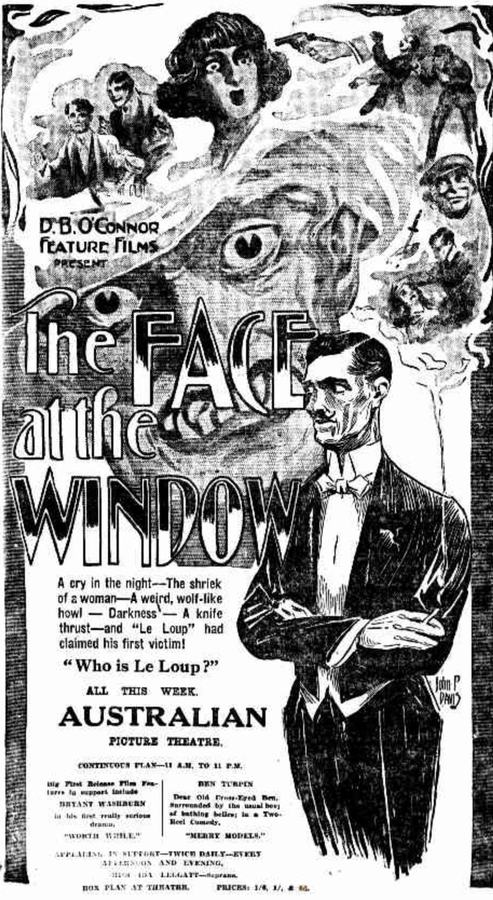
The early cinematic landscape, often perceived as a nascent art form grappling with its own vocabulary, occasionally birthed works of startling sophistication, pieces that transcended their technical limitations to tap into universal human fears. Among these, The Face at the Window stands as a testament to the enduring power of psychological terror, a silent-era gem that, even today, can send a shiver down the spine with its audacious premise and chilling execution. Released in an era when overt monsters and melodramatic villains often dominated the nascent horror genre, this film dared to venture into the more insidious realms of mental anguish and perception, crafting a narrative where the very act of seeing becomes a harbinger of doom.
What distinguishes The Face at the Window from its contemporaries is its singular focus on a highly specific, almost surgical, form of terror. The plot, deceptively simple on paper – victims of a killer are distracted by a hideous face peering through the window – unfolds with an unnerving precision that belies its minimalist description. This isn't just a jump scare; it's a meticulously engineered psychological assault. The ‘face’ itself, a grotesque and unsettling apparition, acts not merely as a visual cue but as a primary weapon, disarming its targets long before any physical harm is inflicted. It preys on the sanctity of personal space, on the primal human need for security within one’s own dwelling, turning a comforting window into a portal for dread. The violation is not just physical but profoundly mental, rendering victims vulnerable not through brute force, but through sheer, overwhelming psychological disorientation.
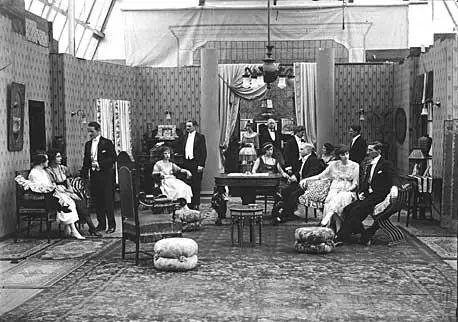
In an era devoid of spoken dialogue, the burden of conveying terror, confusion, and despair fell squarely upon the shoulders of the performers. The ensemble cast, featuring talents such as Gilbert Emery, Claude Turton, Millie Carlton, and Gerald Harcourt, navigates this challenge with remarkable dexterity. Gilbert Emery, in particular, likely carries a significant portion of the dramatic weight, employing a nuanced physical language to articulate the slow creep of paranoia. His expressions, the subtle tremors in his posture, the widening of his eyes – these become the lexicon of fear. Claude Turton and Millie Carlton would have similarly relied on exaggerated yet precise gestures, their bodies contorting with fright, their faces contorting into masks of horror and disbelief as the spectral visage makes its appearance. It's a masterclass in silent film acting, where every flicker of emotion, every strained muscle, every desperate glance out of the frame contributes to the overarching atmosphere of dread. The effectiveness of the 'face' itself is amplified by the sheer terror it elicits from the actors; their palpable distress becomes contagious, drawing the audience into the victims' spiraling nightmare. Without a single word, they communicate a profound sense of violated sanctuary and impending doom.
The success of such a premise also hinges heavily on the directorial vision and the writers' blueprint. Brooke Warren and Gertrude Lockwood, credited with the script, deserve considerable commendation for conceiving a horror mechanism so psychologically acute. They understood that the most terrifying monsters are often those that reside not in the shadows, but in the mind's eye, those that challenge our perception of reality. The 'face' is not just a prop; it's a meticulously designed psychological weapon. Its hideousness is less about gore and more about its sheer incongruity, its unnatural presence, the way it shatters the mundane and introduces the utterly unthinkable. This narrative ingenuity sets a high bar for later psychological thrillers, demonstrating that true horror can be evoked without explicit violence, relying instead on the slow, agonizing erosion of sanity.
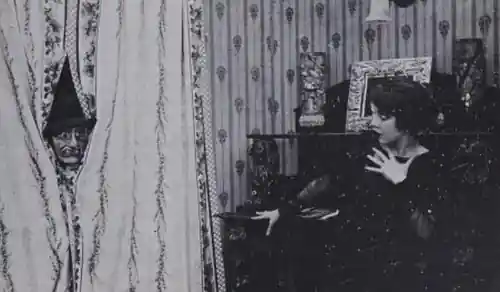
While details on the specific directorial choices are often sparse for films of this vintage, one can infer much from the film's impact. The staging of the 'face' at the window must have been executed with a keen understanding of suspense. The use of close-ups, even rudimentary ones, to emphasize the grotesque details of the face and the visceral reactions of the victims would have been crucial. Lighting, a nascent art in early cinema, would have played a pivotal role. Imagine the stark contrast of a dimly lit interior suddenly illuminated by the ghastly visage, perhaps with a primitive special effect to make it appear disembodied or otherworldly. The director, often uncredited or less prominently featured in early film history, would have been tasked with orchestrating these elements to maximize their unsettling effect. The pacing, the lingering shots on the victims' faces, the sudden cuts to the 'face' – these cinematic techniques, though perhaps in their infancy, were nevertheless powerful tools for building tension and delivering shocks.
The supporting cast, including Percy Walshe, Syd Everett, Charles Villiers, Collet Dobson, Lulu Vincent, D.L. Dalziel, Charles Beetham, D.B. O'Connor, and Agnes Dobson, would have contributed to the film's texture, perhaps embodying the wider community's fear or skepticism, or becoming additional victims, each encounter with the 'face' escalating the sense of pervasive terror. Their collective performances, even in smaller roles, would have amplified the film's atmosphere, painting a broader canvas of a community gripped by an inexplicable, horrifying phenomenon. The cumulative effect of these performances, from lead to supporting, is what truly elevates The Face at the Window beyond a mere novelty and into the realm of enduring psychological drama.
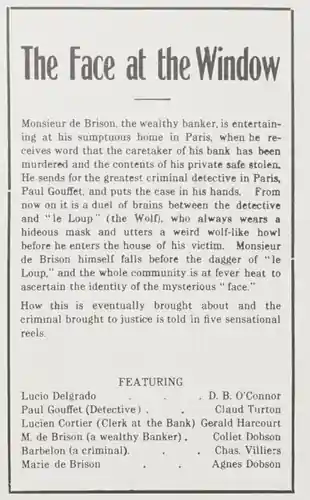
At its core, The Face at the Window is a profound meditation on human vulnerability. The window, typically a symbol of connection to the outside world, becomes a permeable membrane through which terror seeps. The home, usually a sanctuary, is rendered utterly insecure. This subversion of familiar comforts is a potent source of dread. The film explores the fragility of the human mind when confronted with the inexplicable and the horrifying. How long can one maintain composure when a grotesque, silent observer continually invades one's private moments, signaling an imminent, inescapable end? The narrative implicitly asks whether the psychological torment preceding death is not, in fact, more terrifying than death itself.
The 'face' itself can be interpreted in myriad ways. Is it supernatural? A manifestation of madness? A clever disguise? The ambiguity only heightens the terror. It represents the unknown, the irrational force that can shatter our carefully constructed reality. This thematic depth, surprisingly rich for a film of its era, suggests an early understanding of horror's potential beyond mere spectacle. It taps into the existential dread of being utterly powerless, observed, and ultimately, marked for destruction by a force that defies comprehension.
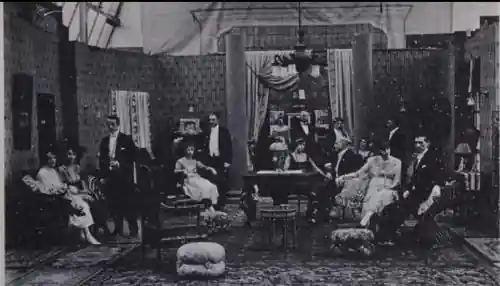
To truly appreciate The Face at the Window, one must place it within the broader context of early silent cinema. While many films of the time focused on grand narratives, historical epics, or light comedies, a nascent genre of thrillers and horror was also taking shape. This film stands out for its psychological intensity, a quality that perhaps only a handful of its contemporaries truly explored. When considering other films of this period, one might draw parallels, albeit often tenuous, to works that delved into the darker corners of the human experience. For instance, films like Der Prozeß Hauers, if it similarly explored themes of internal struggle or legal and psychological duress, could offer a comparative lens on the portrayal of mental states. Similarly, the atmospheric dread achieved in a film like Sir Arne's Treasure, though a different genre, resonates with the pervasive sense of foreboding that The Face at the Window so expertly cultivates. Both films, in their own ways, demonstrate the power of suggestion and environmental mood to enhance narrative tension.
The sheer novelty of its central conceit also distinguishes it from more straightforward narratives of crime or romance, such as perhaps At the Cross Roads or Carolyn of the Corners, which likely adhered to more conventional melodramatic structures. While films like Damaged Goods (1918) might have tackled social issues with a dark edge, they rarely delved into the pure, unadulterated psychological horror that is the hallmark of The Face at the Window. Even films hinting at the uncanny, like Mystic Faces, would need to deliver a similar sustained sense of unsettling presence to truly compare in terms of psychological impact. This film’s unique approach to terror, focusing on the disorienting effect of a repeated, silent visual threat, truly sets it apart.
Even a century later, the core concept of The Face at the Window retains a chilling resonance. It taps into deeply ingrained human anxieties: the fear of surveillance, the violation of privacy, and the terror of the unknown. The idea of an unseen, malevolent entity observing from beyond the glass is a trope that has been revisited countless times in subsequent horror cinema, from slasher films to supernatural thrillers. This film, in its silent, stark simplicity, laid some of the foundational groundwork for such terrifying scenarios. Its influence, though perhaps not overtly acknowledged in every instance, can be felt in any narrative where psychological manipulation and the erosion of a victim's mental state precede their ultimate demise.
The film's exploration of perception as both a source of information and a conduit for terror is particularly sophisticated. What one sees, or *thinks* one sees, becomes the instrument of one's undoing. This plays into the unreliable narrator trope, even if not from a first-person perspective, by questioning the objective reality of the victims' experiences. Are they truly seeing a face, or is it a descent into madness fueled by fear? The film masterfully maintains this ambiguity, amplifying the psychological impact. The absence of sound, rather than diminishing the horror, amplifies it, forcing the audience to focus intently on the visual cues and the agonizing expressions of the characters. The silence itself becomes a heavy, suffocating presence, punctuated only by the audience's own gasps and the imagined screams of the victims.
In a world increasingly saturated with explicit gore and sophisticated special effects, the understated terror of The Face at the Window serves as a powerful reminder of horror's most potent ingredients: atmosphere, psychological tension, and the exploitation of primal fears. It demonstrates that the most enduring frights are often those that leave more to the imagination, those that tap into the vulnerabilities of the human psyche rather than merely assaulting the senses. This film is more than just a historical artifact; it is a vital piece of cinematic history that continues to inform and inspire, a chilling blueprint for how to truly get under an audience's skin without uttering a single word. Its place in the pantheon of early horror is assured, not just for its pioneering spirit, but for its timeless and deeply unsettling effectiveness.
IMDb —
1925
Community
Log in to comment.