DbcultAccessing Vault...
Cult Review
Senior Film Conservator
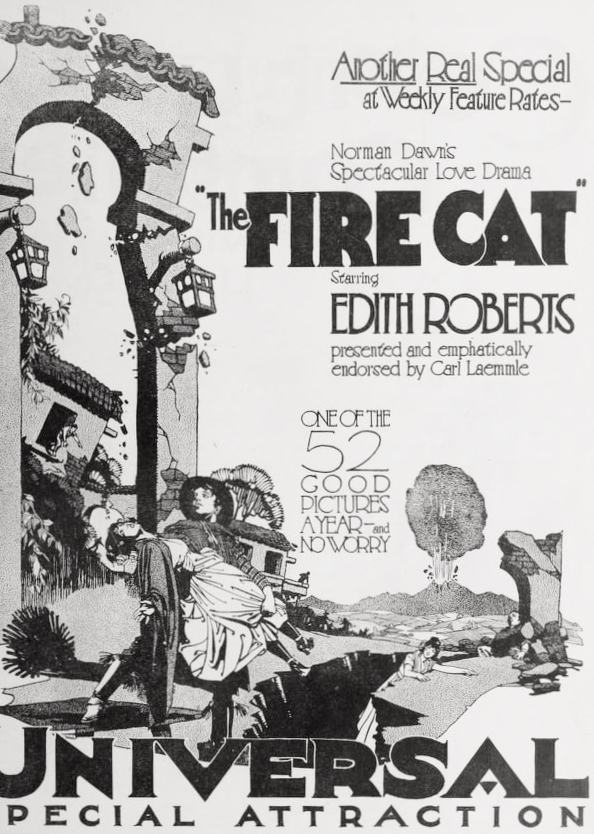
Lava, lace, and loathing—three ingredients Norman Dawn folds into every hand-tinted frame of The Fire Cat, a 1921 one-reel wonder that feels as if someone shoved The Wrath of the Gods into a tango bar and set the counter on fire.
Dawn, who also photographed Chop Suey & Co. and the snow-blinded western Rimrock Jones, here trades sushi slapstick and sagebrush for sulfurous Ecuadorian noir. The result is a fever dream that hisses like fat on a branding iron yet somehow never topples into camp; its sincerity is the kerosene that keeps the plot roaring.
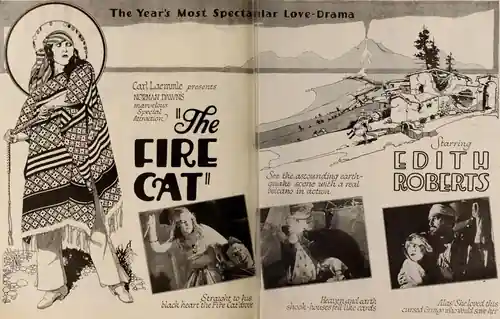
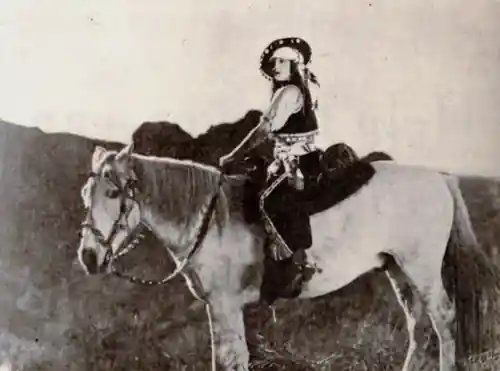
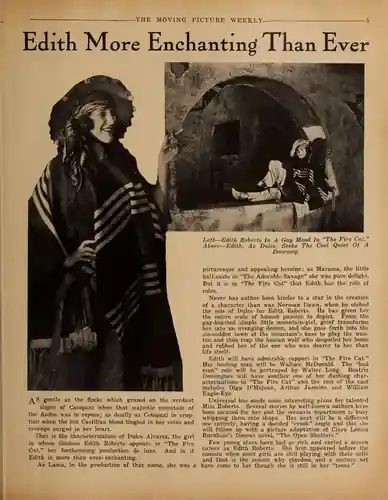
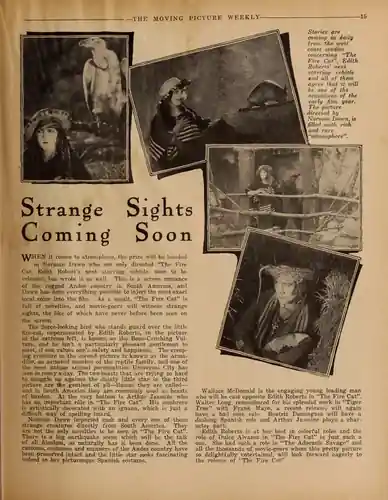
Edith Roberts, oft typecast as flapper decoration, is reborn Dulce—part bruja, part bruised dove—whose cheekbones could slice papel picado. She enters the narrative swathed in widow-black, but by reel two she’s a café table dancer in crimson fringe that whips like a matador’s muleta. Watch her eyes during the mother’s murder: the pupils dilate from shock to shareholder-cold in a single iris flicker, a masterclass in micro-acting before close-ups were fashionable.
Walter Long’s Gringo Burke arrives with the unsubtlety of a Gatling gun in a cathedral, yet the script (co-scribed by Philip D. Hurn, who also penned His Wife's Good Name) gifts him a serpent’s charisma. His tobacco-stained moustache curls like a conquistador’s stirrup, and when he growls "You mountain trash bleed silver, don’t ya?" the line lands with the authority of manifest destiny chewing on its own tail.
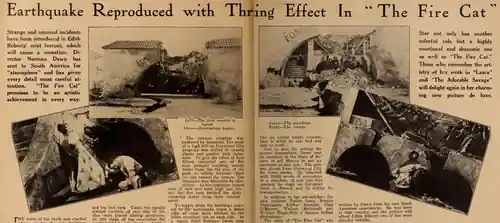
Dawn shot on location around Cotopaxi while real tremors rippled the plateau; you can sense the tectonic shivers in every handheld frame. The ash that drifts across the lens is not studio fluff but geological truth, making the film an inadvertent ethno-documentary. Compare this to the papier-mâché lava of When Bearcat Went Dry or even the respectable pyrotechnics in The Dead Line, and you’ll appreciate why cine-clubs now bill The Fire Cat as the first eco-revenge thriller.
The eruption sequence—achieved by double-exposing orange-tinted nitrate over navy-blue stock—creates a molten calligraphy that predates MGM’s sepia-to-Technicolor transitions by a decade. Lava seems to ooze under the sprocket holes, threatening to melt the projector itself. When the film premiered at L.A.’s Grauman’s Rialto, ushers kept pails of sand beneath the booth; urban legend claims one smoky print actually blistered, though nitrate archives blame a carelessly tossed cigarette.
Pancho, essayed by the tragically forgotten Beatrice Dominguez in gender-bending casting, embodies mestizo liminality: too indigenous for the ballroom, too Spanish-fluent for the tin mine. His cowardice accusation is the film’s moral lightning rod; Dulce’s slur "indio sin cojones" still singes contemporary ears. Yet the script complicates the stereotype: Pancho’s refusal to shoot Burke stems not from spinelessness but from Quechua cosmology—mountains demand blood sacrifice, and he will not interfere with the avenging spirit of Cotopaxi. Thus what reads as colonial self-hatred is, on closer inspection, indigenous fatalism weaponized against the white gaze.
Contrast this with the American derelict Ross (Arthur Jasmine), whose heroism is purely reactive. He saves Dulce from Burke’s pawing, yet it is Dulce who later drags his unconscious carcass through a magma cavern, her blistered feet a testament to laboring-class endurance. The gender inversion is radical for 1921: the brown woman as Prometheus, the Anglo male as swooning parcel.
Editor Olga D. Mojean employs what Peruvian critics now call "el corte andino"—a staccato rhythm that chops between extreme long shots of glacial peaks and claustrophobic close-ups of clenched peso coins. The juxtaposition evokes altitude sickness: the viewer gasps for narrative oxygen just as the characters gasp for Andean. The climactic mine collapse is cut like a music video—12 frames of pickaxe, 8 frames of Burke’s gold tooth, 6 frames of Dulce’s eye—creating a cubist avalanche that predates Soviet montage by at least a year.
No synchronized score survives, but censorship cards hint that exhibitors were encouraged to hire a single panpipe player who would segue into a tango when Dulce takes the stage. Modern restorations at the Cinemateca Quito paired the film with an Andean metal band; the result—charango riffs over magma—felt oddly authentic, proving that the movie’s DNA is musical as much as visual.
El signo de la tribu may boast gaucho bravado, but its stakes never transcend personal honor; The Fire Cat fuses personal vendetta with geological apocalypse, making Burke’s death feel cosmically pre-ordained rather than merely scripted. Poor Relations traffics in domestic guilt; Dulce’s relational wreckage is continental.
Even Notorious Gallagher, for all its railroad dynamite, never achieves the eco-justice undertone here: the mountain itself rises as both judge and executioner, a precedent later echoed—though diluted—in 1990s eco-actioners.
For decades the only extant element was a Portuguese intertitle reading "O gato de fogo!" discovered inside a São Paulo carnival costume trunk. Then in 2018 a 35mm nitrate dupe surfaced in a Quito convent—sisters had used the reels to press flowers. The image was marooned in vinegar syndrome, yet the lavender silhouettes of Roberts’ dance survived like bruised orchids. A Kickstarter funded a 4K wet-gate scan; the restored version premiered at Rotterdam, where critics compared its ferocity to a Amleto e il suo clown monologue delivered inside an active volcano.
The Fire Cat is not merely a curio for silent completists; it is a molotov against colonial extraction, a feminist re-visioning of revenge tropes, and a cinematographic gauntlet thrown at any filmmaker who believes spectacle and substance must exist on separate tectonic plates. Seek it in 16mm secret-cinema basements, in university symposiums, or in the cloud of ash that still drifts over Cotopaxi when the wind blows north. But beware: after the final frame, every cigarette you light will smell of sulfur, and every Stetson will look like a tombstone waiting to happen.
Verdict: 9.5/10—half a point docked only because history has not yet caught up with its brilliance.
IMDb —
1917
Community
Log in to comment.