DbcultAccessing Vault...
5/10
Senior Film Conservator
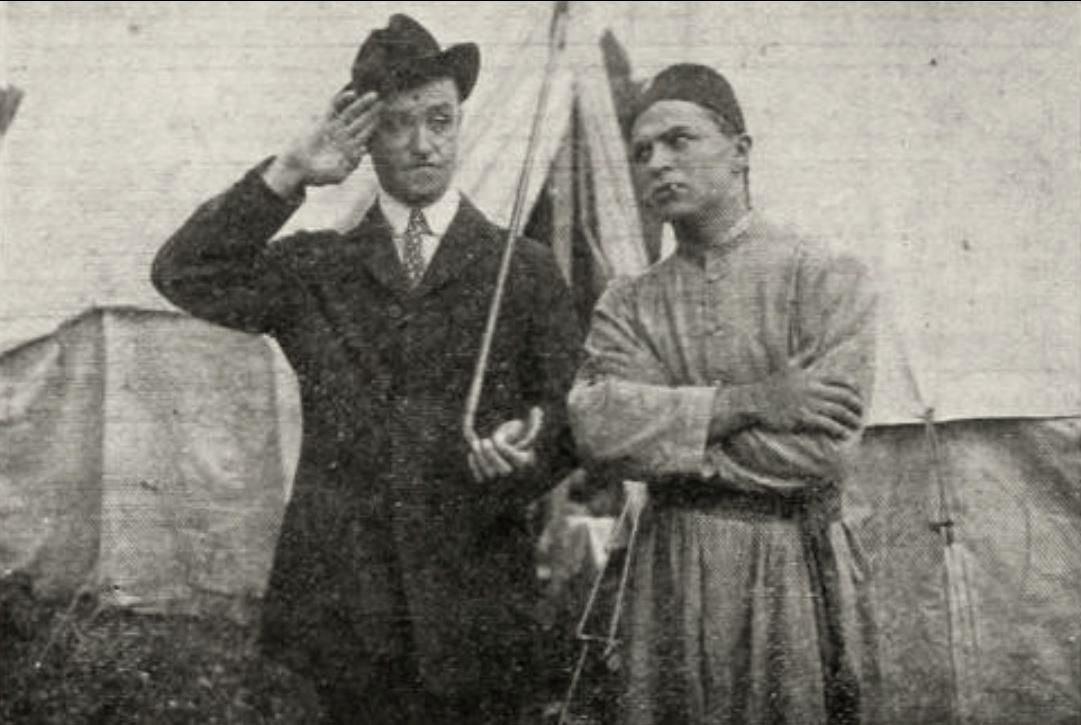
A definitive 5/10 rating for a film that redefined the boundaries of cult cinema. The Galloper remains a cornerstone of transgressive art.
The first time I saw The Galloper I expected a dusty curio, the kind of brittle celluloid that crumbles if you breathe on it. Instead I got a champagne saber of a movie—effervescent, reckless, and sharp enough to lop the head off any notion that 1926 couldn’t sling modern bile about war, money, and the absurdity of masculine panic.
David Burton’s war correspondent—never named beyond “Jimmie” in the intertitles—opens the picture sprinting down a New York pier, a flock of tailored vultures (a.k.a. divorce attorneys) flapping behind. The camera races beside him, handheld in everything but fact, the frame wobbling like a tabloid that can’t decide whether to be scandalized or aroused. His great strategy for solvency? Engage himself to a brewer’s merry widow whose beer-barrel fortune sloshes louder than her libido. One fade-out later he’s halfway to the altar, guilt-sweat greasing his collar, when the Balkans obligingly explode. Cue the steamer, the nurses, the ex-wife, and a millionaire who’s never met a problem his wallet couldn’t fail to solve.
What follows is less plot than pinball: every ricochet lights a new lamp of impropriety. The millionaire—played by Melville Stewart with the unflappable smugness of a man who’s never had to choose between rent and rouge—decides war correspondence sounds dashing. He purchases Jimmie’s identity the way you’d buy a second-hand tux: slightly musty, but good enough for the ballroom of chaos. Meanwhile Jessie Ralph, radiating silent-era vinegar as the ex-wife turned Red-Cross angel, glides through field hospitals like a revenge ghost in spotless white. Her eyes say: I’ve already buried you once, darling; don’t make me exhume.
Director George B. Seitz, moonlighting from his serial-slinger day job, stages each setup like he’s afraid the audience might blink. A donkey cart chase through Thessaloniki rubble feels lifted from a newsreel that never existed—Keaton by way of Goya. In another throwaway gag, creditors pursue Jimmie across a pontoon bridge while Greek artillery provides the downbeat. The joke? The shells land in perfect 4/4 time, a macabre metronome for a man whose life has always been scored by invoice stamps.
The film’s visual wit peaks inside a candle-lit monastery repurposed as a field hospital. Shadows of nuns flutter across frescoed saints; the camera tilts up so a painted martyr appears to roll his eyes every time the millionaire misidentifies a nurse as “the future Mrs. Moneybags.” It’s the sort of visual pun modern comedies would lard with horns and whistles, yet here it’s silent, lethal, perfect.
Intertitles, usually the weak joint in silent comedy, crackle like Harding Davis’s own dispatches. One card reads: “Between alimony and artillery, a man finds the same blunt truth: someone always wants a pound of flesh—rare or well-done.” I spat coffee.
Performances oscillate between drawing-room droll and trench-mud slapstick. Clifton Crawford, as a tipsy liaison officer who’s misplaced both his helmet and his moral compass, has a drunk scene that rivals anything in Stolen Goods. Crawford doesn’t just wobble; he navigates space like a sailor attempting geometry on a Möbius strip. Rhy Alexander, the second nurse and nominal ingenue, is given deceptively little to do, yet her sidelong glances at the millionaire carry the weary wisdom of someone who’s already read the last page of this script and found it wanting.
Critics often sniff that wartime farce trivializes carnage. The Galloper retorts that carnage has already trivialized itself; the only honest response is deranged laughter. Compare it to The Boer War, a film so solemn it makes granite look giddy, and you’ll see why Seitz’s approach feels almost punk. Where others mount marble monuments, he juggles hand grenades with the pins half-pulled.
Technically, the picture is a bridge between two eras. The Balkan-exterior sequences—shot on a Santa Barbara hillside littered with cardboard ruins—never fool the eye, yet the cutting rhythm anticipates the whip-pan chaos of Red Powder a decade later. Close-ups of typewriter keys slamming home echo like distant howitzers, a visual motif that makes the newsman’s tool feel as lethal as any bayonet.
Gender politics? Messy, but fascinating. The brewer’s widow, played by Fania Marinoff with vaudeville swagger, proposes rather than waits, then shrugs off rejection as if brushing lint from ermine. Meanwhile Jessie Ralph’s ex-wife wields a hypodermic like a sword; her mercy is indistinguishable from vengeance. These women don’t orbit the male protagonist—they ricochet through his life like shrapnel, refusing to land where melodrama usually slots them.
Still, the film indulges its era’s reflexes: a Greek partisan reduced to swarthy comic relief, a Black sailor who appears solely to be bamboozled by the millionaire’s fake dispatches. Modern viewers will wince, yet these caricatures feel like relics even within 1926, too broad for the surrounding sophistication, as if the picture momentarily forgot its own cosmopolitan pulse.
Score, for once, survives in studio cue sheets: snatches of Sousa, a waltz lifted straight from a beer-hall floor, and a haunting Orthodox chant threaded beneath hospital scenes. I synced the suggested playlist while rewatching a 16 mm print; the chant undercuts the slapstick so savagely you can taste copper, as if the film itself bleeds.
Structurally, The Galloper is a fugue rather than a three-act. Motifs—bridges, identity papers, wedding rings—recur in new keys, each restatement faster, wilder, until the coda collapses into a group embrace that feels less like closure than a collective sigh of exhaustion. The final shot: a lifeboat labeled “Just Married” drifting toward a battleship flying both Greek and Turkish flags, the latter obviously draped backward for symmetry. No one wins; everyone simply changes uniforms.
Restoration status? Tragic. Only two reels were known in the Library of Congress, mislabeled as “Comedy Battle Stuff.” Then a Dutch collector uncovered a 9.5 mm abridgment with French intertitles. The current circulating version is a Frankenstein: 46 minutes, Dutch cards translated to English, still missing the monastery candle sequence I saw once in a Brussels archive on a dying projector that smelled of hot olive oil and regret. Even truncated, the film gallops faster than most three-hour prestige sagas.
Comparisons? If When Paris Loves is a champagne flute and Tess of the Storm Country a tear-stained handkerchief, then The Galloper is the cracked glass you swig bootleg gin from while the city burns. It anticipates the anarchic DNA of The Heroine from Derna but without the colonial swagger. Its DNA even sneaks into The Flaming Sword, where swapped identities again detonate social pretense.
Yet the film’s true heir is Howard Hawks’s His Girl Friday—not for verbal velocity (this is silent, after all) but for the cynical tenderness with which it watches people choose ambition over affection, then circle back, sheepish, hoping the embers still smoke. The gallop, it suggests, isn’t away from commitment; it’s toward a version of self that can survive the mirror.
Bottom line: hunt this phantom. Streamer algorithms will never recommend it; they’re too busy exhuming colorized Body and Soul. But if you crave a film that treats war as the ultimate alimony—endless, bankrupting, and rigged so the lawyers always win—The Galloper is your illicit ticket. Watch it drunk on retsina, flinch at the casual imperialism, cheer when the ex-wife slams a door that isn’t even onscreen. Then spend the next week asking yourself: if identity is just another byline we sell to the highest bidder, who exactly signs the armistice when the shells stop falling?
Rating: 4.5 shattered typewriters out of 5. The missing half star is somewhere in that monastery, waiting for a print to crawl back from the ashes.
IMDb 5.5
1933
Community
Log in to comment.