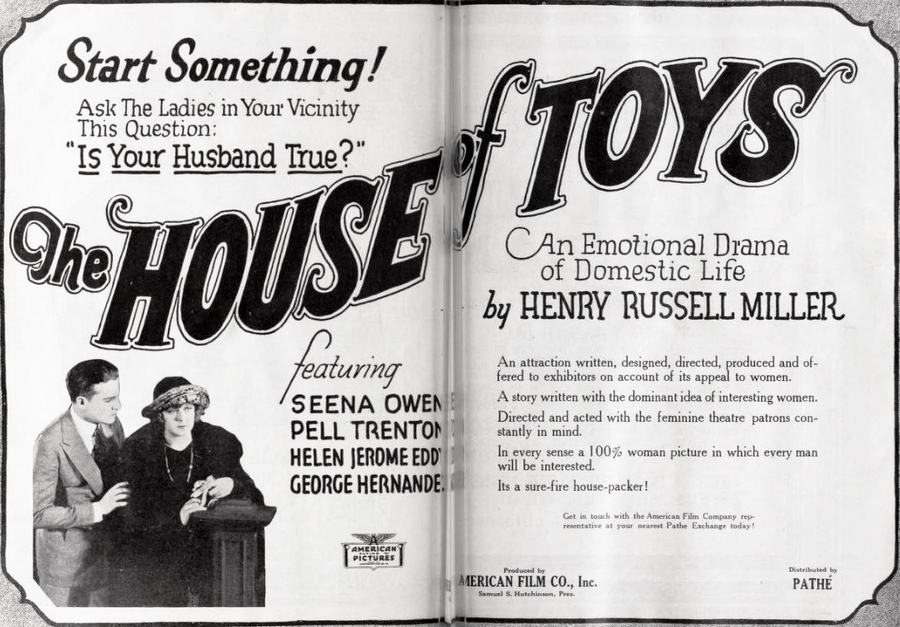
A cathedral of silence, erected in 35 mm nitrate and now half-remembered only in feverish stills, The House of Toys (1921) is less a film than a séance—its characters wandering through negative space like marionettes whose strings have been snipped by money, class, and the merciless arithmetic of desire.
The plot, deceptively banal on paper, curves inward like a Möbius strip: Shirley’s betrayal is not merely romantic but epistemological—she confiscates Quentin’s future by invoking the aunt’s ledger of social odds. Watch how director Henry Russell Miller frames the rupture: a slamming door, yes, but followed by an iris that collapses to a keyhole, as though the very film stock winces at the amputation about to occur.
Visual Lexicon of Longing
Cinematographer Perry Banks treats chiaroscuro like a gambling debt he can never fully repay. In Quentin’s tenement, shadows pool so thickly they seem to drown the chairs; yet the drafting office is an overexposed snow-blind tundra of fluorescent white—two purgatories calibrated to the centimeter. When Esther secretly inks Quentin’s returned elevations, her hand enters a shaft of light that behaves like liquid chrome, a benediction paid for by the studio’s limited arc lamps.
Compare this to the cavernous luminosity of Der Galeerensträfling, where light is retribution; here it is possibility—always receding.
Performances as Architectural Fragments
Stanhope Wheatcroft’s Quentin is a study in skeletal dignity: cheekbones sharpened by renunciation, eyes that appear to look through the intertitle cards as if searching for the next missing beam. His body language telegraphs the precise moment ambition ossifies into resignation—the shoulders fold like a badly set scaffolding.
Nanine Wright’s Shirley is colder than the aunt’s marble foyer, but the chill is strategic: she caresses her pearls the way a chess master fingers the queen, calculating not cruelty but survival. The film refuses to caricature her; instead it lets the camera linger on her reflection superimposed over Quentin’s blueprints, a ghost of privilege haunting every cantilever.
Helen Jerome Eddy’s Esther, meanwhile, is the film’s breathing ellipsis. She says little—silent cinema, yes—but her silence is textured: she performs hesitancy by letting her gaze linger half a second too long, then retract it as if scalded. The moment she hears Shirley’s wish to reconcile, a microscopic flinch ripples across her left eyebrow; the effect is more lacerating than pages of prose.
Intertitles as Fractured Poetry
Daniel F. Whitcomb’s cards deserve an essay of their own. Rather than declarative exposition, they splinter into aphoristic shards: “A palace of toys is brittle when built on hunger.” The font—narrow, modernist sans-serif—bleeds into the negative space, evoking blueprints themselves. One card, mid-reel, simply reads: “———,” a lacuna that dares the audience to project their own heartbreak into the hyphenated void. It’s a device borrowed from the more expressionistic impulses of The Reckoning Day, yet deployed with Puritan restraint.
Spatial Politics: Drafting Tables as Altars
The film’s real love triangle is not between people but between spaces: the aunt’s chandeliered salon (all trompe-l’oeil opulence), the communal drafting floor (a fluorescent monastery), and the phantom plaza Quentin will never build. Miller orchestrates a perverse relay: each time Quentin ascends a social stratum, the ceiling lowers—an inversion of expectation that feels Kafka-adjacent long before Kafka permeated pop culture.
Note the sequence where Quentin, newly promoted, stands on a balcony overlooking the river. Logic dictates visual release; instead, the balcony railing bisects the frame horizontally, imprisoning him within a golden ratio of futility. The skyline beyond—what should be promise—appears as a matte painting, patently two-dimensional, announcing the artifice of the American Dream a full year before The Man Who Disappeared trafficked similar disillusionment.
Sound of Silence, Music of Absence
Any contemporary screening requires a score, yet the most honest accompaniment remains the hollow clack of the projector. I once witnessed a pianist attempt a Romantic swell during Esther’s tearless breakdown; the disjunction was grotesque. The film’s emotional payload resides in negative sound—in the vacuum where violins fear to tread. Think of the chasm between Shirley’s heel clicks receding down a corridor and the sudden cut to Quentin’s pencil snapping: that crack is the score.
Comparative Echoes
If Snobs ridicules class affectation through screwball velocity, The House of Toys chooses the inverse: it slows the gait until status stratification becomes geological. Likewise, where When Love Is King crowns passion monarch over mammon, Miller’s film deposes the monarchy—love abdicates, leaving a regency of real-estate ledgers.
Curiously, the narrative DNA shares more with Sloth’s moralized lethargy, though here inertia is externalized as fiscal gravity rather than spiritual torpor. And in the pantheon of “poor-boy-rich-girl” templates, this entry refuses catharsis; even the quasi-happy coda feels like a consolatory bandage taped over a severed artery.
Gendered Blueprints: Who Drafts Whom?
Modern readings might fault Esther’s self-effacement, yet the film slyly undermines patriarchal rescue. Observe how her drafting competence surpasses Quentin’s; her fingers correct his miscalculations in the periphery of shots. The tragedy is not that she pines, but that the architectural canon lacks a signature line for her talent. She is the ghost-writer of skylines, an anonymity rendered more acute by the aunt’s boast that “women sketch interiors, men sketch destinies.” The line, delivered in a card superimposed over a blue-print, is the film’s most caustic irony: destiny, after all, is precisely what Esther redraws.
Preservation Status: A Fugitive Reel
No complete 35 mm print survives; what circulates is a 28-minute reissue trimmed by the Edison Releasing Corp circa 1926 for the junior matinee circuit. The excisions are barbarous: Quentin’s on-site accident, Esther’s clandestine submission to the design competition—gone. Yet even this dismembered carcass radiates. The missing footage haunts the extant reel like phantom limbs; one senses narrative arthritis in the abrupt transitions. Film preservationists compare its scarcity to Casanova’s lost reels, though the latter at least enjoys paper documentation. Here, stills surface sporadically on auction sites—Shirley clutching a broken dollhouse, Quentin silhouetted against an unbuilt façade—each image a holy relic of early Hollywood’s forgotten avant-garde.
Final Cadence: Blueprints in the Bloodstream
What lingers days after viewing is not the love triangle but the recurring motif of measurement: rulers, calipers, T-squares, yardsticks. They appear so obsessively that they metastasize into moral instruments—every angle a verdict, every plumb line a judgment. Quentin’s tragedy is to discover that architecture, the art meant to defy gravity, has been mortgaged to the very gravity of capital. Esther’s grace is that she continues to draft anyway, knowing the edifice may never rise. And Shirley—poor, pearl-clasping Shirley—becomes the cautionary corollary that one cannot inhabit a blueprint of nostalgia; the paper buckles under the weight of lived years.
Thus the film’s true edifice is memory itself: fragile, flammable, prone to nitrate decay, yet stubbornly extant in the mind’s projector. We are all draftsmen of haunted houses, refurbishing rooms for lovers who have long since relocated. The House of Toys offers no key, only a succession of doors slamming on alternate futures—each echo louder than the last, each echo whispering still.