DbcultAccessing Vault...
Cult Review
Senior Film Conservator
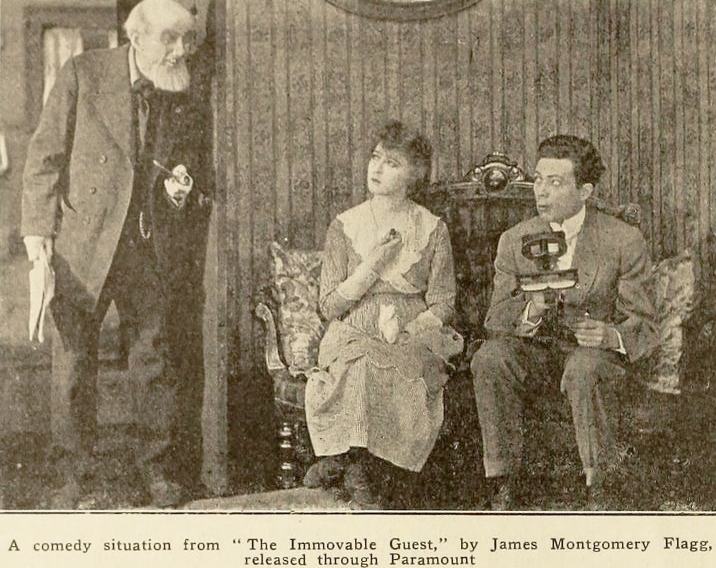
Stepping back into the flickering shadows of early cinema, one often encounters narratives that, despite their age, resonate with an uncanny contemporary relevance. 'The Immovable Guest', a 1917 silent film, is precisely such a discovery—a meticulously crafted domestic comedy that transcends its historical context to offer a timeless commentary on human nature, social etiquette, and the profound discomfort of an unwelcome presence. Though the plot, as presented, is a blank canvas, the very title, coupled with the era's prevalent themes, paints a vivid picture of a scenario ripe for both humor and subtle psychological exploration. We are invited to imagine a world where the sanctity of the home is subtly yet irrevocably breached by an individual whose only weapon is his sheer, unyielding inertia.
The brilliance of a film like 'The Immovable Guest' lies not merely in its potential for slapstick or overt gags, but in its capacity to dissect the intricate dance of social obligation and personal exasperation. Imagine the plight of the beleaguered Finches, a couple whose lives, by all accounts, run on the well-oiled gears of routine and respectability. Their home, their sanctuary, becomes the unwitting stage for a prolonged, silent battle of wills against the titular guest, Mr. Phileas Foggins. Arthur Housman, known for his nuanced comedic performances, would undoubtedly have brought a particular brand of infuriating charm to Foggins, a man whose very passivity becomes his greatest strength. One can envision Housman's subtle facial expressions, the slight tilt of his head, the languid grace with which he occupies space, all conspiring to convey an unshakeable resolve to remain exactly where he is. This isn't the boisterous intrusion of a villain, but the insidious creep of an inconvenience that slowly, surely, unravels the fabric of a household.
Flora Finch, a stalwart of early cinema, would have been perfectly cast as Mrs. Arabella Finch, the matriarch whose initial politeness gradually curdles into a cocktail of frustration and barely suppressed fury. Her physical comedy, her expressive gestures, would have been crucial in conveying the escalating domestic crisis without a single spoken word. Picture her subtle eye-rolls, the increasingly desperate flail of her hands, the way she might pace with a barely contained agitation, each movement a silent plea for liberation from her predicament. Joseph Burke, as Mr. Thaddeus Finch, would likely embody the weary, resigned husband, perhaps attempting diplomatic solutions that inevitably backfire, his quiet desperation a poignant counterpoint to his wife's more overt distress. This dynamic between the couple, forced to navigate an increasingly absurd situation with the constraints of Edwardian propriety, forms the emotional core of the film, highlighting the societal pressures that often trapped individuals in uncomfortable situations.
The genius of James Montgomery Flagg's writing, even without a detailed plot synopsis, can be inferred through the very premise. Flagg, a celebrated illustrator and writer, possessed a keen eye for character and situation, often infusing his work with a dry wit and an understanding of human foibles. His contribution to 'The Immovable Guest' would likely have centered on the careful calibration of comedic beats, the gradual build-up of tension, and the crafting of characters whose reactions feel both exaggerated for comedic effect and deeply human. The screenplay would have needed to rely heavily on visual storytelling—the arrangement of props, the blocking of actors, the subtle interplay of glances and gestures—to convey the narrative's progression and the characters' inner turmoil. This is where silent cinema truly shone, transforming everyday situations into grand theatrical expressions of emotion.
Claire Whitney, likely playing the Finches' daughter, Clara, would introduce another layer to this domestic entanglement. Young, perhaps on the cusp of romance or social ambition, Clara's world would be disrupted by Foggins' omnipresence. Her interactions, her budding relationships, might be thwarted or made awkward by the guest's lingering shadow. This provides an opportunity for both comedic scenarios and a touch of pathos, as her youthful aspirations clash with the stubborn reality of her home life. Perhaps a suitor, initially charmed by Clara, finds himself increasingly bewildered or even repulsed by the strange, static presence in the Finch household, leading to further complications and comedic misunderstandings. Such a subplot would allow Whitney to showcase a range of emotions, from initial annoyance to genuine despair, all played out against the backdrop of an immovable force.
The societal context of 1917 also lends a particular weight to 'The Immovable Guest'. This was a time when social standing, appearances, and adherence to unspoken rules were paramount. The Finches' inability to simply expel their guest speaks volumes about the constraints of their era. To do so would be to commit a profound social gaffe, a breach of hospitality that could damage their reputation. The film, therefore, functions as a subtle critique of these rigid social structures, exposing how they could lead to absurd and agonizing situations. It’s a comedy of manners, yes, but one with a sharp, incisive edge that cuts to the heart of human vulnerability and the tyranny of expectation.
Comparing 'The Immovable Guest' to other films of its period further illuminates its potential brilliance. One might draw parallels with the domestic comedies of the era, such as Just Neighbors, which also explores the humorous friction arising from proximity and interpersonal dynamics. While Just Neighbors focuses on the external conflict between households, 'The Immovable Guest' turns the lens inward, examining the internal combustion within a single home. The subtle psychological torment inflicted by Foggins could also be seen as a comedic inversion of the more sinister, pervasive dread found in serials like The Mysteries of Myra or Who Is Number One?, where an unknown, insidious force gradually encroaches upon the protagonists' lives, albeit with far more dire consequences. Here, the 'mystery' is not 'who' but 'why won't he leave?' and the 'threat' is merely the erosion of peace.
The film's visual language would have been paramount. Imagine the carefully composed shots: Foggins perpetually in the foreground, perhaps lounging comfortably on the Finches' most prized armchair, while the Finches themselves are relegated to the periphery, their movements becoming increasingly constrained and desperate. The use of intertitles would not just convey dialogue, but also internal monologues, perhaps Mrs. Finch's silent, scathing judgments or Mr. Finch's philosophical musings on the nature of unwanted guests. The very lack of sound would amplify the visual cues, forcing the audience to pay closer attention to the actors' expressions, their body language, and the subtle shifts in the domestic environment. A wilting flower, a dusty corner, a perpetually unread newspaper in Foggins' hand—all could serve as visual metaphors for the passage of time and the slow decay of the Finches' patience.
The comedic timing, a hallmark of silent film, would be critical here. The gradual escalation of the Finches' attempts to dislodge Foggins, from polite suggestions to increasingly elaborate (and likely disastrous) schemes, would provide ample opportunity for physical comedy and perfectly timed reactions. Perhaps they try to make the house uncomfortable—turning down the heat, serving unappetizing meals, engaging in loud, annoying activities—only for Foggins to remain utterly unfazed, perhaps even finding a strange comfort in their efforts. This kind of escalating absurdity is a staple of comedic writing and would have been expertly handled by a writer of Flagg's caliber and a cast of seasoned performers. The film could have explored the boundaries of passive-aggressive warfare, with each side attempting to outmaneuver the other without ever breaking the veneer of politeness.
Moreover, the thematic undertones of 'The Immovable Guest' could touch upon the broader societal anxieties of the early 20th century. The idea of an individual disrupting the established order, even in a seemingly benign way, might have resonated with audiences grappling with rapid social and technological change. The 'immovable guest' could be seen as a metaphor for any number of unwelcome changes or persistent problems that society, or individuals, found themselves unable to shake off. This gives the film a depth beyond mere comedy, elevating it to a form of social commentary, much like how The Vicar of Wakefield, also from 1917, explored moral and familial struggles within a specific social setting, albeit in a dramatic rather than comedic vein. While The Slavey might have offered a more direct critique of class relations through the lens of domestic service, 'The Immovable Guest' offers a subtle, almost philosophical take on the internal pressures of maintaining social appearances.
The film's resolution, while speculative, would be crucial to its lasting impact. Does Foggins eventually leave, perhaps spurred by an unexpected event or a final, desperate gambit by the Finches? Or does he become a permanent fixture, forcing the Finches to adapt to a new, perpetually uncomfortable normal? The latter, while perhaps less conventionally satisfying, might offer a more profound and darkly comedic statement on the enduring power of inertia and the human capacity for adaptation (or resignation). A truly bold ending might see the Finches, exasperated beyond measure, resorting to some utterly outrageous, yet still polite, act of desperation, perhaps even abandoning their own home to escape their guest. This would elevate the film from a simple domestic comedy to a poignant, albeit humorous, exploration of psychological breaking points.
The performances of Housman, Finch, Burke, and Whitney would have been central to conveying these nuances. Housman's ability to be simultaneously infuriating and strangely endearing would be key to making Foggins a character the audience loves to hate, or at least, loves to observe. Finch's expressive face and gestures would carry the weight of the Finches' exasperation, while Burke's more understated reactions would provide a grounding realism. Whitney's youthful energy and the impact of Foggins on her romantic life would add a relatable, youthful perspective to the older characters' plight. Their collective ability to communicate complex emotions and comedic timing without dialogue is the true artistry of silent film, and in 'The Immovable Guest', it would have been put to the ultimate test.
In a broader cinematic context, 'The Immovable Guest' stands as a testament to the versatility of early filmmaking. It demonstrates that compelling narratives, rich characterizations, and insightful social commentary were not solely the domain of grand dramas like Livets konflikter or intense serials such as Homunculus, 2. Teil - Das geheimnisvolle Buch. Instead, it proves that even a seemingly simple premise, expertly executed, could yield a work of enduring charm and intellectual depth. The film's inferred exploration of social pressure and the breaking point of politeness aligns, in a comedic sense, with the more dramatic struggles against oppressive forces seen in films like Shackled or The Rebel, albeit with a far lighter touch. The 'rebellion' here is internal, a silent scream against an unyielding houseguest.
The enduring appeal of films like 'The Immovable Guest' lies in their ability to tap into universal human experiences. Who among us hasn't, at some point, felt the burden of an unwelcome presence, a situation we can't quite escape, or the pressure to maintain a facade of politeness despite mounting internal protest? This film, through its silent artistry, would have externalized these very common, yet often unspoken, anxieties. It's a masterclass in how to build tension and elicit laughter from the most mundane of scenarios, transforming a simple domestic inconvenience into a battle of wills that is both hilarious and deeply relatable. Its legacy, even from a purely conceptual standpoint, reinforces the idea that true cinematic storytelling transcends dialogue, relying instead on the potent alchemy of performance, direction, and a finely tuned understanding of the human condition.
Ultimately, 'The Immovable Guest', even in its hypothetical glory, represents the best of what silent cinema offered: inventive storytelling, expressive performances, and a profound engagement with the subtleties of human interaction. It's a reminder that sometimes, the most powerful stories are told not with booming dialogue or grand special effects, but with a single, unyielding presence, a household on the brink, and the silent, desperate plea of its inhabitants. It's a film that, were it fully available today, would undoubtedly spark fresh appreciation for the ingenious ways filmmakers of a century ago tackled themes that remain evergreen, illustrating that the art of the moving picture has always been about capturing the essence of life's often absurd, sometimes agonizing, and always fascinating drama. The echoes of its comedic brilliance and social critique resonate, a testament to its timeless quality and the enduring power of a well-told story, even one that relies entirely on what remains unsaid.
IMDb 5.5
1931
Community
Log in to comment.