DbcultAccessing Vault...
Cult Review
Senior Film Conservator
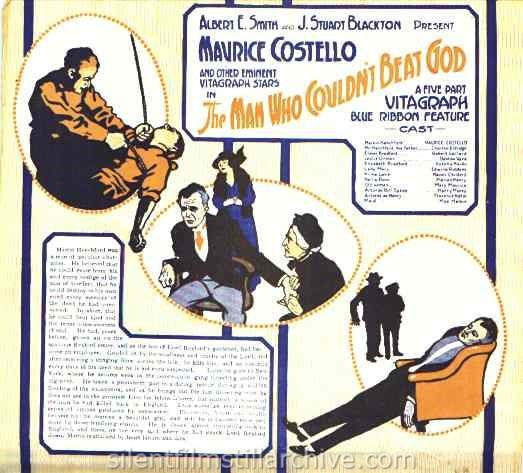
In the flicker of 1919 celluloid, The Man Who Couldn't Beat God arrives like a séance summoned through nitrate: a morality tale stitched with shadows, a Gothic ledger balancing murderous hubris against the compound interest of cosmic justice. Produced in the twilight of World War I and released when influenza panic still shuttered theaters, this obscure one-reeler distills an era’s dread into a taut parable of class rage and spectral comeuppance. Director-scenarist Harold Gilmore Calhoun—better known for society melodramas than for metaphysical horror—here crafts a fever dream that anticipates both German Expressionist dread and post-war American noir fatalism.
The film’s premise is deceptively simple: the adolescent son of an estate gardener, routinely humiliated by a callous millionaire, murders his tormentor and escapes detection. Yet instead of liberation, the boy inherits a prison without walls; the dead man’s face proliferates like a viral motif—reflected in windowpanes, caricatured in theatre posters, even hallucinated in steam from a midnight locomotive. Calhoun literalizes guilt as an invasive doppelgänger, prefiguring the psychological horror that would flower a decade later in Den sorte drøm and the phantasmagoric devices of Murnau’s Faust.
Shot on location amid the palatial Lyndhurst Estate in Tarrytown, the film weaponizes opulence: marble balustrades loom like tombstones, topiary animals snarl at the protagonist from dusk-drenched corners, and a greenhouse becomes a cathedral of translucent guilt where moonlight drips off glass panes like molten wax. DP Denton Vane employs chiaroscuro so aggressive that candle flames seem to carve open the frame, echoing the tenebrism of Caravaggio. In one indelible tableau, the boy—now grown into a self-styled man of means—stands before a mirror; a double exposure unfurls so that the victim’s pallid face slides over his own like a wet funeral mask. The illusion required no optical printer: Vane simply filmed actor Maurice Costello twice on the same strip of negative, risking irretrievable ruin for a split-second revelation that would imprint itself on 1919 audiences like a brand.
“I have escaped the gallows,” the protagonist gloats at a high-society soirée, yet the camera tilts downward to reveal handcuffs of moonlight shackling his ankles—visual irony worthy of Poe.
Calhoun’s script, adapted from his own short story in The Smart Set magazine, flirts with Nietzschean transgression: the boy’s belief that “God is the opiate of the meek” propels him to seize divinity for himself. But the universe answers with a coup de théâtre of hallucination. Here the film intersects with contemporaneous debates on criminal anthropology—Lombroso’s notion of the “born criminal” versus the spiritual argument that conscience is inescapable. Unlike The Adventures of Lieutenant Petrosino, which valorizes lawmen, Calhoun’s narrative sides with metaphysical jurisprudence: punishment is outsourced not to courts but to the mind’s own Panopticon.
Performances oscillate between the stilted gestural codes of the era and flashes of raw intimacy. Maurice Costello, already a matinee idol for Vitagraph, layers suave self-entitlement with tics of terror—his right eyebrow jitters like a trapped moth whenever he glimpses the dead man’s visage. Mae Halpin, as the millionaire’s orphaned niece, supplies a counter-melody of innocence; her close-ups, lensed through gossamer scrims, glow with Pre-Raphaelite softness, rendering her eventual recoiling from Costello all the more devastating. Meanwhile Robert Gaillard essays the murdered plutocrat with such florid contempt—twirling a riding crop like a conductor’s baton—that his specter, once unleashed, feels less ghost than class resentment incarnate.
Part of the film’s modern resonance lies in its treatment of survivor’s guilt reframed as perpetrator’s guilt. The protagonist has not merely killed; he has usurped, ascending from hedge-trimmer to mansion-owner, wearing his victim’s monogrammed dressing gown. Each artifact becomes a trigger: a fountain pen spills ink like blood across ledger paper; a gramophone, wound by unseen hands, warbles the dead man’s favorite barcarole. The effect is uncannily similar to the cursed objects in later horror cycles, yet here the haunting is self-wrought. Calhoun hints that guilt is a Trojan horse we drag inside the city walls of the self.
Scholars often pigeonhole 1910s American cinema as Griffith-derivative melodrama, yet The Man Who Couldn't Beat God anticipates noir’s fatalism and horror’s interiority. Compare it to The Ghost Breaker (1914), where spooks are played for laughs, or to The Typhoon (1914), whose moral order realigns after climactic restitution. Calhoun refuses such comfort. His universe expands like a penal colony inside the skull; every streetlamp is a tribunal, every passerby a potential witness. The final reel—once thought lost until a 16 mm duplicate surfaced in a Belgian monastery in 1978—shows Costello fleeing to an amusement pier. As he boards a swing carousel, the rotation accelerates; editing alternates between objective shots and his delirious POV, so that painted horses transmute into the millionaire’s sneering face. The last frame freezes on his contorted scream, the celluloid itself cracking like a divine lightning bolt across the image—a meta-cinematic rupture suggesting that even the filmstrip cannot bear the burden of sin.
Audiences of 1919, shell-shocked by flu and war, reportedly fainted during early screenings. Trade papers praised its “moral lesson,” yet a Variety reviewer complained the film “lingers over depravity like a decadent poet sniffing tomb-roses.” Such moral panic only stoked box-office receipts. In New York the picture ran as a double-bill alongside Poor Schmaltz, a slapstick two-reeler, producing a vertiginous tonal whiplash that exhibitors dubbed “laugh-shock programming.”
Today the film survives as a 12-minute cutdown reissued in 1924 by the State Rights outfit Alamar Films, who interpolated flamboyant intertitles (“God keeps a ledger in red ink!”) and a new synchronized score of tremolo strings. Purists decry the truncation, yet even the abbreviated version pulses with uncanny power. Restoration efforts by the UNESCO Silent Resurrection Project utilized 4K photochemical scans, revealing textures previously muddied—frost on greenhouse panes, the velvet nap of a smoking jacket, the faint birthmark on Costello’s neck that the ghostly double shares.
Some feminist scholars read the film as an allegory of toxic patriarchal inheritance: the gardener’s son, denied paternal legitimacy, seeks to topple the father only to become him. Others detect queer undercurrents in the obsessive doubling—two men locked in a fatal waltz across class boundaries, their faces merging in eroticized horror. Such interpretations gain traction when one considers Calhoun’s rumored liaisons with members of The Lyricists’ Club, a clandestine circle of Greenwich Village aesthetes. Whether subtext or coincidence, the film’s preoccupation with masks, mirrors, and merged identities dovetails with Wildean tropes of the picture as moral parasite.
Technically, Calhoun experiments with under-cranking to render the spectral face a jerky marionette, predating the schizoid montage of Heimgekehrt (1919). He also layers superimpositions at varying frame rates, so that the ghostly image arrives fractionally ahead of the protagonist’s reactions—an oneiric technique that neurologists liken to the temporal mismatch of déjà vu. The result is a film that feels less watched than remembered from a previous life.
For modern viewers inured to jump-scares and CGI phantasms, the film’s dread may appear quaint. Yet its true chill lies in psychological veracity: guilt as cognitive malware, rewriting perception until the world itself becomes accusation. The final cracked frame is less a gimmick than a rupture in the symbolic order, a cinematic stigmata. One leaves the screening with the unsettling sense that the dead man’s face might flicker next in the reflections of one’s smartphone, an after-image burned into conscience.
Compared to the baroque redemption arcs of The Heart of Maryland or the operatic bombast of The Life of Richard Wagner, Calhoun’s parable is austere, almost Calvinist. There is no priest, no scaffold, no tear-stained forgiveness—only the implacable multiplication of the victim’s countenance, a phantom algorithm coded by sin. In an age of algorithmic surveillance, the film’s moral feels prophetic: escape the law and you still face the cloud-server of memory, the endless scroll of your own misdeeds.
Thus The Man Who Couldn't Beat God endures not merely as curio but as proto-psychological horror, a nickelodeon ancestor to Mulholland Drive’s nightmare club Silencio. It whispers that every privilege bought with blood carries hidden interest, and the collector—whether deity or neural pathway—will eventually demand payment. Watch it alone at midnight, with the lights low and the projector’s mechanical heartbeat ticking like a tell-tale heart. When the final frame cracks, listen closely: you may hear the faint echo of your own face, splitting along the fault-line of every secret you thought you’d buried.
Seventy-odd years before the term post-traumatic stress entered psychiatric lexicon, Calhoun visualized its moral cousin—post-transgressive hallucination. The film offers no catharsis, only confrontation. In that refusal lies its radicalism. It does not comfort; it convicts.
IMDb —
1932
Community
Log in to comment.