DbcultAccessing Vault...
Cult Review
Senior Film Conservator
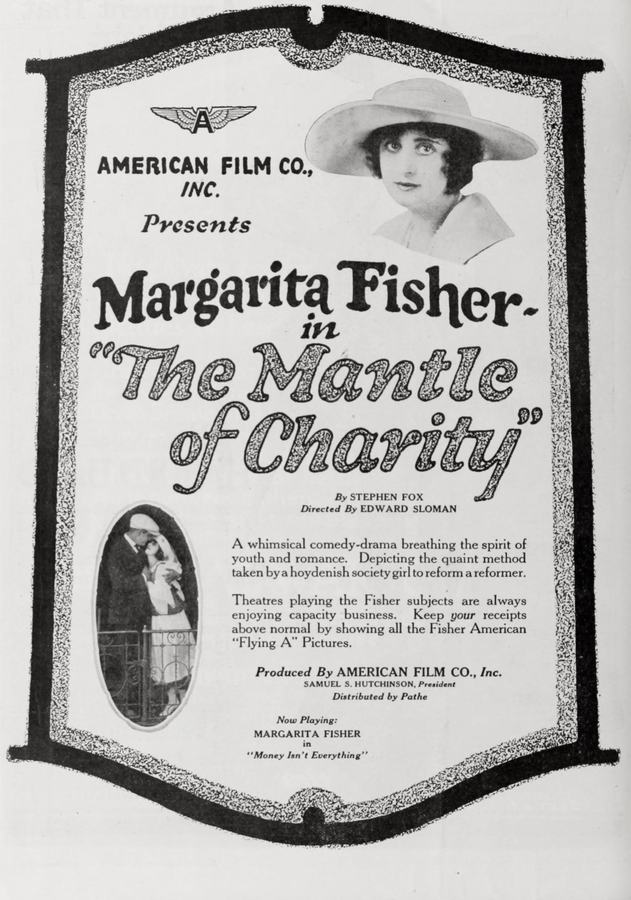
The year 1918 was a watershed moment for the cinematic medium, a period where the primitive flickers of the nickelodeon era were rapidly evolving into sophisticated social commentaries. Among these gems lies The Mantle of Charity, a film that navigates the precarious intersection of romantic comedy and biting sociopolitical satire. Directed by the prolific Edward Sloman and penned by a young Jules Furthman—who would later become a cornerstone of Hollywood’s Golden Age writing—this work remains a fascinating study of early 20th-century American values.
The film opens with a sequence that is both charming and narratively dense. Margarita Fischer, portraying the spirited Norah McDonald, immediately establishes herself as a protagonist of immense agency. Her refusal to consign her pet to the baggage car is not merely a quirk of the wealthy; it is a rejection of the dehumanizing categorization that defines the modern industrial world. By dressing her Pekinese in baby clothes, she engages in a performance within a performance, a motif that resonates with the broader silent era preoccupation with masks and identity, much like the thematic underpinnings of He Who Gets Slapped.
The cinematography, while adhering to the technical constraints of the period, utilizes the claustrophobic space of the Pullman coach to emphasize the social pressure cooker in which Norah finds herself. When she encounters Paul Howell (Jack Mower), the visual language shifts. Sloman employs medium shots that capture the stark contrast between Norah’s warm, maternal (albeit feigned) aura and Howell’s stiff, aristocratic posture. This meeting of two disparate worlds—the organic and the institutional—sets the stage for a conflict that is as much about the heart as it is about the ledger book.
One cannot discuss The Mantle of Charity without addressing its central polemic: the failure of 'Scientific Management' when applied to human suffering. During the late 1910s, the influence of Taylorism began to bleed into social work, suggesting that efficiency and data could solve poverty. Paul Howell is the cinematic avatar of this movement. His charity organization is a labyrinth of forms, interviews, and cold assessments. In this regard, the film serves as a lighter, more optimistic cousin to the grim social realities explored in Within Our Gates, though it tackles its subject with a satirical scalpel rather than a sledgehammer.
Norah’s rebellion against Howell’s methods is the film’s moral heartbeat. Upon accepting a position within his ranks, her disillusionment is instantaneous. She witnesses the friction between the 'deserving' and 'undeserving' poor—a binary that Howell’s bureaucracy reinforces. Her decision to launch a rival organization is an act of radical empathy. Where Howell requires a signature, Norah offers a hand. Where he demands a history of past failures, she offers a future of immediate support. This tension mirrors the domestic and social conflicts found in The Heart of Nora Flynn, where class misunderstandings drive the narrative engine.
Margarita Fischer’s performance is nothing short of luminous. In an era where silent acting often drifted into the histrionic, Fischer maintains a grounded, expressive subtlety. Her ability to pivot from the comedic absurdity of nursing a dog in public to the genuine pathos of helping the disenfranchised is a testament to her range. Jack Mower, conversely, plays the 'straight man' with a stiff-necked precision that makes his eventual softening all the more rewarding. Their chemistry is built on a foundation of intellectual respect, a rarity in the 'meet-cute' tropes of the time.
Edward Sloman’s direction is characterized by a fluid narrative pace. He avoids the static tableaux that plagued many of his contemporaries, opting instead for a dynamic editing style that underscores the frantic nature of Norah’s dual life. The film’s pacing reflects the chaotic energy of the city, contrasting with the quiet, contemplative moments of Norah’s private charity work. This directorial finesse is reminiscent of the sophisticated storytelling seen in The Talk of the Town, another film that deftly balances humor with social observation.
The climax of the film—the revelation that the 'baby' is, in fact, a Pekinese—is a masterclass in comedic timing and thematic resolution. For Howell, the discovery is a moment of profound ego-shattering. He realizes that his entire perception of Norah was built on a fallacy, yet that fallacy led him to a deeper truth about the inadequacy of his own life’s work. The dog, a symbol of frivolous artifice at the film's start, becomes the catalyst for a genuine human connection. This subversion of expectations is a hallmark of Furthman’s writing, which often sought to undermine the rigid moralism of early cinema, much like the tonal shifts in Revelation.
This resolution also speaks to the film's title. The 'mantle' of charity is not a uniform to be worn or a set of rules to be followed; it is a flexible, living thing that must be draped over the specific needs of the individual. By the time Howell and Norah become engaged, the film has successfully argued that love and charity are synonymous—both require the abandonment of ego and the embrace of the unpredictable. It lacks the melodrama of The Unpardonable Sin, opting instead for a resolution that feels earned through character growth rather than divine intervention.
While The Mantle of Charity may not occupy the same canonical space as the works of Griffith or Murnau, its value as a cultural artifact is immense. It captures a specific American anxiety regarding the professionalization of kindness. In the wake of World War I, as the nation moved toward a more structured, industrial identity, Sloman’s film pleaded for the preservation of the personal touch. It shares a certain thematic kinship with The Scales of Justice, which similarly questioned the efficacy of institutionalized morality.
Furthermore, the film’s portrayal of a woman outsmarting and then outperforming a male titan of industry was quite progressive for 1918. Norah McDonald is not a damsel in distress; she is a disruptor. She uses the tools of the patriarchy (money, status, and even the 'motherhood' trope) to dismantle its inefficiencies. This proto-feminist undercurrent makes the film a compelling watch for modern audiences interested in the evolution of gender roles on screen, perhaps offering a lighter counterpoint to the heavy-handed moralizing found in La Broyeuse de Coeur.
The supporting cast, including Daniel Gilfether and Kate Price, provides a solid foundation for the central duo. Price, in particular, brings a grounded earthiness to her role that helps anchor the more whimsical elements of the plot. The production design, though modest, effectively distinguishes between the sterile, cold offices of Howell’s charity and the warm, cluttered vibrancy of Norah’s rival mission. This visual storytelling is essential in a silent medium, where the environment must speak as loudly as the intertitles.
In conclusion, The Mantle of Charity is a sophisticated, witty, and deeply human film. It manages to critique the burgeoning bureaucracy of the 20th century while maintaining a lighthearted, romantic core. Edward Sloman and Jules Furthman created a work that transcends its era, offering a timeless reminder that true charity cannot be found in a filing cabinet, but in the spontaneous, often messy impulses of the human heart. It stands as a testament to the power of silent cinema to tackle complex social issues with grace and humor, much like the enduring appeal of The Essanay-Chaplin Revue of 1916. For any cinephile looking to understand the roots of the American social comedy, this film is an essential, albeit overlooked, chapter in that history.
IMDb 5.4
1927
Community
Log in to comment.