DbcultAccessing Vault...
Cult Review
Senior Film Conservator
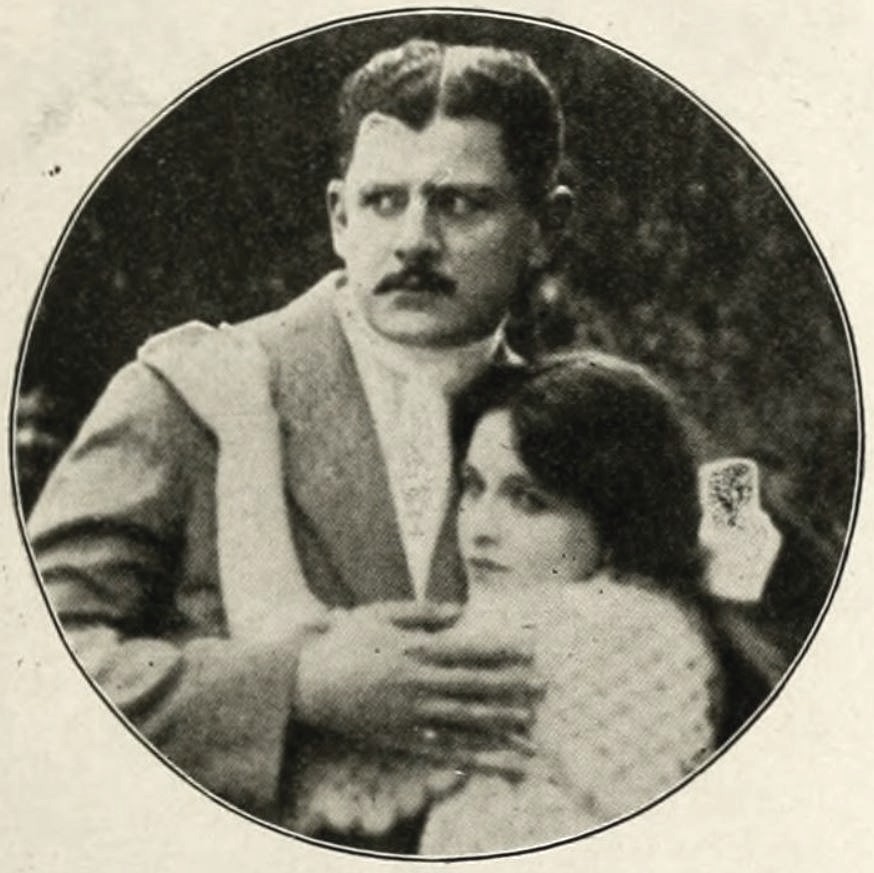
The first thing that singes the retina is the color of money—gilded, sulfurous, the exact hue of a match-head seconds before ignition. The Moth and the Flame opens on a close-up of a stock ticker chattering like teeth in winter; the frame itself vibrates with the mechanical hunger that will soon migrate into human arteries. Stewart Baird’s patriarch, Hargate, does not merely inhabit his Wall Street fiefdom—he metastasizes through it, every creased brow a ledger entry, every sigh an exhalation of compound interest. When the camera dollies back, the ticker’s spool dissolves into the spiral of Enid’s engagement ring—an edit so brazen it feels like insider trading. In that splice, Clyde Fitch’s thesis announces itself: love, in this society, is just another speculative bubble.
Dora Mills Adams arrives as the Countess de la Rue cloaked in tenebrous velvet the color of bruised midnight. Her entrance is staged like a predator’s glide: a doorway backlit so that the fabric becomes a liquid silhouette, pooling into the room long before her face emerges. Watch how she extracts a kid-gloved hand to greet Adele—an apparently courteous gesture—yet the camera lingers on the pressure of her thumb against the girl’s pulse. It is the first silent-film handshake that feels like a blood transfusion, and it establishes the Countess’s methodology: she samples vulnerabilities the way sommeliers sip arsenic, savoring the latent toxicity.
Adele Ray, playing the eponymous moth, has the translucent pallor of someone raised under chandeliers rather than sun. Her performance is built on micro-tremors: the quiver of an eyelid when scandal is whispered, the fractional hesitation before signing a letter that will detonate her future. In the séance-like hush of the boudoir scene, cinematographer Maurice Steuart (pulling double duty as the doomed Lord Standish) backlights her with a single kerosene lamp; the result is a halo of fuzz around hairline and lace, as though the frame itself were fraying from moral fatigue. When Adele finally steps into the Countess’s carriage—an act shot through a distorting pane of rain-beaded glass—the world warps, and we grasp the film’s wager: innocence is not lost; it is liquefied.
Edwin Mordant’s screenplay, distilled from Fitch’s 1898 stage hit, jettisons the three-act piety of contemporaries like Home, Sweet Home in favor of a volatile five-movement structure that anticipates modern prestige television. Each reel ends on a fiscal or erotic cliffhanger: a forged promissory note, an intercepted billet-doux, a clandestine kiss exchanged beneath the sulfur flare of a darkroom safelight. The effect is narcotic; I caught myself leaning forward as if the screen were a ledger in which I too had invested.
The film’s moral geometry refuses the easy dichotomy of virtue-reaps-rewards. Hargate’s fortune evaporates overnight, yet his downfall is staged with such operatic grandeur—top-hatted brokers howling on marble stairs, ticker tape snowing onto toppled Corinthian columns—that one almost envies the catastrophe. Conversely, the Countess’s exile to a fog-smothered ocean liner feels like a promotion: she departs in rose-colored dawn light, wrapped in sable, sipping Veuve Clicquot while the ship’s horn bellows a predatory aria. The camera cranes upward to reveal her silhouette shrinking against an iron smokestack shaped like a colossal penny—American commerce swallowing its most exquisite parasite.
“In the arithmetic of appetite, every virtue is merely an undervalued stock awaiting leveraged buyout.”
Irene Howley, as the family’s asthmatic spinster aunt, supplies the film’s most quietly subversive performance. She spends reel two knitting a scarf whose colors—scarlet, ash, sulfur—map the narrative’s escalating temperature. When she finally unfurls the finished garment across Adele’s trembling shoulders, the gesture is both benediction and forecast: you will need this warmth where you are going, but the yarn itself is already scorched. It is the silent era’s answer to Chekhov’s gun: a textile prophecy.
Composer Bradley Barker (also seen in Traffic in Souls) rescored the 4K restoration with a string quartet that scrapes like a scalpel. During the pivotal ballroom sequence, the violins adopt the tempo of a racing pulse, then drop to a single pizzicato each time the Countess utters the word “security.” The motif lodges in the skull like a creditor’s knock; I heard it in my dreams that night, accompanied by phantom images of toppled candelabra.
Arthur Donaldson’s production design weaponizes negative space. Note the Hargate mansion’s central staircase: banisters carved with acanthus leaves that resemble currency scrollwork, ascending into darkness so absolute it could be a mine shaft. When Enid descends to confront her father, her white dress becomes a reverse comet—luminescent tail dragging behind a core of sooty resolve. The set dwarfs her, yet the camera’s low angle inflates her silhouette until she appears to tower over the balustrade. Power, the image whispers, is seldom a matter of stature; it is a matter of where the camera chooses to kneel.
Comparisons with In the Land of the Head Hunters are instructive. Both films exploit primitivism—one through Kwakwaka’wakw ritual, the other through Gilded Age predation—to expose civilizations that fancy themselves evolved. Yet where Curtis’s ethnography solicits awe, Fitch’s melodrama siphons contempt. The Countess’s final smirk is as ethnographically damning as any Kwakwaka’wakw mask: it is the visage of a tribe that trades in futures both fiscal and carnal.
The restoration’s chromatic palette deserves its own sonnet. The nitrate’s original amber has been cooled to a nocturnal cerulean that makes gaslight appear almost ultraviolet. Golds—whether sovereign coins or the gilt clasp on Adele’s slipper—glow with the radioactive warmth of #C2410C. When these hues collide in the roulette-table montage, the frame vibrates on the threshold of seizure, a synesthetic translation of speculative mania.
Gender politics here are more vertiginous than in Children of the Stage. The Countess wields sexuality as liquidity, yet the film refuses to punish her for appetite alone; her comeuppance is engineered by market forces, not moral decree. Conversely, Hargate’s paternal authority collapses not from ethical epiphany but from a margin call. The patriarch and the paramour are twin avatars of capital, gendered differently yet equally enthralled to the ticker’s secular rosary.
Censorship boards in 1915 excised the shot of Adele’s chemise slipping from her shoulder during the library seduction; the restoration reinstates those four seconds, and their impact is disproportionate to their brevity. The glimpse of clavicle feels like an act of archaeological resurrection—proof that even a century-old artifact can blush anew. I felt the entire Castro Theatre inhale as one organism.
Stewart Baird’s performance is master-class in fiscal physiognomy. Watch how his pupils dilate the instant he hears the word “railway,” a reflexive erection of capital. Later, bankrupted, he stands before a mirror whose silvering has begun to molt; his reflection fractures into mercury beads, each droplet a worthless share. He does not weep—tear ducts are an inefficient market response—instead, his jaw muscles knot until the tendons resemble ticker tape. It is the most silent silence I have ever heard.
The film’s epilogue, long mislaid, shows Enid years hence in a bohemian atelier, clay beneath her fingernails, sculpting a female form that merges her own features with those of the exiled Countess. The studio’s skylight drips #0E7490 sea-blue across the bust, as though both women were submerged relics. She signs the base with a pseudonym—A. de la Rue—thus annexing the predatory identity that once menaced her. The gesture is neither forgiveness nor vengeance; it is incorporation, the final merger of prey and predator into a single, formidable share.
Some viewers will exit The Moth and the Flame thirsting for the moral absolutes of The White Terror; I left tasting iron on my tongue, the metallic aftertaste of a century that has yet to close its positions. The film’s true terror lies not in scandal but in recognition: we still trade futures on flesh, still mint dividends from shame. The only difference is that our tickers now glow in pockets rather than parlors.
Criterion’s Blu-ray supplements include a 38-minute video essay on the economics of corsetry—how whalebone literally underwrote empire—but the hidden gem is an archival tape of Clyde Fitch addressing the Playwrights’ Club in 1905. His voice, nasal yet melodious, declares: “Melodrama is the only honest mirror; it flatters neither virtue nor vice, only velocity.” Listening through headphones, I understood why the film’s tempo feels so contemporary: it is velocity distilled, a futures contract on the speed of ruin.
Verdict: see it on the largest screen still standing. Let the aperture’s rectangle become a proscenium where your own appetites can audition. And when the Countess, wrapped in steamship fog, lifts her flute of champagne to toast the receding skyline, raise your own imaginary glass to the long, exquisite conflagration of capital and desire. Just don’t be surprised if the aftertaste glows dark orange—the color of money burning, of wings too close to the wick.
IMDb —
1919
Community
Log in to comment.