DbcultAccessing Vault...
Cult Review
Senior Film Conservator
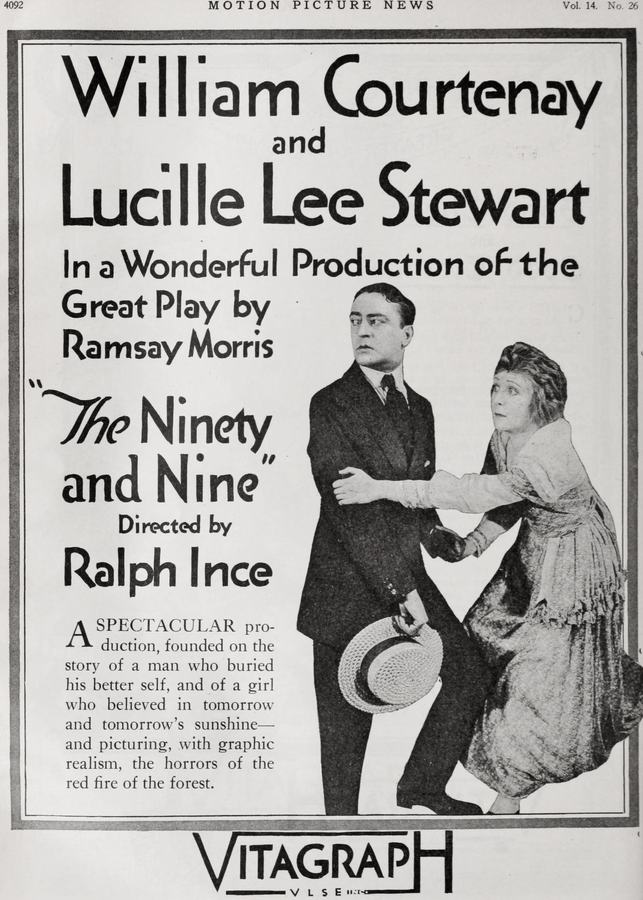
The 1920s represented a peculiar crossroads for American narrative art, a period where the lingering Victorian obsession with moral didacticism began to clash violently with the burgeoning visceral power of the cinematic medium. The Ninety and Nine, directed by David Smith and released in 1922, stands as a quintessential artifact of this transition. It is a film that breathes the air of the pulpit yet moves with the kinetic energy of the industrial age. Based on the play by Ramsay Morris, it takes its title from the famous hymn regarding the lost sheep, and true to its namesake, it explores the harrowing journey of a man who has strayed so far from the flock that he has become a ghost in his own life.
William Courtenay’s portrayal of Tom Silverton is a fascinating study in the aesthetics of the "fallen man." Unlike the clear-cut villains of earlier melodramas, Silverton is introduced as a man whose soul has been hollowed out by a misplaced sense of honor. His alcoholism isn't framed merely as a vice, but as a shroud. When he arrives in Marlow, he is a walking memento mori, a reminder of the city's capacity to devour the virtuous. This thematic tension between the rural and the urban is a recurring trope in films of this era, much like we see in The Country Boy, where the pastoral is presented as the only laboratory capable of synthesizing a man's character back into wholeness.
Opposite him is Ruth Blake, played with a luminous, if somewhat stoic, grace by Lucille Lee Stewart. Ruth represents the "reforming angel," a character type that could easily descend into saccharine cliché if not for the palpable stakes of her environment. Her father, Abner Blake (Frank Currier), is a terrifying manifestation of patriarchal absolutism. Currier’s performance is one of the film’s hidden strengths; he doesn't just play a strict father; he plays a man who believes his wrath is a divine instrument. This creates a domestic atmosphere of high-tension surveillance that rivals the psychological weight of Tess of the Storm Country.
The narrative pivot occurs with the arrival of Kate Van Dyke (Josephine Lovett). The revelation that Silverton took the fall for a murder committed by Kate’s brother is the film’s most potent dramatic irony. It transforms Silverton from a common drunkard into a martyr of the silent screen. This plot point explores a specific kind of masculine nobility that was popular at the time—the idea that a man’s word is worth more than his life, even when given to a woman who ultimately betrays him. The dynamic between Tom and Kate is a precursor to the more cynical noir relationships that would emerge decades later, where the past is a trap that no amount of geographic distance can truly escape.
The film’s middle act is dominated by the suffocating social politics of Marlow. The character of Buddy Bryson, the "half-witted" boy who spies on the lovers, serves as a grotesque catalyst for the tragedy. In the lexicon of 1920s cinema, such characters often functioned as the physical manifestation of the community’s subconscious malice. His intervention leads to the expulsion of Ruth from her home, a scene that resonates with the same social cruelty found in The Broken Law. The moment Ruth is cast out into the night is a harrowing beat that underscores the fragility of female agency in the face of male pride.
While the first two acts are a masterclass in domestic melodrama, the final act of The Ninety and Nine is a jarring, exhilarating leap into the action genre. The forest fire sequence is not merely a set piece; it is a pyrotechnic catharsis. In an era before CGI, the sheer physicality of the fire is overwhelming. The heat seems to radiate from the screen as the flames lick the sides of the locomotive. This is the "Industrial Sublime"—the concept of the machine as a god-like entity capable of conquering the untamed fury of nature.
Tom Silverton’s redemption is literalized through his mastery of the engine. He isn't just saving the town; he is driving a stake through his own past. The locomotive, much like the one featured in the railroad-centric drama Rule G, becomes a character in its own right—a thundering beast of iron and steam that carries the weight of the ninety-nine souls back to safety. The imagery of the train piercing through the wall of smoke is one of the most iconic visual metaphors in the Vitagraph catalog. It suggests that while the spirit may be willing, it is the machine that provides the means for salvation in the modern world.
When comparing this film to its contemporaries, one can see the evolution of the "social problem" film. Unlike It Is Never Too Late to Mend, which focuses on institutional reform, The Ninety and Nine focuses on the internal reform of the individual. It is less concerned with the law and more concerned with the soul. Furthermore, the film’s use of suspense and hidden identity mirrors the tension found in Trapped by the Camera, though it settles its scores through a grander, more operatic climax.
Even the presence of the "city girl" Kate Van Dyke serves as a sharp contrast to the innocence found in films like The Little Dutch Girl. Kate is a creature of artifice and deception, the very personification of the "sex lure" that was so feared by the moral guardians of the time, a theme explored more explicitly in The Sex Lure. By overcoming his attachment to her, Tom Silverton isn't just rejecting a woman; he is rejecting the moral vacuum of the urban elite.
To watch The Ninety and Nine today is to witness the birth of the modern blockbuster sensibility. It understands that for a redemption to feel earned, the hero must be tested by something larger than himself. The film moves from the intimate to the epic with a fluidity that was rare for 1922. It manages to balance its heavy-handed biblical allegories with a genuine sense of peril.
The performances, particularly by Courtenay and Stewart, provide the emotional ballast necessary to keep the film from drifting into pure spectacle. We care about the train because we care about the people inside it. We care about the fire because we understand that it is the only thing hot enough to melt away the years of resentment and guilt that have defined Tom Silverton’s existence. In the end, the film suggests that no one is truly lost, provided there is someone willing to drive an engine through hell to find them. It is a stirring, visually arresting piece of cinema that remains a testament to the power of the silent era’s most ambitious storytellers.
For those interested in the darker side of early cinema's obsession with justice and the past, I would also recommend looking into Ultus, the Man from the Dead or the haunting O Crime dos Banhados, which both deal with the long shadows cast by previous sins. The Ninety and Nine however, remains unique for its synthesis of the spiritual and the mechanical—a true relic of a time when the cinema was our newest, and perhaps most powerful, cathedral.
IMDb —
1920
Community
Log in to comment.