DbcultAccessing Vault...
6/10
Senior Film Conservator
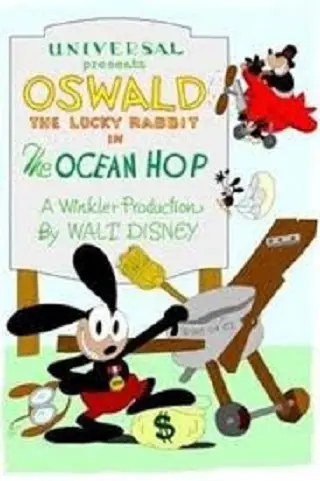
A definitive 6/10 rating for a film that redefined the boundaries of cult cinema. The Ocean Hop remains a cornerstone of transgressive art.
Is The Ocean Hop worth your time nearly a century after its release? Short answer: Yes, but only if you view it as a piece of living history rather than a narrative feature. This film is for animation purists, historians of the silent era, and those who appreciate the raw, unpolished energy of early 20th-century creativity. It is decidedly NOT for viewers who require a coherent plot, high-definition visuals, or characters with complex emotional arcs.
Before we dive into the mechanical madness of Oswald’s flight, let’s establish the baseline for this 1927 short:
In 1927, the world was obsessed with the Atlantic. Charles Lindbergh’s successful solo flight had turned the sky into the new frontier of celebrity. While serious dramas like J'accuse! were exploring the heavy psychological toll of war and society, Walt Disney and Ub Iwerks were looking for a punchline. The Ocean Hop is that punchline.
The film doesn't just reference the flight; it deconstructs the very idea of aviation. When Oswald’s plane falls apart, he doesn't give up. He adapts. This is the core of the Oswald character—a scrappy, slightly mischievous underdog who lacks the later corporate polish of Mickey Mouse. Unlike the protagonists in The Secretary of Frivolous Affairs, Oswald isn't bound by social decorum. He is pure id.
If Walt Disney was the dreamer, Ub Iwerks was the engine. In The Ocean Hop, Iwerks’ draftsmanship is on full display. Look closely at the scene where Oswald inflates the dachshund. It’s grotesque, surreal, and hilarious. The way the dog’s body stretches defies every law of biology and physics, yet within the internal logic of the short, it makes perfect sense. This is 'rubber-hose' animation in its infancy—fluid, bouncy, and unapologetically weird.
Compare this to the stiff, theatrical movements found in contemporary live-action films like Alraune. While live-action was still figuring out how to move the camera, Iwerks was moving the entire world. The background scrolls with a rhythmic persistence that creates a genuine sense of speed, even if the 'plane' is just a dog with balloons. It works. But it’s flawed. The pacing is breakneck, leaving little room for the gags to breathe.
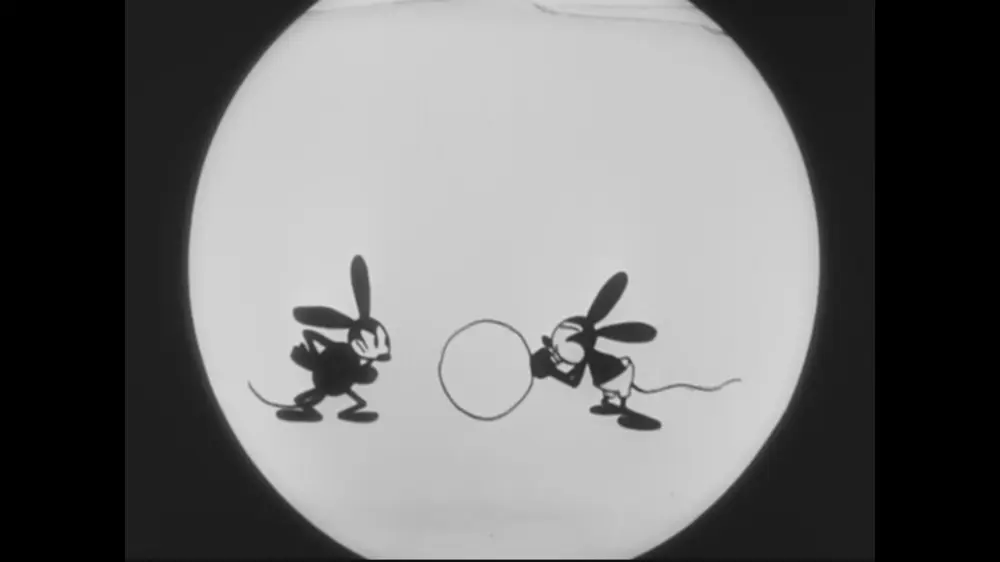
Every hero needs a foil, and Oswald’s rival in this short is a prototype for the many 'Pete' characters that would follow. The peg-legged rival represents the cynical side of the 1920s—the cheater who wants the glory without the grit. His attempts to sabotage Oswald provide the film’s primary conflict, but they also highlight a certain cruelty common in early cartoons. There is a mean-spiritedness here that Disney would eventually sand down. Personally, I prefer this sharper edge. It feels more honest than the sanitized versions of these characters we see today.
The rivalry here is much more physical and slapstick-heavy than the romantic or social conflicts seen in Cupid à la Carte or Red Hot Love. It’s a battle of momentum. Who can stay in the air longer? Who can cheat better? It’s simple, effective, and brutally direct.
Yes, for the historical context alone. The Ocean Hop is a six-minute window into a time when animation was the Wild West. It captures the frantic energy of 1927 perfectly.
If you are looking for a deep narrative, you won't find it here. But if you want to see the exact moment that American pop culture began its obsession with anthropomorphic animals and physics-defying comedy, this is essential viewing. It’s a better use of your time than many of the forgotten melodramas of the era, such as Rose of the Tenements, simply because its visual energy remains infectious.
Cons:
It is impossible to discuss The Ocean Hop without mentioning the legal battle that followed. Shortly after this, Disney would lose the rights to Oswald to Charles Mintz, leading to the creation of Mickey Mouse. You can see the 'almost-Mickey' in every frame. Oswald is brasher, though. He’s more willing to get his hands dirty. In many ways, Oswald was a more modern character than Mickey ever was.
The film also highlights the work of Walter Lantz, who would later take over the Oswald series. While Lantz’s later work like Dan or his Woody Woodpecker shorts have their own charm, the Disney/Iwerks era of Oswald has a specific 'crunch' to it. It’s the sound of a studio finding its voice. It’s messy. It’s loud (visually). And it’s vital.
The Ocean Hop is a fascinating artifact. It isn't a masterpiece in the way we think of modern cinema, but it is a masterclass in visual economy. Every line drawn by Iwerks serves a purpose: to keep the eye moving. While it lacks the emotional weight of a film like Medea di Portamedina, it possesses a kinetic joy that many modern films lack. It is a reminder that before animation was an industry, it was an experiment. And as experiments go, this one was a soaring success—even if it was powered by a dachshund and a handful of balloons.
IMDb 5.3
1931
Community
Log in to comment.