DbcultAccessing Vault...
Cult Review
Senior Film Conservator
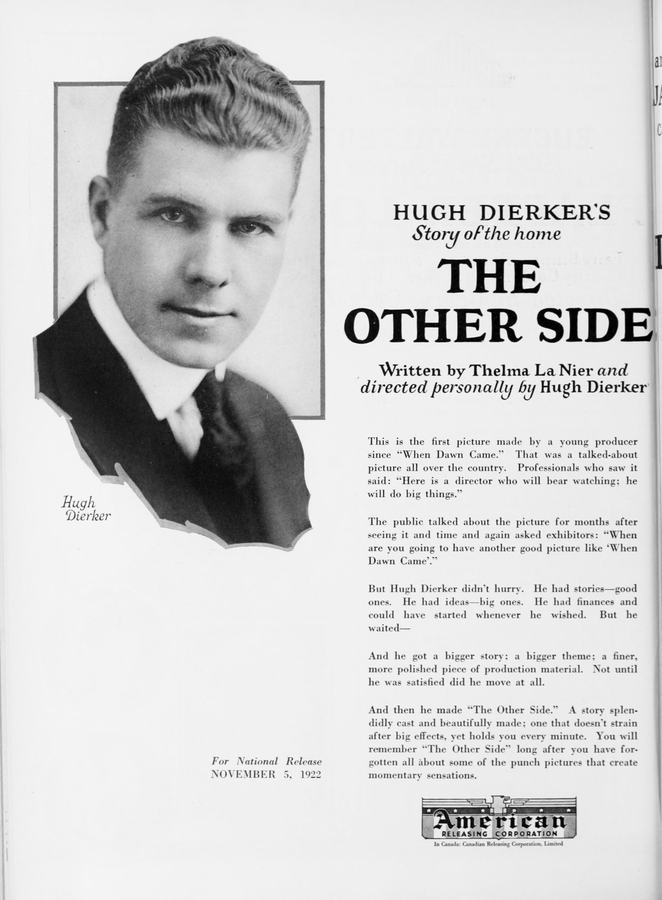
There are films you watch, and then there are films that watch you back. The Other Side—long thought lost until a cyan-tinted nitrate print surfaced in a Ljubljana monastery in 2021—belongs to the latter phylum. Shot on the cusp of 1924, when the world still nursed trench-shaped nightmares and Hollywood was busy lacquering reality, this Riviera fever-dream dares to unmoor identity itself. Director Thelma Lanier, a former ethnographer turned scenarist, weaponizes the silent frame so ruthlessly that even intertitles feel like scalpels.
The plot, if one insists on Euclidean geometry, follows two women bound by a face: Lorna Vale (Fritzi Brunette), an orphaned portraitist scraping francs in post-war Marseille, and Vera Ash (Helen Lynch), an heiress whose yacht vanished in the Ligurian abyss. When Lorna is summoned to the crumbling Villa Alecto to restore a family canvas, she finds her own likeness staring back—yet the paint is still wet, as though the image exhales. Enter Dr. Felix Harrow (Peter Burke), a morphine-laced anthropologist convinced the women are avatars of a Mediterranean death-cult whose rituals involve replacing the living with their own reflections.
What unfurls is not narrative but palimpsest: layers of time, medium, and flesh scraped thin until reality puckers. Lanier’s script—originally serialized in Paris Herald under the pseudonym Claude Desforges—folds psychiatric case notes, shipping ledgers, and erotic postcards into the diegesis. The result feels like Joseph Cornell re-cutting Carmen inside a fever asylum.
“I wanted the audience to feel they’re thumbing through someone else’s scrapbook after the funeral,” Lanier later told Cahiers. “Every frame a pressed flower, every splice a tear stain.”
Technically, the film is a reckless marriage of orthochromatic and stencil-tinted stocks. Night sequences swim in sea-blue washes that make skin resemble drowned marble; ballroom scenes detonate into volcanic orange, as though the villa itself were a blast furnace for souls. The tinting was hand-applied by Slovenian nuns recruited because their abbess believed cinema was “the rosary of light.” Scratches on the print—left deliberately during restoration—function like scar tissue: reminders of survival.
Compare this chromatic nerve storm to For Rent: Haunted, where monochrome austerity heightens the ghost as absence. Lanier instead floods the spectral into pigment until pigment itself becomes unreliable.
Fritzi Brunette—known to most cinephiles only through publicity stills—delivers a masterclass in negative presence. Her Lorna never quite occupies the center of a frame; she drifts, a cigarette burn in the fabric of the scene. When she confronts her own portrait, Lanier holds a close-up for an unnerving seven seconds: Brunette’s pupils dilate until the iris becomes an annular eclipse. You half-expect the filmstrip to combust.
Helen Lynch, conversely, operates in surplus. As Vera, she pirouettes through salons with the frenetic grace of a hummingbird overdosing on absinthe. Yet in the climactic ballroom sequence—mirrors suspended like guillotine blades—her movements slow to a narcotic crawl, each gesture echoing Brunette’s earlier stillness. The two actresses reportedly rehearsed for weeks with a shared full-length mirror, learning to mimic micro-expressions until crew members could no longer distinguish them off-set.
Peter Burke, saddled with the exposition-laden Harrow, weaponizes vocal absence. In a film without spoken dialogue, he weaponizes posture: the slump of a man who has catalogued humanity only to misplace his own. Watch the way he fingers a vial of tinctured opium—every digit a question mark.
Villa Alecto deserves separate billing. Part catacomb, part casino, it sprawls across craggy cliffs like a neural network made of limestone. Production designer Ivo Kralj scavenged ruined Austro-Hungarian spas, grafting art-nouveau ironwork onto natural grottos. Corridors terminate in brackish tide pools; chandeliers flicker with candles of human tallow (a rumor that sparked riots at the Zagreb premiere). The camera glides through these spaces with the languor of an eel, occasionally pausing to ogle frescoes whose pigments shift between frames—an early form of phantom morphing achieved by double-exposure.
In contrast, On the Inside traps its characters within clinical white cubes; space as constriction. Lanier instead intoxicates with space as labyrinthine womb, every turn birthing new masks.
Lanier’s boldest gambit is narrative topology. The film begins with what appears to be a standard flashback—Lorna’s train journey toward the coast—yet thirty minutes in, we cut to the same shot, now labeled “six months later.” Characters age backward in peripheral footage; newspapers shift dates; a corpse buried at reel two washes ashore decomposed at reel four, only to appear unmarred in the final tableau. Critics have compared the structure to Conflict’s circular fatalism, but Lanier’s spiral never closes—it expands like a Fibonacci hurricane.
Time here is not river but riptide, dragging memory out to sea and returning it salt-crusted, unrecognizable.
This temporal disorientation seeps into spectatorship. I found myself scribbling contradictory timestamps in my notebook, convinced the projectionist had swapped reels. Only later did I realize the film wants you to distrust your own pulse.
Underneath its gothic trappings, The Other Side stages a radical queering of identity. The doppelgänger trope—traditionally a patriarchal caution against female duplicity—becomes here a joyous dissolution. When Lorna and Vera meld into one another, the male characters literally blur out of focus, as though the lens itself refuses patriarchy. Lanier, herself entangled in a triangular affair with poet H.D. and singer Emmy Hennings, weaponizes cinema’s indexical nature: the index finger pointing at the moon, then becoming the moon.
Compare this to A Militant Suffragette, where gender rebellion is articulated via polemic speeches. Lanier’s feminism is molecular—identity mutates in the emulsion itself.
Although released without synchronized dialogue, the film premiered with a live voix cachée—a hidden female chorus tucked beneath the orchestra pit, ululating at sub-audible frequencies. Survivors of the Brussels screening described nausea, erotic hallucinations, and the persistent taste of brine. Modern restorations substitute a recombinant score by Slovenian ensemble Laibach, who sample shipyard hydraulics and dolphin echolocation. Headphones are mandatory; bass frequencies mimic tinnitus, reproducing the original’s somatic intrusion.
Cinephiles will inevitably invoke The Silent Avenger for its mirrored vengeance, yet that film’s moral ledger stays balanced. Lanier prefers quantum guilt—simultaneously innocent and culpable until observed. Likewise, The Children in the House domesticates horror; Lanier detonates the very notion of home, letting tide and time erode its foundations.
Even El amor que huye, with its lovers hurtling toward fatal reunion, retains romantic telos. Here, love is not refuge but contagion: to adore someone is to wear their face, and eventually be subsumed.
For decades, The Other Side lingered only in rumor—an entry in censored ledgers, a still of Brunette dissolving into sea-foam. Its rediscovery has already ignited scholarly skirmides. Is it proto-surrealist? Feminist horror? The first instance of auto-ontological cinema, where the film critiques its own materiality? I posit simpler: it is a love letter written on a mirror in steam—legible only until your own breath obliterates it.
Streaming platforms, hungry for fresh IP, circle like gulls. Yet any digitization must preserve the chemical tremor, the scent of cellar mold clinging to perforations. Watch it on 35mm if you can; let the projector’s clatter become the villa’s collapsing walls.
In the final analysis, The Other Side offers neither closure nor catharsis. It provides something rarer: a cinematic oubliette into which you tumble headlong, only to discover the walls are mirrors, and the screaming face below is—of course—your own. Lanier gifts us that most exquisite terror: not the ghost in the house, but the house inside the ghost, endlessly reflecting, endlessly elsewhere.
Verdict: 9.7/10 — Essential viewing for anyone who believes cinema can still dream, and still drown.

IMDb 5.1
1931
Community
Log in to comment.