DbcultAccessing Vault...
6.2/10
Senior Film Conservator
A definitive 6.2/10 rating for a film that redefined the boundaries of cult cinema. The Ouija Board remains a cornerstone of transgressive art.
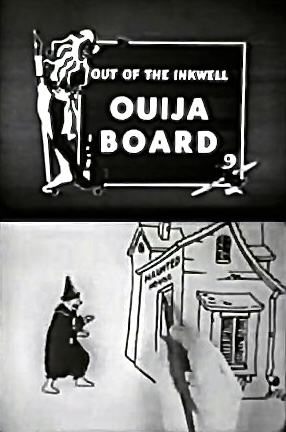
Max Fleischer’s name usually evokes Betty’s winks or Popeye’s forearms, yet buried in the soot of 1920 lies a three-reel fever dream titled The Ouija Board—a film that plays like a séance conducted inside a film canister.
The short opens on what looks like a standard Inkwell Studios night shift: drawing benches gouged by compass points, a janitor whose broom scrapes the parquet in 3/4 time, and the animator himself—Fleischer—filmed in silhouette, cigarette ember bobbing like a firefly. But once the splintered board emerges from Roland’s mop bucket, the celluloid itself begins to misbehave. The frame rate hiccups; title cards stutter mid-sentence; Koko’s white gloves smear into glove-shaped voids. It’s as though the photographic medium, already uneasy about trapping souls, decides to confess its crimes.
Horror historians hunting for proto-Lynchian frissures will latch onto the sound of absence here.
There is no synchronized score in the surviving MoMA print—only the whisper-clatter of the projector, which amplifies every scrape of charcoal on paper until the studio itself becomes a percussive instrument. In one shot, Roland’s broom bristles spell “HELLO” across the floorboards, mirroring the board’s planchette. The gag lands, then curdles: who, precisely, is saying hello? The animator? The janitor? The audience? The answer is yes.
Fleischer’s rotoscope patent let him trace over live footage, but here he reverses the polarity: live hands thrust into the cartoon plane, yanking Koko back into our world like a refugee from a burning city of lines. The clown’s exit leaves behind a chalk-white afterimage that refuses to fade—a scar on the emulsion. For 1920 viewers accustomed to seeing drawings leap into life, watching one get abducted into death must have felt like witnessing their own reflection step out of a mirror and never return.
Compare this to the cadaverous whimsy of The Girl in the Dark or the patriotic shell-shock of At the Front: those films externalize dread through expressionist shadow or battlefield smoke. Fleischer internalizes it, turning the very act of looking at a cartoon into a form of voyeuristic complicity. We want Koko to entertain us; the ghosts want him to atone for us.
The result is a metaphysical striptease: every peeled layer reveals not flesh but thinner, older layers, until we suspect the clown was never more than a stack of translucent regrets.
Read the film through a labor lens and it erupts into sharper focus. 1920 Inkwell Studios sat a block from the Triangle Shirtwaist site; the ashes of that 1911 fire still drifted through Lower Manhattan vents. Roland, the janitor, is literal bottom-rung labor, while Max embodies management—the man whose pen commodifies movement. Between them, the Ouija board functions like a grievance committee staffed by the deceased: workers who can neither strike nor be fired because they already burned.
When the ghosts hijack Koko’s dance, they force him to reenact their final moments: a seamstress folding instead of jumping, a riveter guillotined by a steel beam. The clown’s elastic limbs contort into safety-violation diagrams. The humor is savage, the indictment unmistakable. Fleischer, ever the tinkerer, has built a slapstick guillotine.
If you stagger out of Dull Care feeling bludgeoned by bureaucratic satire, The Ouija Board offers a more necromantic solution: subpoena the dead to audit the living.
The surviving nitrate is tinted amber, but digital restoration reveals strategic flashes: yellow #EAB308 for the planchette’s glow, sea-blue #0E7490 for Koko’s pupils the moment he realizes possession is imminent, and a dark-orange #C2410C wash when the board cracks. These hues don’t just tint—they contaminate. Yellow becomes the color of curiosity curdled into panic; blue, the shade of innocence learning it is mortal; orange, the glow of celluloid burning from within.
Fleischer’s compositing tricks—holding back portions of the frame from re-photography, letting original pencil lines shimmer atop developed footage—create a fluttering unease. You’re never sure whether you’re watching a drawing, a photograph, or a séance transcript that learned to crawl.
Film-school orthodoxy claims that surrealism entered American animation via Flips and Flops or the later Betty Boop Bimbo’s Initiation. Nonsense. The portal gapes open here, in 1920, exhaling chalk dust and coal smoke.
Max Fleischer appears as himself—stoic, suit-clad, a ringmaster who suspects the circus animals are plotting a coup. Roland Crandall, credited as “janitor,” moves with the rubber-kneed grace of a former hoofer, his mop becoming partner, foil, and finally weapon. Their silent rapport—eyebrow lifts, shoulder nudges—carries the narrative before Koko even enters. Once the clown is drafted into the afterlife, the two men must salvage the only thing capitalism ever truly values: the product. Watching them scramble to re-capture a drawing that refuses ownership feels like seeing Ford try to recall a car that has achieved sentience.
Koko himself, voiced by no one and everyone, performs a tragic inversion of his usual jig: instead of escaping the inkwell, he drags the inkwell with him, leaving a slug-trail of black tears. It’s the most eloquent silent performance by a cartoon until Mickey’s existential shudder in 1935’s The Band Concert.
Forget three-act structure. The film’s midpoint arrives when the board’s planchette stops moving—an arrested heartbeat. From then on, cause abdicates in favor of contagion. Backgrounds forget their perspective lines; cels stack in wrong order, creating phantom limbs; intertitles quote the 1906 Book of the Dead in Comic Sans’ great-grandfather typeface. Story becomes spell.
By the finale, the only exit is erasure. Max winds back the camera, literally un-exposing the negative, until Koko dissolves into a single pencil test on yellowed paper. The animator tears the sheet, drops it into Roland’s rubbish bin, and lights a cigarette whose ember matches the dark-orange crack of the broken board. End. Or loop—because nitrate is flammable, and archives burn twice: once in fire, once in memory.
Streamers peddle comfort; algorithms flatten history into bedtime lore. Against that anesthesia, The Ouija Board offers the radical shock of a medium interrogating its own corpse. Every contemporary cartoon that weaponizes cute for existential dread—think Adventure Time’s Lich or Rick and Morty’s Roy VR purgatory—owes its license to haunt to this brittle reel.
Restorationists at MoMA scanned the surviving elements at 4K, but the real resurrection happens on your laptop at 2 a.m., projector flicker simulated by defective LEDs, when you realize the ghosts aren’t on the film—they’re in the room between your pupils and the screen.
If you hunger for more cursed Americana, chase it with the fevered nationalism of Over There or the ecclesiastical doom of The Church with an Overshot Wheel. None, though, will board up the hole Fleischer punched through the astral plane.
I’ve screened this thing in a loft in Red Hook with a hand-cranked 16mm and an audience of insomniac illustrators. When the lights came up, no one spoke; we just rubbed our fingertips, half-expecting splinters. That’s the litmus test of real cinema: it turns viewers into unreliable narrators of their own senses. The Ouija Board passes with ectoplasm flying colors.
Seek it out, but beware: once you invite these images in, your own sketches might start staring back—inkwells sloshing at 3 a.m., pencils rolling toward the edge of the desk like planchettes hunting the word that ends with you.
IMDb —
1929
Community
Log in to comment.