DbcultAccessing Vault...
Cult Review
Senior Film Conservator
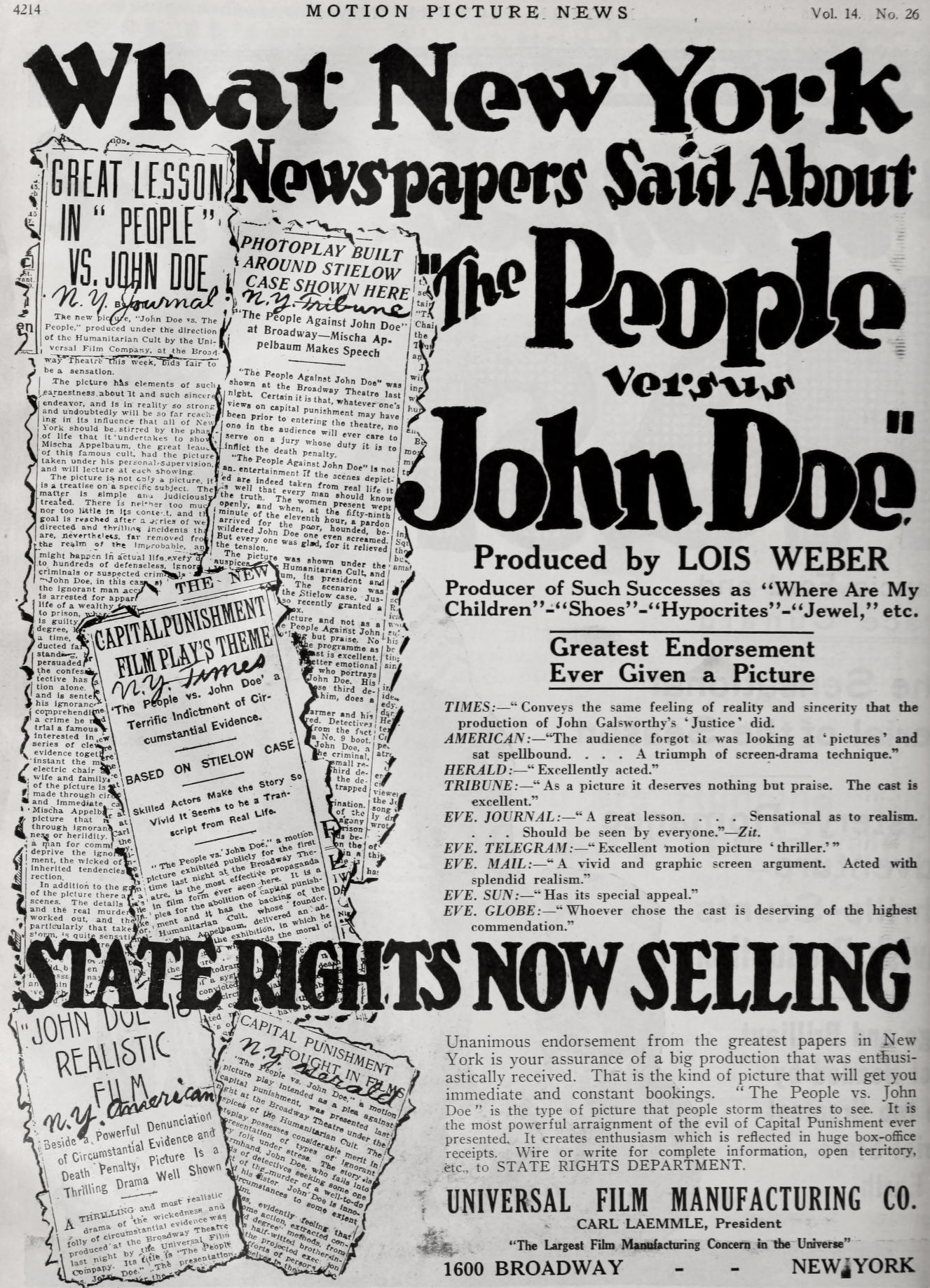
To witness The People vs. John Doe in the modern era is to participate in an act of cinematic archaeology that unearths the very foundations of the social-problem film. Directed and penned by the formidable Lois Weber, this 1916 silent feature is far more than a historical artifact; it is a thundering polemic against the fragility of justice. At a time when the medium was still grappling with its own grammar, Weber was already utilizing the screen as a pulpit, a laboratory, and a courtroom. This film, a composite of several high-profile wrongful conviction cases, serves as a grim reminder that the 'blindness' of Justice is often not an impartial virtue but a catastrophic flaw.
Lois Weber occupies a singular space in early Hollywood history, and The People vs. John Doe is perhaps the purest distillation of her ideological rigor. Unlike the populist escapism found in The Romance of Elaine, Weber’s work is characterized by a relentless pursuit of verisimilitude. She does not merely tell a story; she constructs an argument. The film’s protagonist is intentionally generic—a 'John Doe'—to emphasize that this tragedy could, and does, befall any citizen lacking the shield of wealth or influence. The cinematography, though restricted by the technology of the era, employs a stark chiaroscuro that mirrors the moral ambiguity of the legal proceedings.
Weber’s directorial hand is felt in the nuanced pacing. She allows the camera to linger on the faces of the marginalized, capturing a level of psychological depth that was rare for 1916. While films like The Bargain were exploring the rugged individualism of the American West, Weber was turning her lens inward, toward the rotting core of urban institutions. Her use of cross-cutting between the sterile environments of the court and the visceral desperation of the accused’s family creates a rhythmic tension that rivals the best thrillers of the silent era.
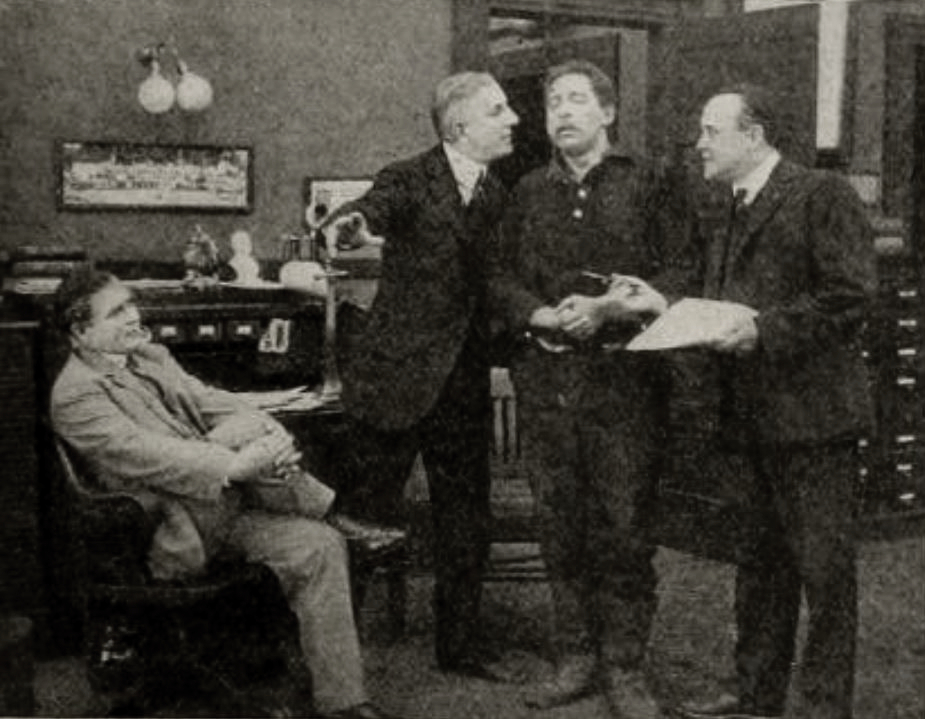
The cast, led by the understated Charles Hill Mailes and the hauntingly expressive Evelyn Selbie, eschews the broad gesticulation common in early silent cinema. Mailes, as the doomed John Doe, portrays a man not just defeated by a crime he didn't commit, but by the sheer incomprehensibility of the system. His performance is a study in stasis; he is a body being moved through a machine. In contrast, Selbie provides the film’s emotional anchor, her performance vibrating with a frantic energy that serves as the audience’s surrogate for outrage.
Supporting turns by Maude George and George Berrell flesh out a world populated by archetypes that feel uncomfortably real. We see the 'Law' not as a monolithic entity of truth, but as a collection of fallible men—some well-meaning but incompetent, others actively malicious in their pursuit of a 'win.' This thematic complexity elevates the film above the standard melodrama found in contemporary works like The Primal Lure, where morality is often binary and easily resolved.
"Weber’s John Doe is not a hero in the traditional sense; he is a sacrifice at the altar of societal convenience, a ghost-to-be haunting the very halls of justice that demand his life."
Technically, The People vs. John Doe is a marvel of narrative economy. Weber utilizes title cards not just for dialogue, but for philosophical punctuation. The way she frames the courtroom—as a cavernous, impersonal space where the individual is dwarfed by the architecture of the state—prefigures the expressionistic legal dramas of the 1920s. There is a specific scene involving the presentation of 'speculative evidence' that is edited with such precision that it exposes the logical fallacies of the prosecution better than a thousand words of dialogue could. It is pure visual rhetoric.
Comparing this to the theatricality of Cetatea Neamtului or the adventurous spirit of The Adventures of Kathlyn, one realizes that Weber was operating on a different intellectual plane. She wasn't interested in the exotic or the historical for their own sake; she was interested in the 'now.' The film feels like a precursor to the gritty realism we would later see in The Rogues of London, yet it carries a moral weight that is uniquely its own.
One cannot discuss this film without acknowledging its real-world impact. Lois Weber was deeply moved by the case of Charles Stielow, a man with intellectual disabilities who was nearly executed for a double murder he did not commit. Weber used this film as a weapon of advocacy, screening it for governors and legislators. This is cinema as direct action. It shares a certain thematic DNA with The Price of Tyranny, but whereas that film deals with external political forces, Weber focuses on the tyranny within our own borders—the tyranny of the 'fair' trial.
The film’s portrayal of the death penalty as an irreversible error is handled with a sobriety that is still shocking. There are no last-minute heroics of the sort found in Nuori luotsi; instead, there is the slow, agonizing crawl of the clock. This existential dread is what gives the film its lasting power. It asks the viewer: 'If the state can kill an innocent man in your name, are you not also the executioner?'
In the broader context of 1916 cinema, The People vs. John Doe stands as a monolith of social conscience. While films like The Feast of Life or Cora were exploring the complexities of romance and class, Weber was interrogating the very social contract. Even when compared to the legal maneuvering in Gambier's Advocate or the financial scandals of Other People's Money, Weber’s work feels more urgent because the stakes are not just property or reputation, but the very soul of the nation.
Even the visceral nature of the Nelson-Wolgast Fight feels pale in comparison to the spiritual violence depicted here. Weber understands that a punch to the face is nothing compared to the slow crushing of a man’s spirit by a cold, unfeeling bureaucracy. This film is a bridge to the future of cinema—a direct ancestor to '12 Angry Men' and 'The Thin Blue Line.' It proves that the camera is most powerful when it is used to speak for those who have been silenced.
Ultimately, The People vs. John Doe is a testament to the power of the medium. It avoids the pitfalls of the 'Great Circus Catastrophe' (as seen in The Great Circus Catastrophe) by keeping its focus intimate and human. It doesn't need explosions or grand spectacles; the sight of a man’s hand trembling as he signs a false confession is spectacle enough. It is a film that demands to be seen, not just by film historians, but by anyone who believes in the concept of justice.
Weber’s legacy is often overshadowed by her male contemporaries, but this film proves she was their equal, if not their superior, in terms of thematic depth and social impact. Like the intermediary figures in The Middleman, Weber stood between the harsh realities of the world and the burgeoning art of cinema, translating pain into poetry. This is a vital piece of film history that continues to echo in every courtroom drama that dares to question the status quo. It is a masterpiece of empathy, a triumph of direction, and a haunting reminder that the 'People' must always be vigilant against the 'Doe' becoming a ghost.

IMDb 7
1931
Community
Log in to comment.