DbcultAccessing Vault...
Cult Review
Senior Film Conservator
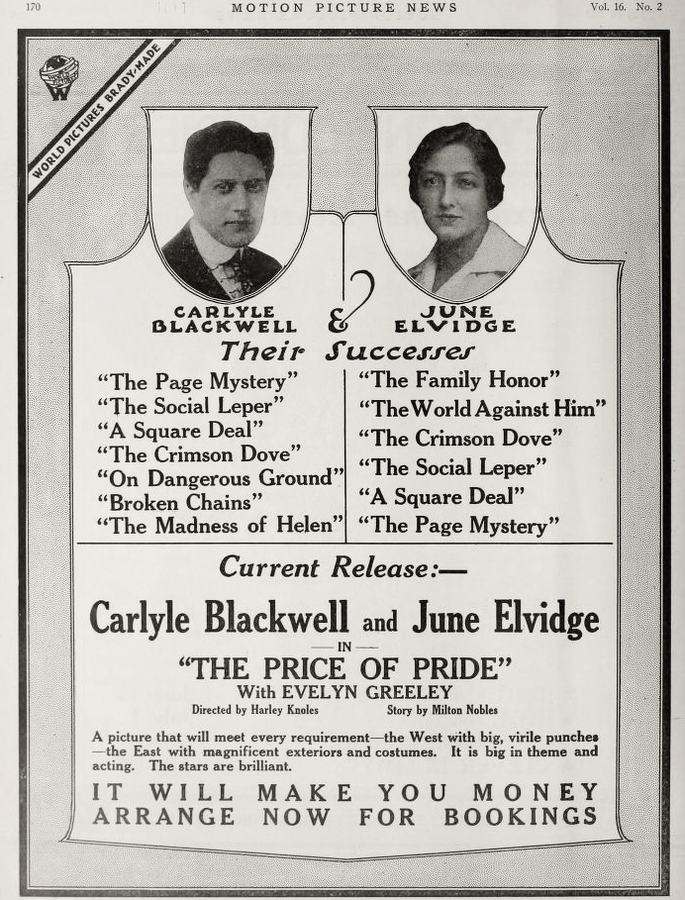
There's a certain gravitas that silent films, particularly those from the nascent era of feature-length storytelling, carry within their frames. They speak in gestures, in the stark contrast of light and shadow, and in the raw, often melodramatic, force of human emotion. Milton Nobles' 1917 creation, The Price of Pride, is a quintessential example, a sprawling narrative tapestry woven with threads of betrayal, mistaken identity, societal judgment, and the enduring, often destructive, power of familial bonds. It’s a film that demands immersion, inviting us to ponder the ripple effects of a single, ill-fated moment and the decades-long shadow it casts over multiple lives.
The story begins with an almost Shakespearean simplicity, yet its ramifications prove profoundly complex. Madge Black, celebrating her young son David's second birthday, witnesses a seemingly innocuous, yet utterly devastating, act: her husband, Jeffrey Arnold Black, a man of considerable professional standing, sharing a kiss with her closest confidante, Nan Westland. The immediate, visceral reaction from Madge is one of wounded pride and righteous indignation. She banishes Nan from her home, an act swift and decisive, but tragically devoid of context. Jeffrey, fueled by his own anger and a perhaps misguided sense of defiance, chooses silence over explanation. He refrains from revealing the crucial truth – that their comfortable existence, far from being sustained by Madge's father, is entirely his own making. This single, unspoken truth, this price of pride in its most nascent form, becomes the linchpin for the ensuing decades of sorrow and separation.
Jeffrey, a man clearly burdened by his wife's misapprehensions and his own wounded ego, departs, leaving behind his wife and young son. Fate, or perhaps the inexorable pull of unresolved desires, intervenes swiftly. On a westbound train, Jeffrey encounters Nan once more. She presents herself as a woman compromised, a victim of circumstance, fleeing to hide from the societal scorn her perceived indiscretion has brought upon her. Touched by what he perceives as genuine sorrow and perhaps a lingering sense of responsibility, Jeffrey offers her protection. He explicitly states his lack of love for her, a brutal honesty that Nan, consumed by her own affection for him, willingly accepts. She is prepared to embrace any terms, any semblance of a life with him, regardless of the emotional void. This initial arrangement, founded on desperation and a protective instinct rather than mutual affection, sets a precarious foundation for their future.
A year passes, and a son, William, is born to Nan and Jeffrey. The arrival of a child intensifies Nan's plea for legitimacy. She desperately implores Jeffrey to divorce Madge and marry her, to bestow a proper name upon their son. Yet, Jeffrey remains unyielding, his past entanglement with Madge, and perhaps his own stubborn pride, preventing him from fully committing to Nan. His refusal to sever ties legally with his first family, even as he builds a new one, speaks volumes about the societal pressures of the era and his own internal conflict. This period of his life, a clandestine existence marked by a lack of full commitment, mirrors the struggles seen in films like The Making of Maddalena, where women often found themselves navigating complex social strictures and the expectations placed upon them.
Into this emotionally fraught household steps Ben Richardson, a client of Jeffrey's, whose sincere attention gradually wins Nan over. Goaded by Jeffrey's persistent indifference and her yearning for a stable, recognized union, Nan makes a profound and heartbreaking choice. She leaves Jeffrey and, crucially, abandons her son William, to become Richardson's wife. This act, while providing her with the societal acceptance she craved, simultaneously creates another deep, festering wound – the abandonment of a child, a decision with consequences that will echo through two decades and ultimately define the film's tragic climax. It’s a stark illustration of the choices women were forced to make in a society that often offered limited pathways to respectability outside of marriage, a theme explored with different nuances in melodramas of the period.
The narrative then leaps forward twenty years, a significant temporal chasm that allows for the full blossoming of the initial seeds of discord. David Black, Madge and Jeffrey's son, has matured into a paragon of honorable manhood, destined for a leadership role in a Western mining plant. His upbringing, presumably stable despite his father's absence, has forged him into a respectable figure, embodying the ideals of success and rectitude. In stark contrast, his half-brother, William Arnold – now known by the ominous moniker “Rodeo” – has become the charismatic, yet dangerous, leader of a lawless band. His life, bereft of a mother's presence and a father's consistent guidance, has spiraled into criminality, a stark testament to the profound impact of early abandonment and societal neglect. This dichotomy between the two brothers, one representing order and the other chaos, is a classic narrative device, found in countless tales of familial separation and divergent destinies.
The stage for their inevitable collision is the American West. Happily married, Ben Richardson and Nan have found prosperity, becoming the proprietors of Chanceland, a bustling gambling-house in Colorado. The irony is palpable: Nan, having sought stability and a new identity, unknowingly presides over a den of chance that will draw her estranged son into her orbit. “Rodeo,” seeking to try his luck, loses all his money at Chanceland. Drawn by the music, he saunters into an adjoining room, where he encounters Nan. Eager to impress, he introduces himself as “Rodeo the bandit,” eventually revealing his true name, William Arnold, and his separation from his father at fourteen. He confides in her, unaware of her true identity, that he never knew his mother, a poignant moment of dramatic irony. Nan, recognizing her lost son, maintains her composure, presses a ring into his hand, and offers him a lifeline: to come to her if he ever finds himself in trouble. Believing he has captivated the “Queen” of the establishment, Rodeo departs, oblivious to the profound maternal connection he has just rekindled.
In the same town, David Black is diligently pursuing his mining ventures. In a fleeting, yet pivotal, moment, “Rodeo” passes David in the doorway of Chanceland. Both men are struck by their uncanny resemblance, a visual foreshadowing of the tragic events to come. This visual parallel, a powerful silent film trope, sets the stage for the film’s central conflict. David receives a telegram from his fiancée, Kathleen May, requesting a meeting at the train arriving the next morning. This seemingly innocent detail becomes the catalyst for disaster.
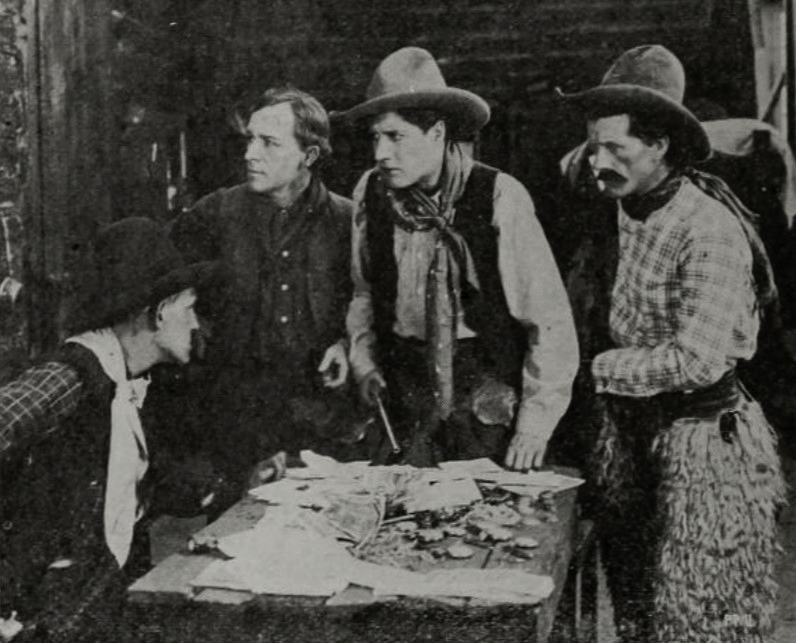
That very night, Rodeo and his gang execute a daring train robbery. As Rodeo systematically relieves passengers of their valuables, the conductor courageously leaps upon him, tearing away the bandit’s concealing bandanna. In a moment of cruel fate, Kathleen, on the train, witnesses the unmasked bandit and, due to the striking resemblance, firmly believes she is seeing David. The bandit makes his escape, leaving Kathleen with a shattered image of her beloved. The next day, when the real David arrives to meet her, she snubs him, walking past him in cold condemnation. This devastating misidentification, a common but always effective dramatic device, as seen in films like Kiss of Death, plunges David into a nightmare of false accusation and emotional turmoil.
Ben Richardson’s servant, a silent observer, reports to his master after witnessing Rodeo and his men dividing their plunder. Richardson, astute and suspicious, intimates to Nan that the young man she has taken an interest in is now suspected of numerous crimes. The pieces of the puzzle fall into place for Nan; a mother’s instinct confirms her worst fears: her son is in grave danger. Meanwhile, a disconsolate David, seeking solace or perhaps distraction, finds himself at Chanceland, where he is promptly arrested on charges of mail robbery and train holdup. The net tightens around the innocent brother.
In a bold, desperate maneuver, Rodeo seeks out Nan. It is here that she finally discloses her identity as his mother, pleading with him to exercise extreme caution. She warns him that as soon as David can establish an alibi, the sheriff will undoubtedly turn his attention to Rodeo. The emotional weight of this revelation, a mother finally reuniting with her long-lost son under such dire circumstances, is immense. Hearing Richardson approach, Nan impulsively shoves her son into her bedroom, attempting to conceal him. Richardson, however, suspects a clandestine lover, not a long-lost son. He bursts into the room, firing at Rodeo, who is wounded. The wounded bandit is then taken to court, where David is already on trial for the very crimes Rodeo committed.
The courtroom scene is the undeniable dramatic apex of The Price of Pride, a masterclass in silent film melodrama. The narrative threads, meticulously laid over two decades, converge in a single, tension-filled space. Nan, recognizing the profound injustice unfolding, confesses to Richardson that Rodeo is their son. Her urgent confession propels her to the courthouse, where a tableau of shattered lives awaits. Also present are Kathleen, David’s heartbroken fiancée, and Madge, David’s mother, whose initial act of pride set this entire tragedy in motion. The presiding judge, in a twist of almost poetic cruelty, is Jeffrey Arnold Black, the father of both the prisoner on trial (David) and the soon-to-be-introduced true culprit (Rodeo).
When Rodeo is brought into the courtroom, a hush falls, quickly followed by a maelstrom of emotion. The two half-brothers, so alike in appearance yet so divergent in destiny, finally face each other across the chasm of their shared, yet separate, histories. Nan, overcome with maternal agony and relief, embraces her wayward son. In a heart-wrenching moment, Rodeo, now dying from Richardson's gunshot wound, bewails the cruel irony of finding his mother only to lose her almost immediately. With his last breaths, he vindicates David, confessing to the train robbery and clearing his innocent half-brother’s name. His death, a tragic culmination of a life shaped by abandonment and circumstance, serves as the ultimate sacrifice, dissolving the cloud of suspicion hanging over David.
The aftermath of Rodeo's death is a period of profound reconciliation. Madge, Jeffrey, and their son David are finally reunited, their family fractured for so long, now mended, albeit with the indelible scar of William’s loss. Jeffrey’s initial silence, Madge’s pride, and the subsequent choices made by all parties have exacted a terrible toll, but forgiveness, at last, pervades the scene. Richardson, consumed by guilt and remorse for his suspicions and the fatal shot, seeks and obtains Nan’s forgiveness. Her journey, from a scorned friend to a mother reunited with her dying son, is perhaps the most poignant of all, reflecting a resilience and capacity for love that transcends her earlier choices. David and Kathleen, their love tested by the crucible of false accusation, embrace, their future now clear and bright, discussing their hopes for a simple cottage for two. It’s a classic Hollywood ending, where virtue is rewarded, and love, after much tribulation, finds its rightful place. However, the shadow of William’s life and death, the ultimate price of pride, remains a somber note.
Carlyle Blackwell, as Jeffrey Arnold Black, delivers a performance that subtly conveys the character's internal conflict – his initial anger, his stubbornness, and his eventual remorse. June Elvidge's Madge embodies the stern, proud wife whose inflexibility sets the tragedy in motion, while Evelyn Greeley's Nan Westland is a complex figure, portraying vulnerability, desperation, and ultimately, a fierce maternal love. The film’s pacing, typical of the era, allows for the slow burn of emotional development, building towards the dramatic crescendo in the courtroom. The use of intertitles is effective, conveying dialogue and crucial narrative exposition with clarity, while the visual storytelling relies heavily on expressive gestures and facial performances, characteristic of silent cinema.
In its essence, The Price of Pride is a moral fable, a cinematic exploration of how seemingly small acts of ego and misunderstanding can spiral into decades of profound suffering. It delves into the societal pressures placed upon individuals, particularly women, and the often-unforeseen consequences of choices made under duress or out of wounded pride. The film’s narrative arc, from domestic rupture to criminal enterprise and ultimately to a tragic, redemptive courtroom drama, offers a powerful commentary on the nature of justice, forgiveness, and the enduring strength of familial ties. The striking resemblance between the half-brothers serves not just as a plot device for mistaken identity, but as a potent visual metaphor for their shared lineage and the inescapable influence of their parents' choices.
Comparing it to other films of its time, such as The Straight Way, which also explores themes of moral choices and their repercussions, The Price of Pride stands out for its intricate, multi-generational plot and its unflinching depiction of the long-term emotional damage caused by a single act of pride. It’s a film that resonates even today, reminding us that the cost of ego, left unchecked and unaddressed, can indeed be immeasurable, paid not just by individuals, but by generations. The melodrama, while heightened for the screen, taps into universal human experiences of love, loss, regret, and the arduous path towards redemption. It’s a testament to the power of early cinema to craft narratives that, despite their age, continue to provoke thought and stir the soul, proving that some stories, and their profound lessons, are truly timeless.
IMDb 5.3
1937
Community
Log in to comment.