DbcultAccessing Vault...
7/10
Senior Film Conservator
A definitive 7/10 rating for a film that redefined the boundaries of cult cinema. The Radio King remains a cornerstone of transgressive art.
A brittle ribbon of nitrate flickers alive, and suddenly the Jazz Age smells of ozone and burning copper.
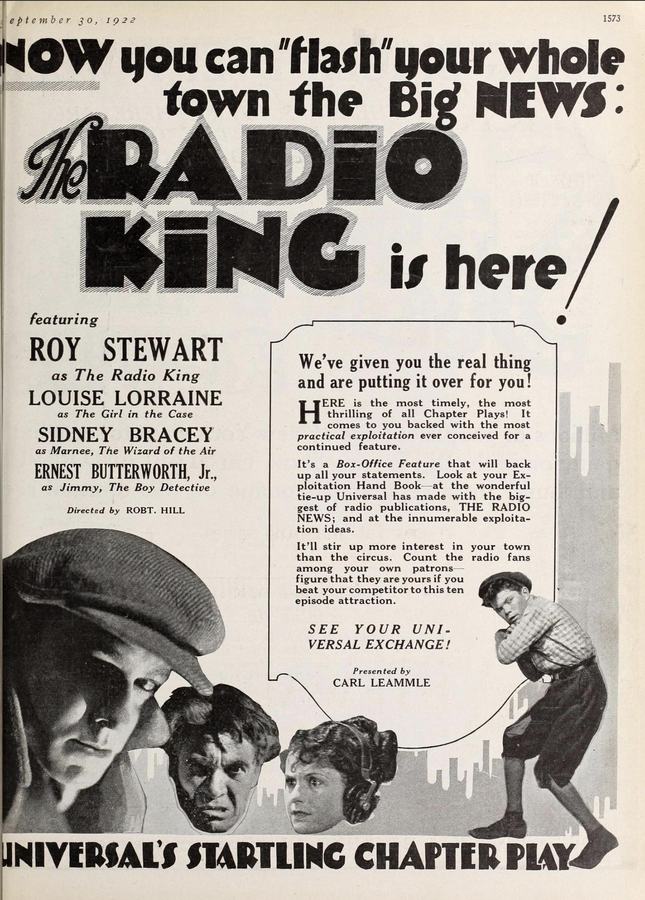
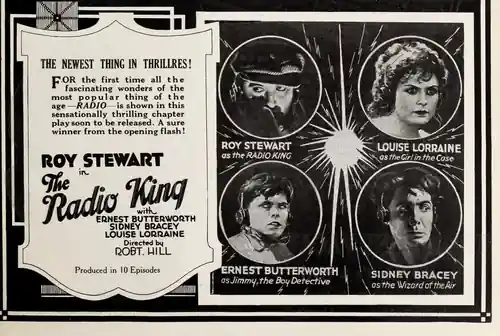
That metallic perfume lingers across every chapter of The Radio King, a 1922 Pathé serial whose 15 episodes once unspooled like black-market mercury in nickelodeons now condemned to parking-lot archaeology. Today, only four complete chapters survive—yet what shards we possess detonate in the skull with more voltage than most 4K restorations of better-known silents. Director Robert Dillon, a name unjustly buried beneath the rubble of Lang and Hitchcock, orchestrates a pulp symphony whose leitmotif is the death rattle of information: the moment when a human voice, once loosed upon the air, refuses to die.
Sterling vs. Vortex: the dialectic of enlightenment turned steampunk blood-feud.
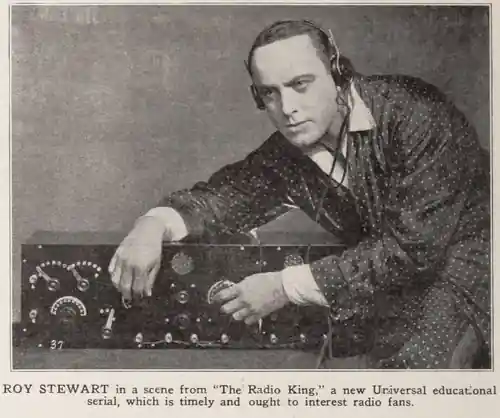
Roy Stewart—square-jawed, but with the pallor of a man who has already seen his own autopsy—embodies scientific rationality as Dr. Alan Sterling, criminologist to the Department of Justice. Opposite him, Albert J. Smith essays Dr. Basil Vortex, a surname so on-the-nose it loops back around to poetry. Vortex’s hair is parted with surgical exactitude, but his eyes jitter like mis-synchronized metronomes; he speaks of "social surgery" while fondling a brass console that can recall every wireless confession ever transmitted. The film’s McGuffin—retroactively nicknamed the Ether Siphon—functions like today’s NSA metadata trawl, except it crackles, sparks, and occasionally liquefies the unwary operator. Dillon stages their rivalry not as good against evil but as two versions of modernity wrestling for the steering wheel of history.
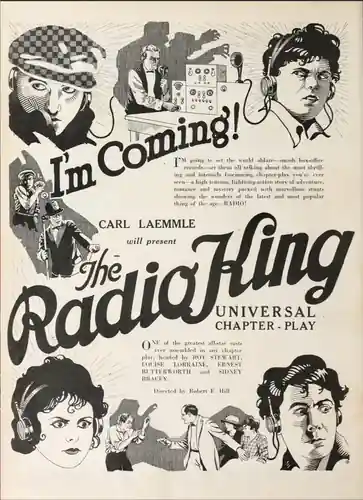
The first chapter, "The Spark of Doom," unleashes a set-piece that film-school syllabi should rank alongside the Odessa Steps. Sterling, lured to an abandoned powerhouse, steps onto a copper dais rigged to a million-volt capacitor. Dillon cuts from a medium shot of the detective’s realization to an extreme close-up of a telegraph key—its brass nipple moist with sweat—then to a vertiginous 45° Dutch angle as the switch slams home. For ten frames the screen itself appears to blister; the print’s emulsion bubbles as if the filmstrip is protesting its own content. When the surge subsides, Sterling collapses, pupils blown, and Vortex’s masked anarchists glide in to harvest his wristwatch (a chronometer whose gears later decode the Siphon’s frequency). A title card, lettered like a death certificate, informs us the hero now carries "a heart timed to detonate before the autumn equinox." From that instant, every subsequent thrill is seasoned with cosmic irony: each victory for Sterling hastens his myocardial sunset.
Louise Lorraine’s Daphne Hale is no imperiled secretary but a one-woman avant-garde.
Where contemporaries like For Those We Love trade in saccharine damsels, Daphne pirouettes across parapets in newsboy cap and knee-high aviation boots, piloting a de Havilland whose fuselage is stenciled "The Morning Star." In Chapter 7, "Wings of Static," she strafes a dirigible commanded by Vortex, her propeller chewing through antennae like a voracious phonograph needle. The camera—mounted on the actual aircraft—captures the actress’s un-doubled terror as the plane sideslips, a proto-Mad Max ballet scored only by slipstream. Later, when forced to bail out, she clutches a wax-paper parcel containing Sterling’s sole vial of digitalis; the image of this woman falling through cumulonimbus with a heart in her hands feels plucked from surrealist verse.
Meanwhile, Slim Whitaker’s Scoop Mallory provides the picaresque grease that keeps the narrative gears from seizing. A booze-breath scribbler who files copy via carrier pigeon, Scoop functions as both Greek chorus and living appendix of Prohibition vernacular. His best moment arrives in Chapter 10, "The Laughing Station," where he commandeers a derelict AM booth, loops a record of maniacal laughter, and broadcasts it across police frequencies—an auditory smokescreen for Sterling’s infiltration. The montage intercuts cops choking on their own wireless laughter with Vortex’s lieutenants clawing at headphone static, their faces lit by cyan bulbs. It’s 1922’s equivalent to a denial-of-service attack, executed with nothing more than shellac and moxie.
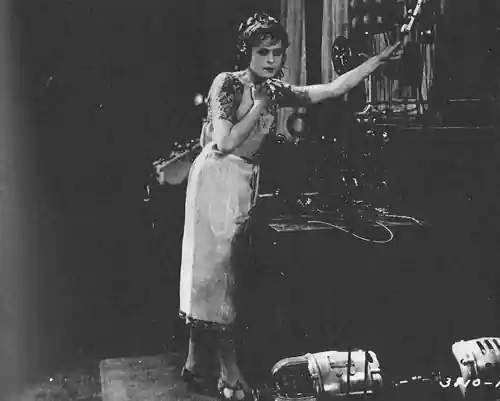
The serial’s visual grammar invents neon-noir a decade before the term existed.
Cinematographer D. Mitsoras—a name so elusive that even the Silent Era Database lists him as "possibly Greek, possibly myth"—bathes sets in pools of mercury-arc light that fracture into violet halos. In Chapter 5, "The Catacombs of Echo," characters traverse a sewer whose brick walls are painted with phosphorescent salt; when lantern light strikes, the bricks recite a ghostly Morse code, the very masonry gossiping about trespassers. The effect anticipates the bioluminescent corridors of The Breath of the Gods, yet predates them by eight years. Elsewhere, dissolve transitions ripple like disturbed water, suggesting that time itself is a broadcast medium prone to interference.
Sound, though absent on the track, haunts the imagery as a negative presence. Repeatedly, Dillon frames characters screaming into candlestick telephones whose receivers belch animated zig-zags of cartoon electricity—an oneiric visualization of desperation ricocheting through vacuum. When Vortex finally demonstrates the Ether Siphon, he twists a Bakelite dial labeled "Mnemosyne"; the machine disgorges ribbon-like strips of tin foil that unfurl bearing fragmentary sentences—"I love you," "The vault is open," "Kill the king." These metallic tongues flutter like Pentecostal fire, a startling precursor to the paper strips spooled by Soviet surveillance wire recorders. Censors of the era objected that the device "might inspire criminality among youthful amateurs of wireless," resulting in several regional bans. Hence, surviving prints bear scorch-marks where excised frames were physically sliced away, scars that only amplify the film’s mystique.
Structurally, the serial is a fractal Möbius strip: every resolution coils back into the circuitry of loss.
Each chapter terminates with a cliff-hanger that appears to annihilate our heroes—yet the subsequent installment reveals the previous peril to be a nested hallucination, a false memory injected by overdoses of Ether Siphon feedback. The device, we gradually intuit, does not merely retrieve signals; it rewrites the synaptic ledger of anyone exposed too long. Thus Sterling’s dwindling lifespan may be less a cardiac verdict than a metaphysical side-effect of having his remembrance siphoned out and re-ingested. The serial’s true suspense is ontological: if your past can be edited in real time, does a future remain possible? This anxiety places The Radio King closer to Borges than to the Saturday-matinee thrills promised by its lobby cards.
Performances oscillate between grandeur and Grand-Guignol. Stewart, a veteran of The Three Musketeers, underplays to the brink of somnambulism; his reserve amplifies the horror of a man who must solve the world before his own pulse flatlines. Smith, conversely, chews scenography with teeth bared, yet his hamminess is calibrated—note how his left eyelid twitches in perfect synchronization with the spark-gap transmitter’s clatter, as though he’s being conducted by his own machine. Fontaine La Rue, as Vortex’s ambivalent half-sister, delivers a single close-up in Chapter 12 that deserves anthologizing in textbooks on silent acting: her irises seem to dilate and contract within the same second, conveying lust, dread, and filial complicity without a single intertitle.
Gender politics, though mired in 1920s strictures, sprout unruly fungi of subversion.
Daphne’s aerial heroics aside, the serial sneaks in a covert critique of patriarchal technocracy: every male inventor—Sterling included—constructs apparatuses that violently extract; the lone female tinkerer, little Marion Feducha’s Cub scout-ish radio prodigy "Toodles," builds a pocket crystal set that listens without stealing, a humble receiver that saves the day in the penultimate reel. The film never trumpets this contrast, yet it lingers like an after-image. Similarly, the anarchist cell ultimately fractures because Vortex cannot abide a woman (La Rue) possessing administrative passcodes—a misogynist blind spot that mirrors the era’s fear of flappers in ballot booths.
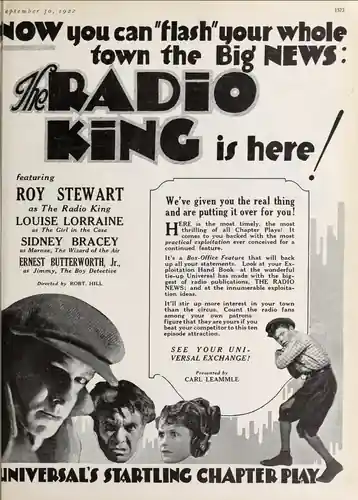
The final episode, "The Silence That Kills," survives only in a 9.5 mm Pathé-Baby digest. Even truncated, it detonates with nihilistic poetry. Sterling, having sabotaged the Ether Siphon, stands atop a radio tower while dawn stains the sky like potassium permanganate. Vortex, fatally irradiated by his own apparatus, crawls across the gantry, gloved fingers sparking. Overlaid title cards—lettered in smaller font than usual, as though whispering—declare: "The air forgets nothing; it simply waits." The men grapple, their silhouettes scorched into the emulsion, until both figures plummet. The last frame is not of impact, but of empty sky, followed by a fade to white that feels colder than black. No cavalry arrives; Daphne and Scoop can only listen on a headset that now carries only the hush of cosmic background noise. Cue end titles superimposed over a slow zoom into a vacant loudspeaker cone—an abyss that hisses like a seashell bereft of ocean.
Comparative contextualization: why this fever dream outlives its contemporaries.
Stack The Radio King beside Das neue Paradies and you witness the Atlantic divide between Germanic romanticism and Yankee kineticism—Ufa’s pastoral afterlife versus Pathé’s voltage-drunk modernity. Against The Texas Kid’s frontier moral absolutes, our serial revels in quantum ethics where every heroism is paid for with someone’s annihilation. Even I morti ritornanoGet Your Man flirts with comparable fatalism, yet it cushions the denouement in romantic reconciliation—King offers no such pillow.
Contemporary resonance? Glance at today’s debates about data permanence, right to be forgotten, deep-fake testimony—The Radio King prophesied each anxiety with radio tubes instead of neural nets. Its vision of airborne archives that can be subpoenaed by either cops or crooks anticipates the Snowden revelations more acutely than any cyber-thriller of the 1990s. The serial’s dystopia is not Big Brother watching but Big Brother downloading, a subtle yet chilling distinction.
Preservation status and where to glimpse the fragments.
Archivists at UCLA and the BFI have stitched the extant reels into a 73-minute composite, available on Archive.org (search "Radio King 1922 restoration"). A 2K scan, funded by a 2021 Kickstarter, reveals granular detail: the texture of Vortex’s lamé waistcoat, the acne scars beneath Louise Lorraine’s greasepaint. For cine-geeks, the disc includes a commentary track where scholars decode the Morse graffiti on the catacomb walls; it spells out "DILLON WAS HERE"—a playful autograph smuggled past censors. Blu-ray edition rumored from Kino Lorber for 2025; until then, the streaming file suffices, though headphones are advised—its silence is thunderous.
Verdict: Mandatory viewing for anyone who believes noir began with hard-boiled dialogue. The Radio King proves that noir is a condition—an ultraviolet awareness that progress always invoices collateral ghosts. Watch it at 2 a.m., lights extinguished, your phone in airplane mode. Notice how the room feels suddenly porous, as if your own memories might be siphoned into the ceiling fan’s lazy orbit. That chill is the serial’s final broadcast—an admission that we are all unwitting repeaters in an endless relay, and somewhere, in a shuttered theater of the mind, the feed is still live.
★★★★☆ (4.5/5) — A mangled masterpiece, more relevant tomorrow than yesterday.
IMDb 6.7
1936
Community
Log in to comment.