DbcultAccessing Vault...
Cult Review
Senior Film Conservator
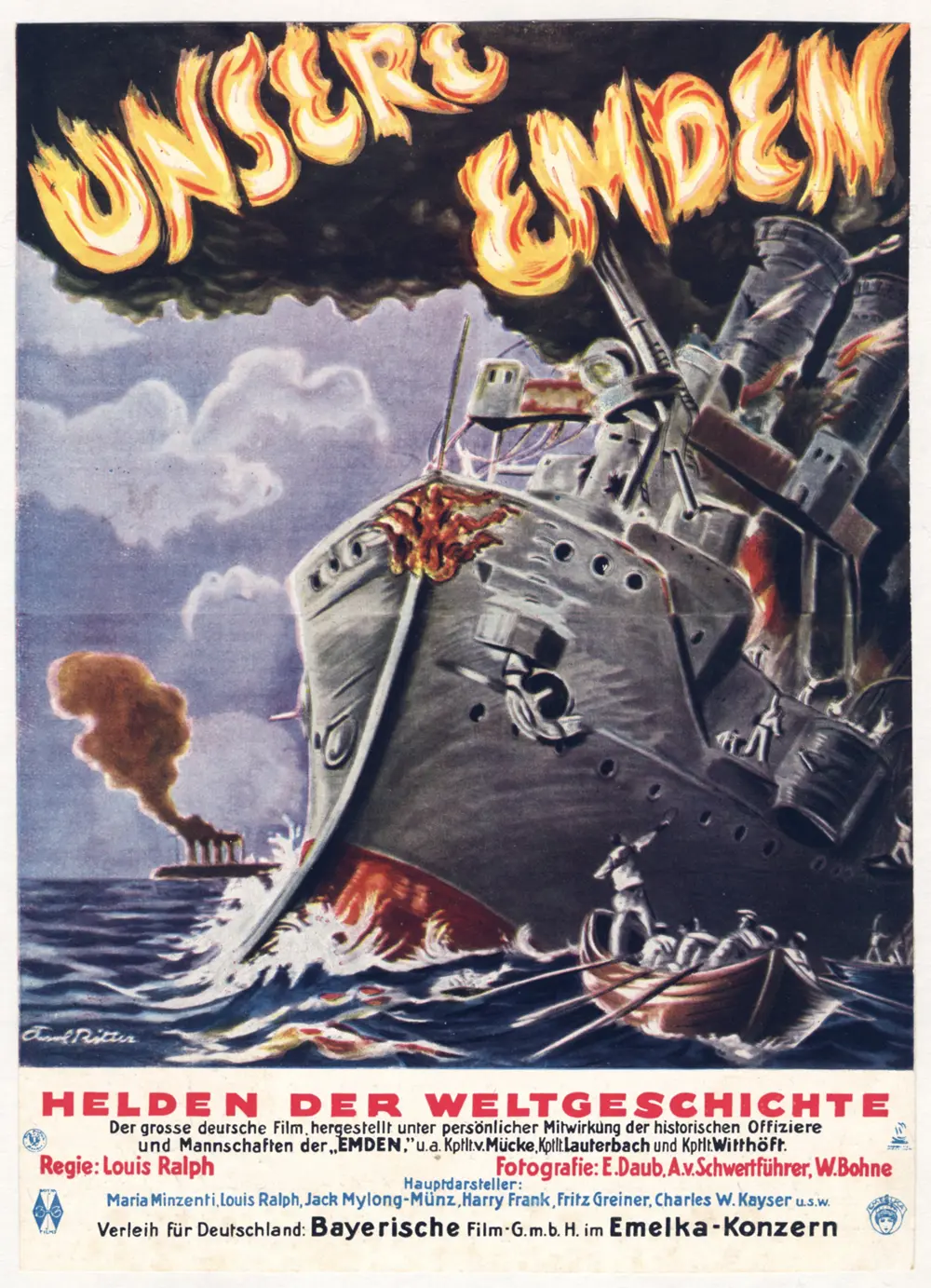
Should you invest your time in a silent-era account of a German cruiser? Short answer: yes, but only if you have a deep-seated fascination with naval history and the evolution of the war film.
This is not a film for the casual viewer seeking high-octane explosions or rapid-fire editing. It is a film for the patient observer who finds beauty in the mechanical choreography of a 1920s battleship and the stoic performances of a cast that lived through the very era they are depicting.
1) This film works because it prioritizes technical authenticity over melodramatic fluff, using real naval maneuvers that feel heavy and consequential.
2) This film fails because its silent-era pacing can feel glacial to modern eyes, especially during the long stretches of navigation between engagements.
3) You should watch it if you want to see how the 'Gentleman of the Seas' myth was constructed in the aftermath of World War I.
The Raider Emden (originally titled Unsere Emden) is a fascinating specimen of Weimar-era cinema. Unlike the experimental expressionism of the time, this film leans into a gritty, almost documentary-like realism. Director Louis Ralph, who also stars as the captain, treats the ship itself as the primary protagonist. The SMS Emden isn't just a setting; it is a character with a soul, a 'Swan of the East' that navigates the treacherous waters of the Indian Ocean with a grace that belies its destructive purpose.
The film’s structure is episodic, mirroring the actual logbooks of the voyage. We see the capture of merchant ships, the clever use of a fourth funnel to disguise the ship's silhouette, and the eventual landing on the Cocos Islands. This procedural approach gives the film a grounded feel that is often missing from more romanticized war stories like The Port of Missing Men. It doesn't rely on a central love story to keep the audience engaged; it relies on the tension of the hunt.
Louis Ralph’s performance is a study in restraint. In an era where many actors were still using the broad, theatrical gestures found in films like Paid in Full, Ralph opts for a quiet authority. His eyes convey the weight of command, particularly in the scenes following the sinking of the Zhemchug. You can see the conflict between his duty to the Kaiser and his personal code of honor. It’s a nuanced performance that anchors the entire production.
The supporting cast, including John Mylong and Maria Mindzenty, provide necessary human texture, though the film occasionally stumbles when it tries to introduce civilian stakes. The moments on land feel less vital than the moments on the bridge. When the camera is on the water, the film breathes. When it moves to the drawing rooms or the barracks, it feels like it’s checking off boxes. It’s a common flaw in silent dramas, similar to the pacing issues in The Price of Silence, where the narrative momentum hits a brick wall of exposition.
For a film made in 1926, the scale is impressive. The cinematography captures the vastness of the ocean with a sense of dread. There is a specific shot of the Emden’s smoke plume on the horizon that feels hauntingly beautiful. It’s a reminder that in 1914, the sea was a place of total isolation. There were no satellites, no instant communication. If you were caught, you were alone. The film captures this loneliness perfectly.
The battle sequences are handled with a surprising lack of flash. Instead of quick cuts, we get wide shots of the ships firing their batteries. You see the delay between the flash of the gun and the splash of the shell. This attention to physical reality makes the eventual destruction of the Emden feel much more visceral. It isn't a 'movie' explosion; it feels like a mechanical failure, a tragic end to a complex machine. This level of detail is something we rarely see in contemporary silent works like Rarin' to Go, which favored action over accuracy.
Yes, for the right audience. If you are a student of naval history or a fan of early German cinema, this is a vital piece of the puzzle. It offers a perspective on the war that is rarely seen in English-language media. However, if you struggle with silent film conventions or require a clear hero/villain dynamic, you will likely find it frustrating. It is a slow-burn historical document that demands your full attention.
Here is a debatable opinion: The Raider Emden is actually a horror movie in disguise. Think about it. The Emden is a phantom ship that appears out of the fog, destroys its prey, and vanishes. For the Allied sailors, it wasn't a 'gentlemanly' opponent; it was an invisible monster. The film tries to frame this as a heroic saga, but the imagery often suggests something much more macabre. The way the ship stalks the merchant lanes has more in common with early German horror than with the lighthearted adventure of Cupid's Roundup.
Furthermore, the writing by von Mücke himself adds a layer of eerie authenticity. Having the actual officer involved in the events penning the script creates a strange feedback loop between history and myth. It’s not just a recreation; it’s a self-hagiography. It’s fascinating and slightly unsettling to watch a man direct a version of his own life where every decision is retroactively justified. It makes the film feel like a living memory rather than a piece of fiction.
Pros:
Cons:
When compared to other 1920s films like What Happened to Jones or the Western tropes of The Texas Trail, The Raider Emden feels like it belongs to a different world entirely. It lacks the populist appeal of those films. It doesn't want to make you laugh or cheer in a simple way. It wants you to respect the machinery of war. Even the animated shorts of the time, such as Felix at the Fair, had more narrative 'zip' than this. But that’s the point. This film is a monument, not a toy.
It shares some DNA with Das Gefängnis auf dem Meeresgrund in its fascination with the ocean's depths and the isolation of maritime life. However, while that film leans into the fantastical, The Raider Emden is obsessed with the real. It’s a film that would rather show you a boiler room than a mermaid. It’s a film that values the 'how' over the 'why'.
The Raider Emden is a difficult, beautiful, and occasionally tedious masterpiece of naval cinema. It works. But it’s flawed. It captures a very specific moment in time when the world was changing, and it does so with a level of technical detail that is still impressive a century later. It’s not a 'cinematic journey' in the cheesy sense; it’s a grueling voyage that leaves you feeling as exhausted as the crew. If you can handle the silence and the slow-motion tragedy of it all, you will find something here that modern CGI-filled war movies can never replicate: a sense of true, physical weight.
"A stark, mechanical elegy for a lost era of naval warfare that refuses to apologize for its own deliberate pace."
In the end, the film stands as a testament to the power of silent film to convey scale and atmosphere without the need for a single spoken word. It is a ghost ship of a movie, sailing forever through the archives of cinema history. Watch it for the history. Stay for the haunting imagery of the Indian Ocean at sunset. Just don't expect it to hold your hand.

IMDb 6.4
1926
Community
Log in to comment.